
The Creator’s Dilemma: Choosing Between Sora 2 and Veo 3 Without Losing Your Mind
The gold rush of AI video is no longer about finding a tool that works; it is about finding the one that actually fits a specific workflow. Right now, the creative community is split down the middle. On one side, there is the raw, cinematic power of Sora 2. On the other, the hyper-efficient, integrated logic of Veo 3.
For a freelance filmmaker or a social media content lead, this isn’t just a technical debate. It is a practical nightmare. Picking the wrong horse means hours of wasted rendering time and prompts that just don’t land. The struggle is real because both models are incredible, yet they feel like they speak two different languages. One chases the dream of perfect photorealism, while the other focuses on the nuances of movement and user control.
I. Decoding the DNA of Two Video Giants
Before clicking “generate,” every creator asks the same question: Is this tool going to understand what is in my head, or am I going to spend three hours fighting the interface?
- The Aesthetic Philosophy of Sora 2 When people talk about Sora 2 AI, the conversation usually starts with physics. There is a weight to the movement that feels grounded in reality. If a character walks through a puddle, the ripples move exactly how the human eye expects them to. This version has moved past the “uncanny valley” of earlier models, focusing on complex character consistency and long-form narrative coherence. It isn’t just about making a pretty five-second clip; it’s about maintaining the soul of a scene across multiple shots.
- The Intuitive Logic of Veo 3 Veo 3 takes a different path. It feels less like a “black box” and more like a collaborative partner. The strength here lies in the prompt-to-action translation. While other models might struggle with specific cinematic directions—like a “low-angle tracking shot with a lens flare”—Veo 3 handles these technical requests with surprising grace. It is built for creators who come from a traditional film background and want their AI to respect the rules of cinematography.
II. Real-World Scenarios Where the Choice Becomes Difficult
Imagine a high-stakes deadline. A client wants a high-fashion commercial featuring a digital avatar walking through a desert that slowly turns into an ocean. This is where the choice between these two powerhouses becomes a high-stakes gamble.
- The Photorealism vs. Stylization Battle If the goal is to fool the audience into thinking the footage was shot on a RED camera in the Sahara, Sora 2 Video is often the default choice. Its lighting engine is currently the benchmark for the industry. However, if the project requires a specific “vibe”—perhaps a 1970s grainy film aesthetic or a futuristic neon-soaked dreamscape—Veo 3 often provides more creative flexibility without the AI over-correcting the “errors” that actually make film look like film.
- Handling Complex Motion and Interaction One of the biggest hurdles in AI video is the interaction between objects. In many tests, Sora 2 excels at showing the physical consequences of an action—like a hand crumpling a piece of paper. Veo 3, meanwhile, seems to have a better grasp of “choreography,” such as complex dance movements or the way a group of people moves through a crowded street without merging into one another.

III. The Hidden Costs of Fragmented Workflows
The problem isn’t that these tools are bad, the problem is that they are isolated. Most professional creators find themselves needing both. You might use Sora 2 Video Generator for the epic wide shots and environmental establishing scenes, but then switch to Veo 3 for the close-up character interactions where specific movement control is non-negotiable.
- The Subscription Fatigue Maintaining top-tier access to every major model is becoming a financial and administrative burden. Creators are juggling different login credentials, different prompting structures, and different credit systems. It’s a friction-heavy process that kills the “flow state” necessary for high-level creative work.
- The Learning Curve Paradox Every time a creator switches between models, they have to shift their mental framework. The prompt that works for a Sora 2 AI Video Generator might result in a chaotic mess on Veo 3. This lack of a “universal translator” for AI video means that instead of being a director, the creator becomes a technician, constantly troubleshooting why one model understands “cinematic lighting” differently than the other.
IV. Bridging the Gap with a Unified Solution
At some point, the friction becomes too much. The realization sets in: the future of AI video isn’t about loyalty to a single model, but about the ability to toggle between the best tools for the job without leaving the creative environment. This is where the narrative shifts from “Which model is better?” to “How can I use all of them efficiently?”
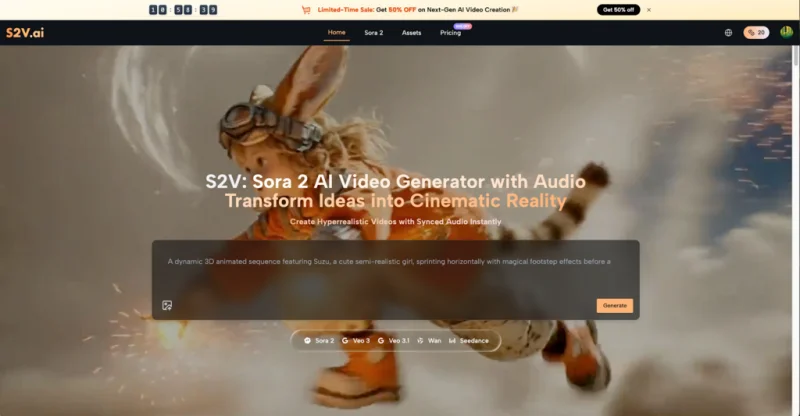
S2V emerges precisely at this crossroads. Instead of forcing a choice between the cinematic depth of one and the technical precision of the other, it provides a centralized gateway. It isn’t just another video tool; it is a specialized environment designed to streamline the access to these heavyweights.
- A Single Entry Point for Professional Models S2V simplifies the landscape by bringing these disparate technologies under one roof. For a creator who needs the specific output of Sora AI Video, the process no longer involves navigating separate platforms or waiting in fragmented queues. Everything is accessible from a single, streamlined interface that respects the user’s time.
- Direct Access to High-End Generation The core value of the Sora 2 integration within S2V is the removal of technical barriers. It allows the user to focus entirely on the descriptive prompt and the visual outcome. By acting as a sophisticated bridge, S2V ensures that the latest advancements in video generation are immediately usable, rather than locked behind complex waitlists or regional restrictions.
V. Final Thoughts
The “Sora 2 vs. Veo 3” debate doesn’t have a single winner because the winner depends on the shot. One is the master of light and physics; the other is the master of intent and direction. The smartest move for any creator isn’t to pick a side, but to adopt a system that allows for the use of both.
S2V provides that middle ground. It removes the friction of choice and replaces it with the freedom of access. In a world where visual content is moving at the speed of light, having a single point of control is no longer a luxury—it’s a necessity for anyone serious about digital storytelling.
Ti potrebbe interessare:
Segui guruhitech su:
- Google News: bit.ly/gurugooglenews
- Telegram: t.me/guruhitech
- X (Twitter): x.com/guruhitech1
- Bluesky: bsky.app/profile/guruhitech.bsky.social
- GETTR: gettr.com/user/guruhitech
- Rumble: rumble.com/user/guruhitech
- VKontakte: vk.com/guruhitech
- MeWe: mewe.com/i/guruhitech
- Skype: live:.cid.d4cf3836b772da8a
- WhatsApp: bit.ly/whatsappguruhitech
Esprimi il tuo parere!
Ti è stato utile questo articolo? Lascia un commento nell’apposita sezione che trovi più in basso e se ti va, iscriviti alla newsletter.
Per qualsiasi domanda, informazione o assistenza nel mondo della tecnologia, puoi inviare una email all’indirizzo [email protected].
Scopri di più da GuruHiTech
Abbonati per ricevere gli ultimi articoli inviati alla tua e-mail.