
The Forge Roblox Wiki: Ores, Multipliers, and Crafting Fundamentals Explained

The Forge is one of the more system-driven crafting games on Roblox. While it appears straightforward at first—mine ores, combine them, and forge items—the underlying mechanics reward players who understand how different elements interact.
This article serves as a practical wiki-style reference for players who want a clearer understanding of how crafting works in The Forge. It focuses on visible mechanics rather than speculation, making it suitable both for beginners and for players who want a structured overview of the system.
Overview: How Crafting Works in The Forge
Crafting in The Forge is influenced by combinations, not single inputs. Each craft pulls from multiple factors simultaneously, and the final result reflects how well those factors work together.
At a high level, crafting outcomes are shaped by:
- The types of ores used
- Their associated multipliers
- The interaction between traits
- The overall balance of the setup
Importantly, rarity alone does not determine success. Many failed crafts occur not because of poor luck, but because materials were combined without considering how they interact.
Ores: More Than Just Rarity
Ores are the primary inputs in crafting, and new players often evaluate them based only on rarity. While rarity can indicate potential value, it does not automatically make an ore effective in every situation.
Key Characteristics of Ores
Each ore contributes differently to a craft. Common distinctions include:
- Support-oriented ores
These help stabilize or enhance other materials. - Multiplier-focused ores
These amplify certain aspects of the craft. - Specialized ores
Often useful only in specific combinations or contexts.
Using a high-rarity ore without understanding its role can actually reduce overall effectiveness if it disrupts balance.
Understanding Multipliers
Multipliers are one of the most misunderstood elements in The Forge.
Rather than acting as flat bonuses, multipliers influence how strongly an ore’s properties affect the final result. Their impact depends on context—what other ores are present, and how the overall build is structured.
Common Multiplier Misconceptions
- “Higher is always better”
In practice, extremely high multipliers can lead to diminishing returns or imbalance. - “Multipliers work independently”
They often interact with other stats, meaning their value depends on the full setup.
A well-balanced combination of moderate multipliers often performs more consistently than an extreme, single-stat build.
Traits and Their Interactions
Traits add another layer of complexity to crafting. While individual traits may appear beneficial, their interaction with other traits and multipliers determines whether they actually improve the result.
Why Trait Synergy Matters
Some traits:
- Reinforce each other
- Amplify the effects of certain multipliers
- Reduce the effectiveness of conflicting traits
Crafts fail frequently when players unintentionally combine traits that counteract one another. Understanding trait roles—even at a basic level—helps avoid these conflicts.
Common Crafting Mistakes (And Why They Happen)
Many crafting failures follow predictable patterns. Recognizing these early can prevent unnecessary resource loss.
Overstacking Rare Ores
Adding multiple rare ores without a plan often leads to inefficient builds. Rarity does not compensate for poor synergy.
Ignoring Build Structure
Crafts assembled without a clear purpose—such as boosting a specific stat or supporting a trait—tend to produce inconsistent results.
Treating Crafting as Trial and Error
While experimentation is part of learning, repeated blind attempts consume resources without providing clear feedback.
Planning vs Guessing: A Systematic Perspective
Players generally fall into two approaches when crafting.
Guess-Based Crafting
- Relies on intuition
- Consumes large amounts of resources
- Produces unpredictable outcomes
Planning-Based Crafting
- Tests combinations before committing
- Compares multiple setups
- Focuses on efficiency and repeatability
Planning does not remove uncertainty, but it significantly reduces unnecessary failures.
Using Simulation Tools for Crafting Decisions
Because crafting involves many interacting variables, players often benefit from tools that help visualize outcomes before committing resources.
What Crafting Simulators Provide
Simulation tools typically allow players to:
- Test different ore combinations
- Compare estimated results across builds
- See how changes affect overall balance
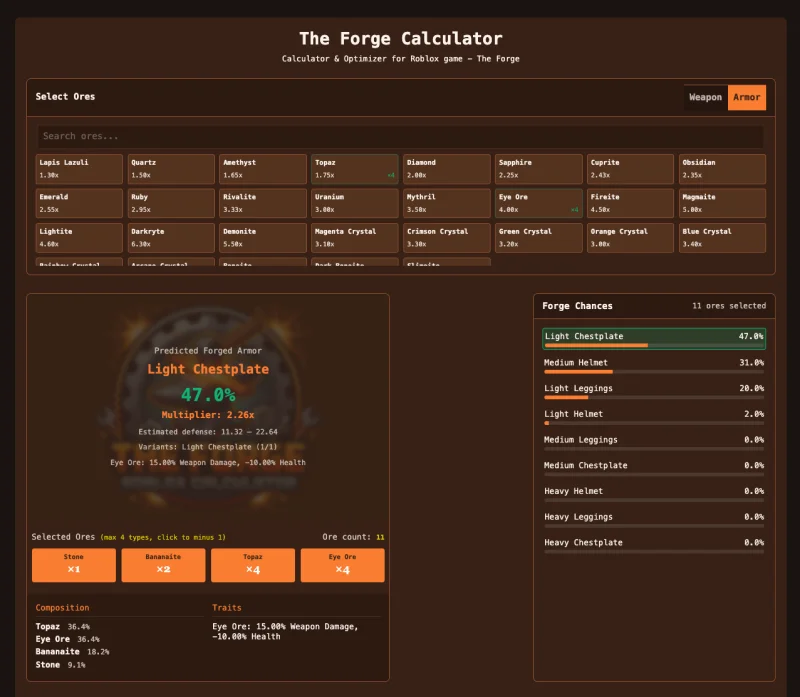
The Forge calculator tools enable players to simulate crafting setups before using in-game materials. Rather than replacing gameplay, tools like this function as planning aids, helping players understand how different inputs influence outcomes.
This approach is particularly useful for:
- Learning how multipliers interact
- Identifying inefficient combinations
- Reducing resource waste during experimentation
It is important to note that simulations offer estimates, not guarantees. Their value lies in comparison and planning, not prediction certainty.
A Practical Example: Structured Crafting
Consider two players attempting the same type of craft.
Player A: Guessing Approach
- Selects ores based on rarity
- Does not account for trait interactions
- Commits resources immediately
Player B: Planning Approach
- Defines the goal of the craft
- Tests several combinations
- Chooses the most balanced setup
- Commits resources with clearer expectations
While both players may still experience variability, Player B consistently achieves better efficiency and learns faster from each attempt.
Why Wiki Knowledge Alone Is Not Enough
Static information—lists of ores or multipliers—is useful, but it has limitations.
- Game updates may change values
- Context matters more than isolated stats
- No single combination works universally
This is why many players combine wiki knowledge with planning tools, using reference material to understand mechanics and simulations to apply that knowledge in real scenarios.
Conclusion: Crafting as a System, Not a Gamble
The Forge rewards players who treat crafting as a system to be understood rather than a gamble to be won.
By learning:
- The roles of different ores
- How multipliers influence outcomes
- Why trait interactions matter
Players can dramatically improve consistency without relying on luck.
While no guide or tool can guarantee perfect results, combining solid mechanical understanding with thoughtful planning leads to better decision-making and more satisfying progress. For players who prefer clarity over guesswork, approaching crafting with a structured mindset makes The Forge far more rewarding.
Ti potrebbe interessare:
Segui guruhitech su:
- Google News: bit.ly/gurugooglenews
- Telegram: t.me/guruhitech
- X (Twitter): x.com/guruhitech1
- Bluesky: bsky.app/profile/guruhitech.bsky.social
- GETTR: gettr.com/user/guruhitech
- Rumble: rumble.com/user/guruhitech
- VKontakte: vk.com/guruhitech
- MeWe: mewe.com/i/guruhitech
- Skype: live:.cid.d4cf3836b772da8a
- WhatsApp: bit.ly/whatsappguruhitech
Esprimi il tuo parere!
Ti è stato utile questo articolo? Lascia un commento nell’apposita sezione che trovi più in basso e se ti va, iscriviti alla newsletter.
Per qualsiasi domanda, informazione o assistenza nel mondo della tecnologia, puoi inviare una email all’indirizzo [email protected].
Scopri di più da GuruHiTech
Abbonati per ricevere gli ultimi articoli inviati alla tua e-mail.