
Why Traditional App Development Is Dying (And What’s Replacing It)
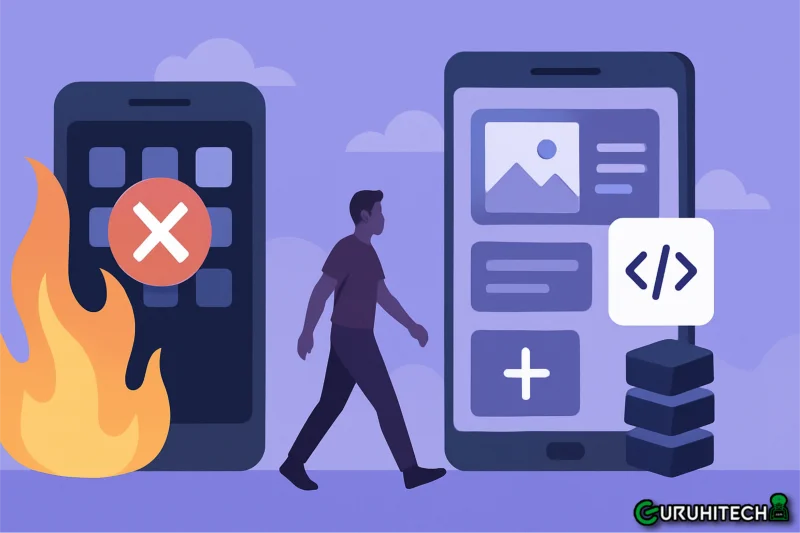
Traditional app development was the only way to build software for many years. Big teams, long timelines, and heavy coding were normal. But the world has changed. Technology moves faster, users expect quick solutions, and founders cannot wait months to launch anymore. This shift is pushing the old model out.
- How traditional development dominated for decades
Companies relied on large engineering teams, complex coding, and long release cycles because there were no alternatives. - Why the landscape is shifting fast
AI, automation, and no-code tools let founders build apps faster, cheaper, and with fewer people. - What founders expect today
Speed, flexibility, instant changes, and early validation. They want results in weeks, not years. - The forces killing the old development model
Rising engineering costs, slow delivery, talent shortages, and the pressure to iterate quickly.
Today’s founders choose speed and agility, not outdated development models.
The Problems With Traditional App Development Today
Traditional development struggles to keep up with how fast businesses move today. What once worked for big companies now slows down founders who need speed, flexibility, and fast validation. Long build cycles and expensive engineering make the old approach unsustainable for most startups.
- Long development timelines
Custom coding takes months because every feature, screen, and workflow is built from scratch. This delays your launch and weakens early momentum. - Extremely high engineering costs
Skilled developers are expensive, especially when you need backend, frontend, DevOps, and QA. Even small tasks require costly hours. - Slow iteration cycles
Updating features requires redesigning, coding, testing, and deploying. This slows feedback loops and makes it harder to react to user needs. - Heavy technical debt
Fast fixes or rushed features create messy code. Over time this becomes a burden that requires major rebuilding. - Difficulty hiring good developers
Skilled engineers are limited, and competition from larger companies increases salaries and hiring time. - Complex DevOps and infrastructure setup
Servers, databases, security, scaling, and monitoring require specialized teams. This adds more layers of work and cost. - Rigid project structures
Traditional teams use fixed plans that are hard to change once development starts.
These issues make traditional development slow, expensive, and hard to maintain.
The Market Forces Making Traditional Development Obsolete
The digital world moves too fast for slow development models. New market forces are pushing companies to abandon traditional coding and adopt faster, more flexible methods like AI and no-code. These forces reshape how products are built and how quickly they must be delivered.
- Demand for faster time-to-market
Businesses cannot wait months to launch an MVP. Speed drives competitive advantage, and slow development creates serious opportunity loss. - The rise of subscription-based businesses
SaaS products need constant updates and improvements. Traditional development struggles to ship updates at the pace customers expect. - Consumer expectation for rapid updates
Users expect weekly improvements, bug fixes, and new features. Slow release cycles damage trust and affect retention. - Remote and freelance-first work culture
Distributed teams make coordination difficult. Traditional development depends heavily on large in-house teams, which is no longer practical. - Global shortage of senior engineers
Competition for talent makes hiring expensive and slow. Startups cannot scale with limited engineering resources.
Market pressure rewards speed, flexibility, and continuous improvement, making traditional development unsuitable for modern startups.
The Technologies Replacing Traditional Development
A new generation of tools is reshaping how founders build apps. Instead of relying on full engineering teams, these technologies allow faster creation, easier updates, and more automation. They reduce complexity and give solopreneurs and small teams the power to build at enterprise speed.
- No-code app builders
Tools like Bubble, Glide, and Webflow let founders build full apps with visual editors. They replace months of coding with simple drag-and-drop workflows. - Low-code enterprise platforms
Platforms like Mendix and Outsystems support larger companies by reducing coding but still allowing advanced customization where needed. - AI-generated code
AI converts natural language prompts into working components, logic, and data structures. It removes the need to write code manually. - AI-driven UI/UX generation
AI creates layouts, themes, and screen structures instantly, reducing design time and improving consistency. - Automation platforms (workflow + integrations)
Tools like Make and Zapier connect systems, automate processes, trigger actions, and replace manual backend building.
These technologies make development faster, cheaper, and more accessible, replacing the need for slow traditional coding.
How No-Code Became the New Default
No-code shifted the way founders build products. Instead of relying on engineering teams, solopreneurs and small startups can now create full apps using visual tools. This makes development faster, simpler, and more flexible. No-code became the default because it removes many early-stage barriers.
- Visual development
You build apps using drag-and-drop editors. This lets you design screens, workflows, and logic without writing code. - Ready-made components
Forms, lists, user login, dashboards, and workflows already exist. You assemble these pieces instead of building everything from scratch. - Instant hosting
No-code platforms handle servers, scaling, and deployment automatically. You publish your app with one click. - Integrated databases
Most tools include built-in databases that connect directly to your app. You do not manage servers or write SQL. - Scalable app templates
Templates help you start fast and customize later. They reduce setup time and give you proven layouts for common app types.
No-code became the default because it gives founders speed, clarity, and full control.
How AI Changed the Game Completely
AI transformed app development by removing the need to make every decision manually. Instead of building each part yourself, AI creates logic, screens, and workflows from simple instructions.
This makes development more intuitive and reduces the need for technical skills. And if you ever need expert guidance, exploring trusted AI app development specialists can help you unlock even more value as your product grows.
- Build apps with natural language
You describe your idea, and AI turns it into app structures, user flows, and layouts instantly. - AI-generated backend logic
AI builds workflows, conditions, automation, and database logic behind the scenes, saving hours of manual setup. - Auto-generated interfaces
Screens, components, and UI layouts are created automatically. You get ready-to-use interfaces without detailed design work. - Auto-debugging and optimization
AI identifies inconsistent logic, missing data, or broken flows and fixes them. This reduces testing time and prevents errors before launch. - AI-driven integrations
AI reads API documentation and connects external services automatically, solving one of the hardest parts of traditional development.
AI changed development from a technical task into a prompt-based creative process.
What Modern Apps Look Like Compared to Traditional Builds
Modern apps built with no-code and AI look very different from old, code-heavy systems. They are lighter, more modular, and easier to update. This new style of development helps founders move faster and respond to user needs instantly.
- Modular structure
Modern apps use reusable components instead of custom code. This makes them flexible and easier to maintain. - Faster iteration
New features can be added in minutes by dragging components or giving AI instructions. You can ship updates constantly. - More automation
Modern apps include built-in workflows, notifications, and background tasks. Automation reduces manual work and improves user experience. - Cloud-first design
Hosting, storage, and scaling are managed automatically. You do not worry about servers or infrastructure. - Plug-and-play integrations
Connecting tools like Stripe, Airtable, or CRM platforms takes minutes. No more writing complex APIs manually.
Modern apps are built for speed, flexibility, and continuous improvement.
Why Founders Are Moving Away From Engineering-Heavy Teams
Founders no longer need large engineering teams to build functional products. No-code and AI allow small teams or solo founders to handle most of the work. This shift helps startups move faster, save money, and stay flexible when the market changes.
- Lower burn rate
Without large engineering salaries, early-stage startups spend less each month. This gives founders a longer runway. - Faster MVP cycles
You can launch prototypes, test ideas, and update features much faster without waiting for large teams to code everything. - More ownership and control
Founders can make changes themselves instead of requesting developer time. This increases independence and reduces delays. - Less dependency on developers
With visual building and AI automation, you are not stuck waiting for technical work. This keeps your momentum strong. - Easier product pivots
Changing direction is faster and cheaper because you can update screens and logic without rebuilding the whole system.
Founders choose no-code and AI because it supports fast, lean, and flexible product buildi
The New Development Stack Replacing Traditional Coding
A new development stack has replaced slow, engineering-heavy coding with faster and more flexible tools. This modern stack helps founders build apps visually, connect systems easily, and use AI to automate complex thinking. It reduces setup time and lets solopreneurs build products that once required full developer teams.
- Bubble, Glide, FlutterFlow
These tools let you build complete web and mobile apps with visual editors. They include user login, workflows, backend logic, and responsive design, all without writing code. - Airtable / Supabase as backends
These services handle databases, permissions, and data storage. Airtable makes data simple to manage, while Supabase adds more power for advanced users. - Zapier / Make for automation
These tools connect your app to other platforms and automate tasks like notifications, syncing data, or updating records instantly. - Webflow for the frontend
Webflow gives you high-quality UI design and hosting. It helps you build landing pages, marketing sites, and client-facing content fast. - AI tools for planning, building, and debugging
AI generates screens, fixes errors, creates workflows, and speeds up idea validation. It turns complex tasks into simple prompts.
This new stack is faster, cheaper, and far easier than traditional coding.
Where Traditional Development Still Matters
Even with AI and no-code tools growing fast, traditional development still has a place. Some products need heavy processing, real-time performance, or very custom logic that visual tools cannot match. These cases require specialized engineering and deeper technical control.
- Real-time, high-performance systems
Apps like trading platforms, multiplayer tools, or live collaboration often need millisecond responses. These systems require optimized code and deep engineering. - Deeply custom logic
Products with uncommon rules or unique architecture may not fit no-code tools. Custom code gives full control over how every part works. - Gaming and 3D apps
Games, VR, and 3D simulations need advanced graphics engines and real-time rendering. These projects rely on traditional coding for performance. - Enterprise-level security
Some industries need advanced encryption, compliance, private networks, and custom authentication. These security needs often require full-code teams. - Complex infrastructure-heavy systems
Apps that manage huge amounts of data, special hardware, or custom cloud setups need DevOps and backend engineers.
Traditional development still matters for these high-demand areas, but most modern apps do not require this level of complexity.
Conclusion
Traditional development is fading because it is too slow, too expensive, and too complex for today’s fast-moving world. Founders need speed, quick validation, and the ability to update products without waiting months for engineering cycles. No-code and AI give them exactly that: a faster, cleaner, and more flexible way to build.
- Why traditional development is fading
Long timelines, high engineering costs, and heavy maintenance make the old model unsustainable for modern startups. - What founders should shift to now
No-code tools, AI builders, and automation platforms allow you to move from idea to product in weeks. - The future of product building
Apps will be built with prompts, visual editors, and modular components instead of raw code. - Final take on the next decade of app development
The next era belongs to fast, AI-supported, no-code development.
The tools are changing, and founders must adapt to build smarter and faster.
FAQs
Is traditional development really becoming less common?
Yes. Many startups now start with no-code or AI tools because they allow faster testing and lower cost. Traditional development remains important for complex systems, but most new products do not need heavy engineering at the start. Speed and iteration matter more today.
Can no-code and AI fully replace developers?
Not fully. Developers are still needed for advanced systems, high-performance apps, and deep customizations. But for early-stage products, MVPs, and internal tools, no-code and AI reduce the need for large teams and make development accessible to non-technical founders.
What should founders use instead of traditional coding?
Founders should use no-code builders, AI app generators, automation tools, and modular platforms. These tools help you launch quickly, test ideas early, and improve features without heavy technical barriers. Many teams now move to hybrid development to balance speed and power.
How will app development change in the next decade?
Apps will be built with prompts, AI assistance, and reusable components. Most planning, logic, and design work will be automated. Founders will focus more on ideas, user experience, and growth while AI handles backend, UI, and integrations. The entire process becomes faster and more creative.
Ti potrebbe interessare:
Segui guruhitech su:
- Google News: bit.ly/gurugooglenews
- Telegram: t.me/guruhitech
- X (Twitter): x.com/guruhitech1
- Bluesky: bsky.app/profile/guruhitech.bsky.social
- GETTR: gettr.com/user/guruhitech
- Rumble: rumble.com/user/guruhitech
- VKontakte: vk.com/guruhitech
- MeWe: mewe.com/i/guruhitech
- Skype: live:.cid.d4cf3836b772da8a
- WhatsApp: bit.ly/whatsappguruhitech
Esprimi il tuo parere!
Che ne pensi di questa notizia? Lascia un commento nell’apposita sezione che trovi più in basso e se ti va, iscriviti alla newsletter.
Per qualsiasi domanda, informazione o assistenza nel mondo della tecnologia, puoi inviare una email all’indirizzo [email protected].
Scopri di più da GuruHiTech
Abbonati per ricevere gli ultimi articoli inviati alla tua e-mail.