

Odoo Customization Company: Tailoring ERP to Your Business Needs
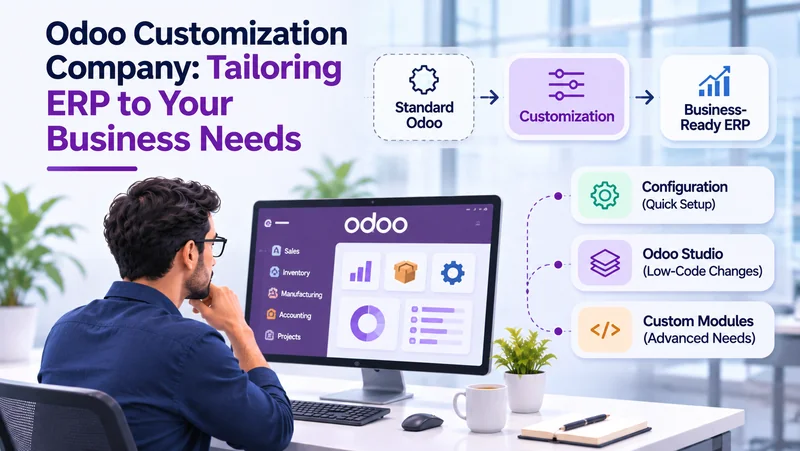
A furniture maker told us once that their old system “did everything,” and then it turned out half of that everything was a spreadsheet taped to the side. Odoo gets a similar treatment. People expect it to bend to every habit in the building, and it will, up to a point. Past that point you’re paying for code you’ll have to carry for years, and every upgrade will remind you of it.
That’s what a good Odoo customization company helps you judge. Not just how to change things. Whether to.
Three Levels of Change, Three Different Bills
Odoo ERP customization isn’t one thing. It runs in layers, and the cost climbs fast as you go down.
First there’s configuration: switching apps on, setting up warehouses, taxes, approval rules, email templates. No code, no upgrade worry. Second comes Odoo Studio, a point-and-click tool in Enterprise for adding fields, tweaking views and building simple automations. Third is custom modules, written in Python and XML, which can do nearly anything and also need testing every time Odoo ships a new version.
A sensible partner pushes you up the list. Can configuration solve it? No? Then can Studio? Only after both fail does code earn a place.
What Studio Does Well, and Where It Runs Out
Adding a “customer PO number” field to sales orders, showing it on the printed quotation, and making it required before confirmation: that’s an afternoon in Studio. It’s fast, and non-developers can maintain it.
Where it strains is logic that spans several records, and Odoo ERP customization of that kind is where a developer earns the fee. Say a rule that prices a job differently depending on the customer’s contract tier, the machine used and the time of year. The studio can’t express that cleanly. Neither can it help with outside connections like a carrier’s API, so that’s the point where a developer enters, ideally one who has already seen how your pricing rules behave in the real world.
Hosting Decides What Odoo ERP Customization Is Even Possible
One fact catches teams off guard. Odoo Online, the hosted service run by Odoo itself, doesn’t normally accept custom Python modules, so heavy customization usually points toward Odoo.sh or your own servers. Plans and rules change, so confirm on odoo.com before you commit.
It’s a decision to make before the contract is signed, not after the first module is half written. If a vendor proposes custom code without asking where you’re hosted, that’s a gap.
The Upgrade Bill Nobody Mentions
Odoo ships a major version each year. Customized databases get upgraded by testing every custom module on a fresh copy of the new version, and the usual damage is renamed fields, moved views and changed syntax. A few small modules are easy, but sixty of them, written by three different developers over four years with no shared notes, are a project of their own that somebody has to staff and pay for.
So ask your Odoo customization company a plain question: what’s your plan for the next version? A good answer mentions automated tests, a staging database and a written list of every customization with a reason attached. A bad answer is a shrug.
What an Odoo Customization Company Should Ask About Every Module
Here’s an exercise we like. Take the proposal and next to every custom item, write down the business reason in one sentence. “Because the old system did it” isn’t a reason. “Because customers in this segment need a different invoice layout under local law” is.
You’ll usually find a third of the list falls away. Some of it was habit. Some of it was a workaround for a process nobody wanted to change. Fixing the process is cheaper than coding around it, though people hate hearing it.
Look at How They Write Code
Odoo has a strong community and a well-known set of practices. Ask whether the team follows Odoo’s own coding guidelines, writes automated tests for custom logic, and keeps code in version control that you can access. Also ask whether they build on community modules where those exist, rather than rewriting from scratch. The Odoo Community Association maintains a large collection, so a lot of common needs already have a tested answer.
Ownership matters too. Who owns the source when the engagement ends? It should be you.
Beware the Everything-Is-Possible Pitch
Technically, almost anything is possible in Odoo. That’s the trouble. A vendor who says yes to every request is selling hours, not judgment. We’d trust the one who says, “We can build that, here’s what it costs to keep, and here’s a cheaper way to get ninety percent of it.”
Watch how they respond when you push back on price. Do they cut scope, or do they quietly cut testing? The second is a trap.
Small Pilot Before the Big Build
Pick one customization that matters, such as a custom approval flow or a document template, and have the vendor deliver it start to finish. Review it, test it on real data and run it through a version upgrade on a copy of your database. It tells you more about their discipline than any sales deck will.
Where BiztechCS Fits
BiztechCS, an Odoo Ready Partner, is one company you could talk to, and the same questions apply to us. We’d suggest listing every customization, scoring each by business value and upkeep, and building only the top of that list at first.
Picking an Odoo customization company comes down to restraint. The best ones say no more often than you’d expect, and they can tell you exactly why.
Ti potrebbe interessare:
Segui guruhitech su:
- Google News: bit.ly/gurugooglenews
- Telegram: t.me/guruhitech
- Facebook: facebook.com/guruhitechfb
- X (Twitter): x.com/guruhitech1
- Bluesky: bsky.app/profile/guruhitech.bsky.social
- Rumble: rumble.com/user/guruhitech
- VKontakte: vk.com/guruhitech
- MeWe: mewe.com/i/guruhitech
- Skype: live:.cid.d4cf3836b772da8a
- WhatsApp: bit.ly/whatsappguruhitech
Esprimi il tuo parere!
Ti è stato utile questo articolo? Lascia un commento nell’apposita sezione che trovi più in basso e se ti va, iscriviti alla newsletter.
Per qualsiasi domanda, informazione o assistenza nel mondo della tecnologia, puoi inviare una email all’indirizzo [email protected].
Che ne pensi?
Scopri di più da GuruHiTech
Abbonati per ricevere gli ultimi articoli inviati alla tua e-mail.