
AI Strategy, Generative AI & Custom Development: The Holy Trinity of Business AI Adoption
Artificial intelligence has moved from competitive advantage to competitive necessity faster than most business leaders anticipated. The conversation has shifted from “should we adopt AI?” to “why is our AI adoption not working?” and that second question is where most organisations find themselves stuck today. They have tools, they have budgets. They have executive buy-in. What they are missing is the structure that turns all three into outcomes.
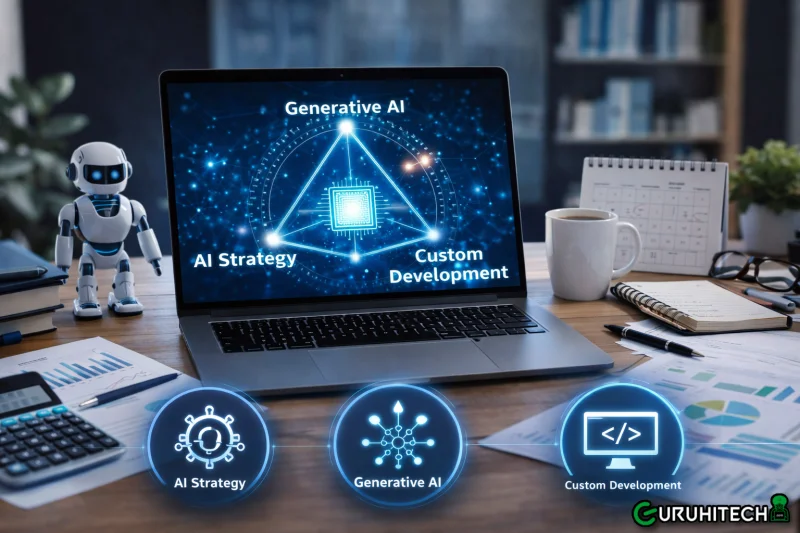
The businesses pulling ahead are not simply the ones spending the most on AI. They are the ones approaching adoption through three integrated disciplines: AI strategy consulting, generative AI development services, and custom AI development. Separately, each delivers value. Together, they form a framework that makes AI adoption systematic, scalable, and measurable.
Why Most Business AI Initiatives Stall
Before examining the solution, it is worth understanding the failure pattern. Most AI initiatives stall not because the technology is inadequate but because the implementation lacks structure. Businesses adopt tools reactively, responding to vendor pitches and competitor announcements rather than working from a defined understanding of where AI can generate the most value in their specific context.
The result is a fragmented AI landscape, a collection of disconnected tools, overlapping subscriptions, and pilot projects that never graduate to production. Teams are enthusiastic but directionless. Leadership is impatient but unable to identify the specific gap causing underperformance.
This is precisely the problem that AI strategy consulting exists to solve, and it is why strategy must come first in any serious adoption framework.
AI Strategy Consulting: The Foundation That Everything Else Requires
AI strategy consulting provides the diagnostic and directional layer that most businesses skip when they are eager to move fast. A rigorous strategy engagement begins with an audit of existing processes, data infrastructure, and organisational capability. It maps where AI can realistically generate value through automation, decision support, content generation, or customer experience improvement and where it cannot yet, given the business’s current data maturity and workflow architecture.
Without this foundation, even sophisticated AI tools underperform because they are pointed at the wrong problems. AI strategy consulting identifies the right problems, sequences the implementation roadmap logically, and establishes the metrics that will determine whether each initiative is working.
Crucially, it also manages the internal change management dimension that technology vendors rarely address. AI adoption changes how people work. A strategy that ignores the human and organisational layer will encounter resistance that no amount of technical excellence can overcome.
Generative AI Development Services: Turning Capability Into Business Output
Once strategy defines the roadmap, generative AI development services provide the execution layer for the fastest-moving category of AI capability available to businesses today. Generative AI, the technology behind large language models, image generation, code synthesis, and intelligent automation has compressed timelines for content production, customer communication, product development, and internal knowledge management.
But generic generative AI tools have a ceiling. They are trained on general data, respond to general prompts, and produce general outputs. For businesses with specific workflows, proprietary terminology, brand voice requirements, and industry-specific accuracy standards, general tools consistently fall short.
Generative AI development services close this gap by building, fine-tuning, and deploying generative AI systems around the specific needs of a business. This includes custom prompt architecture, retrieval-augmented generation systems that connect AI to proprietary knowledge bases, fine-tuned models trained on company-specific data, and automated pipelines that integrate AI output into existing production workflows.
The difference between a business using a general AI tool and one operating a purpose-built generative system is the difference between a business using a calculator and one running a financial model built for their specific portfolio. Both involve arithmetic. Only one generates decisions.
Custom AI Development: Building What Does Not Yet Exist
Generative AI development services address a wide range of business needs, but some challenges require solutions that no existing tool or platform can provide. This is where engaging a custom AI development company becomes the strategic choice rather than the premium option.
A custom AI development company builds machine learning models, intelligent automation systems, and AI-powered applications from the ground up engineered around the specific data, constraints, and outcomes of a single business. This includes predictive models trained on proprietary datasets, computer vision systems for quality control or inventory management, natural language processing pipelines for document classification, and recommendation engines built around actual customer behavior patterns rather than general preference data.
The value of custom development is precision. A model built on your data, optimised for your use case, and integrated into your infrastructure will consistently outperform a general solution adapted to approximate your needs. For businesses where AI performance directly affects revenue in pricing, forecasting, personalisation, or risk assessment, that precision gap translates directly into measurable commercial advantage.
How the Three Work Together
The power of this framework is in the integration. AI strategy consulting identifies where value exists and in what sequence initiatives should be pursued. Generative AI development services execute the highest-priority content, communication, and knowledge management applications quickly and with business-specific customisation. A custom AI development company handles the deeper, proprietary systems where off-the-shelf solutions are genuinely insufficient.
Each layer informs the others. Strategy shapes what gets built. Generative development provides fast, high-impact wins that demonstrate ROI and build internal confidence. Custom development delivers the proprietary systems that create durable competitive differentiation.
Businesses that attempt any one of these in isolation hit a predictable ceiling. Strategy without execution remains a document. Generative AI without strategy produces fragmented, uncoordinated output. Custom development without strategic context risks building the wrong thing with significant precision and cost.
What Successful AI Adoption Actually Looks Like
Businesses that have navigated AI adoption successfully share a consistent set of characteristics. They began with a clear strategy before selecting tools, they built generative AI capabilities around specific, high-value workflows rather than deploying them broadly and hoping for results. They engaged custom development selectively, reserving it for the applications where proprietary performance mattered most. And they measured outcomes against the baselines established at the strategy phase.
AI adoption is not a product decision. It is an organisational capability built deliberately, layer by layer, with the right expertise applied at each stage. The businesses that understand this distinction are the ones that will look back on this period as the moment they built a lasting structural advantage not just a technology upgrade.
FAQs
Q1. What does AI strategy consulting involve, and who needs it?
AI strategy consulting involves a structured assessment of where artificial intelligence can generate measurable value within a specific business, followed by a prioritised roadmap for implementation. It covers data readiness, workflow analysis, tool selection, build-versus-buy decisions, and internal change management planning. Any business that has budget for AI but lacks a clear framework for deploying it effectively stands to benefit significantly. This includes businesses that have already adopted AI tools but are not seeing the returns they expected.
Q2. How do generative AI development services differ from simply using tools like ChatGPT?
General AI tools like ChatGPT are designed for broad applicability. Generative AI development services build systems specifically configured for a business’s workflows, data, terminology, and output requirements. This includes custom prompt engineering, retrieval-augmented generation that connects AI to proprietary knowledge bases, fine-tuned models trained on company-specific content, and automated pipelines that embed AI output into existing production processes. The performance gap between a general tool and a purpose-built generative system widens significantly as business requirements become more specific.
Q3. When should a business engage a custom AI development company rather than using existing platforms?
A custom AI development company becomes the right choice when no existing platform can meet the precision requirements of the use case, when the business has proprietary data that would give a custom model a meaningful performance advantage, or when the AI system needs to integrate deeply into existing infrastructure in ways that commercial platforms do not support. Industries with specific regulatory requirements, unique data types, or performance-critical AI applications such as healthcare, financial services, logistics, and manufacturing most commonly reach this threshold.
Q4. How long does it typically take to see ROI from an AI strategy consulting engagement?
The timeline varies depending on the scope of the engagement and the complexity of the initiatives identified. Businesses typically begin to see measurable returns within 90 to 180 days for initiatives focused on automation and content generation. More complex custom AI systems may take six to twelve months to reach full deployment and measurable impact. AI strategy consulting engagements that establish clear baseline metrics at the outset make ROI measurement significantly more reliable, allowing businesses to course-correct quickly if early results diverge from projections.
Q5. Can small and mid-sized businesses benefit from AI strategy consulting and generative AI development services, or is this only relevant for enterprise?
AI adoption scales across business sizes. AI strategy consulting is, if anything, more valuable for smaller businesses because they have less margin for wasted AI investment and fewer internal resources to course-correct without external expertise. Generative AI development services can deliver significant efficiency gains in content production, customer communication, and internal knowledge management at price points accessible to mid-sized businesses. Custom AI development tends to require a larger investment, but smaller businesses with genuinely proprietary data and specific high-value use cases often find the returns justify the engagement.
Scopri di più da GuruHiTech
Abbonati per ricevere gli ultimi articoli inviati alla tua e-mail.