
How Proxy IPs Help Ecommerce Teams Monitor Prices, Ads, and Competitors
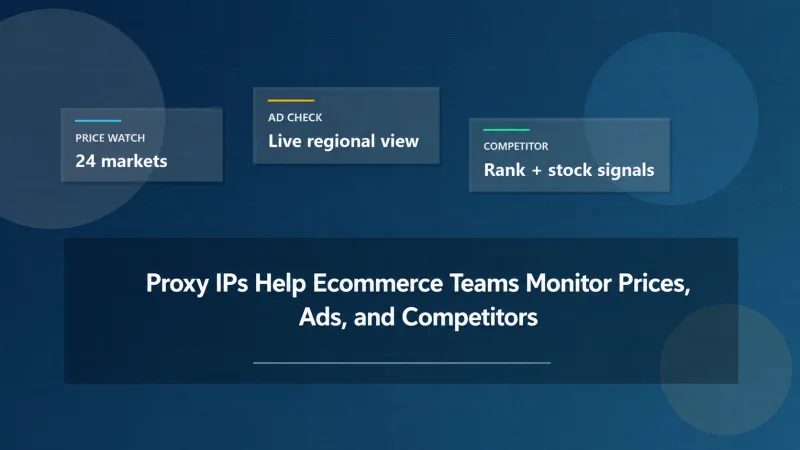
Ecommerce teams live on outside data. Prices change by the hour. Ads appear differently by region, device, and user profile. Competitor listings move up and down. Inventory comes and goes without warning. If you cannot see what real shoppers see in different markets, you are making decisions with partial information.
That is where proxy IPs become useful.
A proxy IP lets a team route requests through a different IP address, often from a specific country, city, network type, or device environment. Used properly, this makes it possible to collect public market data, verify ad delivery, and test localized shopping experiences with far fewer blocks and false readings than a single office IP can provide.
For ecommerce operators, the value is practical: better visibility, better monitoring, and fewer blind spots. This is why many data-driven teams integrate Rola IP into their collection stacks to ensure they always see the true state of the market.
Why Ecommerce Monitoring Breaks Without Proxy Infrastructure
Most retail and marketplace sites are built to detect unusual traffic patterns. If one IP sends repeated requests across many product pages, regions, or search terms, the site may slow responses, show captchas, limit visibility, or block access altogether.
That creates three common problems:
- Price checks stop being reliable because the site starts serving defensive responses.
- Ad verification becomes incomplete because the team can only see one market or one user context.
- Competitor monitoring turns noisy because the data is throttled, cached, or location-distorted.
A proper proxy setup reduces those issues by distributing requests across multiple IPs and allowing the team to view pages from the market they actually care about.
Where Proxy IPs Matter Most in Ecommerce
The strongest use cases are not theoretical. They sit inside everyday ecommerce operations.
1. Price Monitoring Across Regions
A retailer selling in multiple markets cannot rely on one local browser session to understand pricing pressure. Competitors may show different prices in the US, Germany, Canada, or Southeast Asia. Marketplace fees, taxes, promotions, and shipping logic can also change what a shopper sees.
Proxy IPs make it easier to check:
- Regional product pricing: Uncover dynamic pricing strategies applied to different geographical targets.
- Flash-sale changes: Monitor sudden discounts or promotional events in real-time.
- Marketplace listing positions: Track how the Buy Box or search rankings shift based on the searcher’s location.
- Currency-based pricing differences: Ensure localized currency conversions match intended profit margins.
- Shipping price variation: Verify fulfillment costs based on localized warehouse proximity.
Data in Action: Delayed visibility leads to delayed reaction. For instance, a cross-border apparel retailer recently reported that switching to localized residential IPs reduced their delayed price alerts by 85%, allowing them to match a major competitor’s flash sale within minutes instead of hours. That gap saves real revenue.
2. Ad Verification
Paid traffic teams often assume their campaigns are live because the dashboard says impressions were delivered. That is not the same as seeing the ad in the field.
Ads can fail in several ways:
- Render failures: The creative may not display correctly on a marketplace or publisher page.
- Geographic misfires: A geo-targeted campaign may be showing in the wrong region entirely.
- Broken localized offers: A localized discount may be pointing to the wrong landing page or 404 error.
- Brand bidding violations: Resellers or affiliates may be bidding on brand terms in ways the brand did not approve.
With proxy IPs, teams can check how ads actually appear from the target market. That is especially useful for brands running campaigns across different countries, languages, or distributor networks.
3. Competitor Tracking
Competitor monitoring is more than checking a homepage once a week. Serious teams watch product assortment, ranking changes, promotions, bundling, reviews, seller rotation, and stock availability.
This work becomes fragile when every request comes from one IP range. A rotating proxy setup helps spread requests and maintain continuity, especially for recurring monitoring jobs across various business use cases.
That is one reason many data-heavy teams look for providers that support both residential and rotating options. A service such as Rola IP is highly relevant here because it offers residential, datacenter, mobile, and IPv6 proxy types, giving operations teams the flexibility to match the exact network type to the task instead of forcing one rigid setup across every workflow.
A Simple Comparison Table
| Ecommerce task | What teams need to see | Why a single IP falls short | Better proxy approach |
| Price monitoring | Real public prices by country or city | Repeated requests trigger throttling or captchas | Rotating residential IPs |
| Ad verification | Live ads in target regions | Office IP shows only one market context | Geo-targeted residential or mobile IPs |
| Competitor tracking | Category rankings, listings, promotions | Requests become inconsistent over time | Rotating pool with session control |
| Storefront testing | Local language, currency, and shipping view | Cached or non-local experience distorts results | City-level or country-level proxies |
| Marketplace intelligence | Seller changes, stock status, offer rotation | Platforms restrict repeated checking | Distributed request routing |
What Good Proxy Operations Look Like
The difference between a useful proxy setup and a wasteful one is usually operational discipline. Good teams do four things well:
They match the proxy type to the job
Not every use case needs the same network:
- Residential proxies are usually better when you need a shopper-like browsing footprint.
- Datacenter proxies can be more cost-efficient for lighter tasks where detection pressure is lower.
- Mobile proxies can help with highly sensitive mobile or app-like environments.
- Static sessions help when you need continuity and environment isolation.
- Rotating sessions help when you need scale and distribution.
They control request behavior
Even strong proxies will not rescue bad collection habits. Teams still need sane concurrency, pacing, retry logic, and error handling. If a monitoring script behaves like abuse, it will get treated like abuse.
They separate collection from interpretation
Raw price data is only step one. High-performing teams pipe the data into alerting, dashboards, and repricing workflows. Otherwise, the monitoring stack turns into a reporting exercise instead of a decision system.
They stay inside legal and platform boundaries
Proxy infrastructure should be used responsibly. That means respecting applicable laws, contractual limits, and the difference between public market observation and prohibited access behavior. The goal is visibility, not recklessness.
What to Look for in a Proxy Provider
Many proxy vendors sound similar until you look at the details that affect real ecommerce work. A provider is more useful when it offers:
- Broad geographic coverage: Allowing targeted testing down to the city level.
- A large and refreshed IP pool: Preventing sudden blocks due to stale IPs.
- Multiple proxy types: Supplying both residential and datacenter options for different jobs.
- Session flexibility: Offering both sticky and rotating sessions.
- API access: Enabling seamless integration with automation software.
- Standard authentication: Supporting simple username/password and IP whitelist options.
- Responsive technical support: Providing quick fixes when critical monitoring workflows break.
Those details matter because ecommerce monitoring is rarely static. One month you may be checking regional prices. The next month you may be validating ad placement or testing search results in a new country. The “best” proxy is usually not one single product type—it is the provider that lets you switch approaches seamlessly without rebuilding your workflow every time the market changes.
Common Mistakes Ecommerce Teams Make
Proxy tools are often blamed for problems caused by process. Here are the mistakes that come up most often:
Using one setup for every task
Price monitoring, ad verification, and marketplace intelligence are related, but they are not identical. The traffic pattern, sensitivity, and accuracy requirements differ.
Buying on price alone
Cheap bandwidth is attractive until the IP quality is poor, the pool is stale, or support disappears when your workflow breaks. A low nominal cost can become an expensive failure if the data turns unreliable.
Ignoring localization depth
Country-level targeting is helpful, but city-level visibility can matter just as much for ads, localized offers, and search placement.
Treating proxies as the strategy
Proxies are infrastructure. The strategy is the monitoring plan: which sites, which SKUs, which cadence, which alert thresholds, and which actions follow the data.
The Bigger Business Case
When teams talk about proxies, the conversation can get too technical. Leadership usually cares about something simpler: what does this improve? In ecommerce, the answer is straightforward.
Better visibility improves:
- Pricing speed: Reacting to competitor cuts without delay.
- Campaign verification: Ensuring ad spend is not wasted on broken or misdirected links.
- Competitive response time: Spotting new bundles or promotions immediately.
- Expansion into new markets: Testing localized storefronts with confidence.
- Confidence in operational decisions: Basing strategies on real public data, not cached approximations.
If your team is selling across regions or competing on marketplaces where rankings and offers move constantly, better market visibility is not a side tool. It is part of execution.
FAQs
What is the main benefit of proxy IPs for ecommerce teams?
The main benefit is reliable visibility. Proxy IPs help teams view public pricing, ads, listings, and storefront experiences from different markets without relying on one easily flagged IP address.
Are residential proxies better than datacenter proxies for ecommerce monitoring?
Often, yes for sensitive tasks. Residential proxies usually look closer to normal consumer traffic, which makes them useful for price checks, ad verification, and localized storefront testing. Datacenter proxies can still be cost-effective for lighter monitoring jobs.
Can proxy IPs help with ad verification?
Yes. They help teams confirm whether ads are appearing in the intended country, language, or market context, and whether the user journey after the click matches the campaign setup.
Do ecommerce brands need rotating IPs?
In many cases, yes. Rotating IPs are useful when a team needs to monitor many pages, keywords, or markets at scale without overloading one IP identity.
What should a team check before choosing a proxy provider?
Check IP pool size, geographic coverage, session options, authentication methods, API support, support quality, and whether the provider offers the right mix of residential, datacenter, mobile, or static options for your workflow.
Final Thoughts
Ecommerce monitoring is only as good as the visibility behind it. If your team needs to track prices accurately, verify ads in live markets, and watch competitors without constant interruptions, proxy IPs are part of the operating stack, not an optional add-on.
The teams that do this well are not chasing tools for the sake of tools. They are building a cleaner view of the market, then using that view to make faster decisions.
Ti potrebbe interessare:
Segui guruhitech su:
- Google News: bit.ly/gurugooglenews
- Telegram: t.me/guruhitech
- Facebook: facebook.com/guruhitechfb
- Instagram: instagram.com/guruhitech_official/
- X (Twitter): x.com/guruhitech1
- Bluesky: bsky.app/profile/guruhitech.bsky.social
- Rumble: rumble.com/user/guruhitech
- VKontakte: vk.com/guruhitech
- MeWe: mewe.com/i/guruhitech
- Skype: live:.cid.d4cf3836b772da8a
- WhatsApp: bit.ly/whatsappguruhitech
Esprimi il tuo parere!
Ti è stato utile questo articolo? Lascia un commento nell’apposita sezione che trovi più in basso e se ti va, iscriviti alla newsletter.
Per qualsiasi domanda, informazione o assistenza nel mondo della tecnologia, puoi inviare una email all’indirizzo [email protected].
Scopri di più da GuruHiTech
Abbonati per ricevere gli ultimi articoli inviati alla tua e-mail.