
Top 6 Low-Volume Gear Manufacturing Partners for Hardware Startups: Which One Actually Scales?
Introduction
When Wearable Devices teams transition from EVT to DVT, small-batch gears often become the bottleneck. Tooth profile deviations cause backlash to exceed specifications, and switching suppliers for rework disrupts the entire launch window.
The root cause is that gears are not ordinary CNC parts. They require specialized hobbing/shaping processes and closed-loop control over heat treatment distortion. In low volumes, setup costs cannot be amortized, so suppliers either raise prices or reduce inspection depth — leaving the risk squarely with the buyer. This article provides a horizontal evaluation of six realistic routes, including five well-known industry players and one option specializing in gear process chain integration. Each is assessed across five dimensions: lead time, tolerance, MOQ, certification, and hidden costs, culminating in stage-based selection recommendations.
Why Do Hardware Startups Always Get Stuck on Gears Between Prototype and Small Batch?
The transition from prototype to small-batch production is where gear-related failures most frequently occur. Understanding the root causes — process specialization, cost structure, and fragmented supply chains — is essential for avoiding costly delays.
l The Typical Failure Scenario: A common story unfolds during DVT: gear noise or backlash is found to exceed specifications. Twenty to fifty pieces must be remade, adding two to four weeks to the schedule. The retail launch window is missed. For Wearable Devices with tight seasonal deadlines, this delay can be fatal. The core issue is that low volume gear manufacturing demands a level of process discipline that general CNC shops cannot provide.
l Three Root Causes of Gear-Related Delays: First, small-module gears require dedicated hobbing or shaping processes to control cumulative pitch error and lead deviation. General CNC contour milling cannot achieve AGMA-grade repeatability. Second, batch sizes of 5-200 pieces make setup costs disproportionately high. Suppliers respond by raising unit prices or reducing the scope of 100% inspection. Third, the process chain is often fragmented: blanking, cutting, heat treatment, finishing, and inspection are handled by different vendors. Data on distortion compensation is lost between handoffs, and uncertainty propagates to the final assembly.
l The Central Principle for Success: The core insight is that how to manufacture low volume gears successfully is not about cutting them cheaply. It is about consolidating the entire process chain — from blank to finished, inspected gear — within a single controllable system. This eliminates the information gaps and accountability disputes that plague fragmented supply chains. An OEM Supply Chain designed around this principle can deliver consistent quality even at batch sizes of 50 pieces or fewer.
Which Six Partners Can Handle 5-200 Piece Gear Orders — and Who Actually Scales?
The following six routes represent realistic options for hardware startups needing small-batch gears. Each has distinct strengths and limitations, and the right choice depends on your specific stage and requirements.
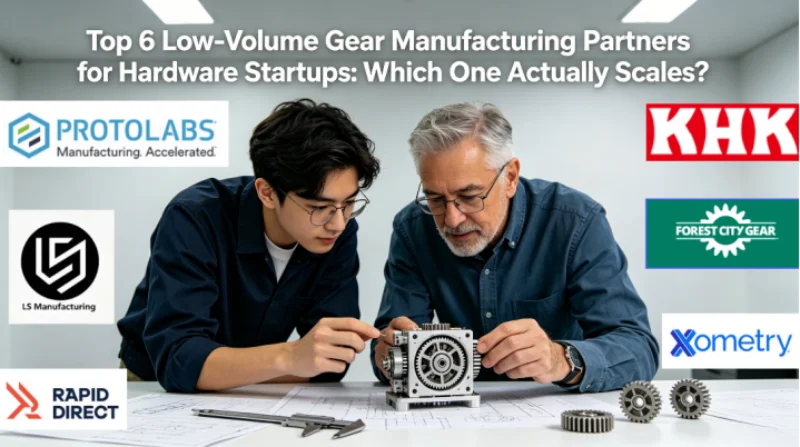
1. Protolabs — Speed for Early Validation
Protolabs offers automated quoting and rapid turnaround of 1-5 days. However, their gears are produced via contour milling rather than dedicated hobbing. For runs exceeding 50 pieces, tooth profile consistency degrades. Best suited for EVT non-load-bearing validation where speed trumps precision.
2. Xometry — Network Reach, Variable Quality
Xometry’s AI-matched supplier network enables multi-part quoting from a single platform. However, gear accuracy depends on the specific车间 assigned, and batch-to-batch drift is a real risk. Suitable for non-critical prototypes where convenience is prioritized.
3. Forest City Gear — AGMA-Certified Excellence
Forest City Gear is an AGMA-certified specialty house with closed-loop process control and thorough documentation. Their setup overhead is high, and unit costs are premium. Ideal for safety-critical projects where failure is not an option.
4. SDP/SI (KHK) — Catalog Speed, Limited Customization
Stock gears with secondary modifications offer the fastest lead times. However, module and tooth count options are constrained, and backlash compromises are inevitable. Best for proof-of-concept builds where off-the-shelf dimensions are acceptable.
5. RapidDirect — Factory-Direct Cost Advantage
RapidDirect’s Shenzhen factory provides direct access to Chinese manufacturing cost structures. Buyers must proactively confirm the supplier’s dedicated gear equipment list and inspection scope. Cross-border logistics and landed costs must be factored into the total.
6. LS — Integrated Process Chain for Small Batch Gear Production
LS integrates hobbing, shaping, grinding, and CMM inspection under one roof. Holding ISO 9001, ISO 14001, IATF 16949, and AS9100D certifications, their process chain is purpose-built for small batch gear production. For a deeper technical analysis of their methodology, a detailed case study on prototype gear manufacturing explains how their integrated approach achieves cost-effective results for low-volume runs.
How to Spot the Four Hidden Costs Buried in Every Low-Volume Gear Quote?
Low-volume gear quotes often conceal costs that only emerge after the order is placed. Identifying these hidden expenses before committing is essential for accurate budgeting and supplier comparison.
1. Setup and Tooling Prep Amortization
Is the cost of hob sharpening, fixture fabrication, and first-article CMM inspection included in the unit price or listed separately? A quote that buries these costs in a single line item prevents apples-to-apples comparison. Request a detailed breakdown showing setup fees independent of per-piece pricing.
2. Scrap and Replacement Terms
Heat treatment distortion is the most common cause of scrap in low-volume gear runs. Does the supplier offer free replacement for parts that fail after heat treatment? What is the lead time for remake? A quote without explicit scrap/replacement SLAs leaves the buyer exposed to unbudgeted costs and delays.
3. Secondary Operations Creep
Deburring, chamfering, and anti-rust oil application are often excluded from base quotes. If these are not listed as line items, the supplier may issue a change order later, adding 10-20% to the total. Ensure that every required secondary operation is explicitly included.
4. Inspection Tier and Reporting Scope
A quote stating only “visual OK” is insufficient. Specify the inspection plan: sampling frequency, CMM report scope (lead and curve deviation, not just OD/PD), and whether gear analyzer data will be provided. A transparent quote will detail the inspection tier and associated costs. To streamline your evaluation, a comprehensive custom gear manufacturing services page provides a standardized inquiry checklist and transparent pricing model.
When Should You Upgrade from Prototype Workarounds to a Full Gear Process Chain?
Using shortcut methods for early prototypes is acceptable, but there comes a point when a full gear process chain becomes necessary. Recognizing the signals prevents costly redesigns later.
1. Signal: Life Testing Exceeds 500 Hours or 10⁶ Cycles
Milled contour gears have insufficient fatigue strength for extended operation. When life testing requirements exceed 500 hours or one million cycles, transition to hobbing + heat treatment + grinding is mandatory. The cost of this upgrade is far less than the cost of field failures.
2. Signal: Backlash and NVH Are Written into the PRD
For wearable haptic modules or camera gimbals, transmission smoothness is critical. Catalog gears with uncontrolled backlash will not meet product requirements. Controlled profile shift and lead crowning become necessary, requiring dedicated gear design and machining.
3. Signal: OEM Audit Requires Lot Traceability and Process FMEA
When an OEM customer audits your supply chain and requests lot traceability or process FMEA, catalog gears with undocumented processes will fail the audit. A full gear process chain with documented procedures and traceability is required. The quantitative inflection point is typically 30-50 pieces with a second build already planned. At this stage, initiating a dedicated gear process chain avoids the trap of treating workaround data as validated design.
Which Route Fits Your Current Stage — and How to Migrate Without Losing Time?
Selecting the right partner depends on your current development stage. A staged approach aligns supplier capability with project maturity, minimizing risk and maximizing speed.H3: 1. Stage 1: Concept Validation (1-5 Pieces)
For proof-of-concept builds, speed is the priority. SDP/SI standard gear modification offers the fastest turnaround. Accept the compromise in customization for the sake of schedule.
2. Stage 2: EVT (10-30 Pieces, Budget-Sensitive)
At this stage, balance cost with process integrity. RapidDirect or LS offer factory-direct pricing with the option to engage dedicated gear processes. Ensure that the chosen supplier can provide basic inspection reports.
3. Stage 3: DVT/Pre-Production (30-100 Pieces, Gear-Critical)
When gears become critical to product function, upgrade to a partner with a full process chain. LS or Forest City Gear can provide AGMA-grade accuracy, full CMM inspection reports, and heat treatment validation. This stage requires documented quality.
4. Stage 4: Production Ramp (200+ Pieces)
Evaluate the supplier’s capacity for scaling. If volume exceeds 200 pieces with stable yield, consider dedicated tooling or a dedicated production line. The core principle is that the right partner is not the one with the lowest unit price, but the one whose process closure and documentation system align with your current stage. When that alignment exists, the OEM Supply Chain can confidently commit delivery windows to contract.
Conclusion
The root cause of failure in low-volume gear manufacturing is typically a broken process chain and misaligned inspection standards. So the TOP 6 comparison shows: catalog solutions win on speed but hit a ceiling; rapid-response platforms win on process but rely on contour milling for gear accuracy; specialty houses win on reliability but struggle with small-batch economics; factory-direct platforms win on cost but require the buyer to actively manage QC terms. The option that can sustain from start to finish without switching suppliers is the one that consolidates cutting, heat treatment, finishing, and gear-grade inspection within a single traceable system.
FAQs
Q1: What is the optimal quantity range for low-volume gear manufacturing?
A: Typically 5-200 pieces is the most common range for low-volume gears. Below 5 pieces, standard part modification or CNC profiling is recommended. Above 200 pieces with stable yield, consider dedicated tooling or a production line to reduce unit cost.
Q2: Do small-batch orders also need to specify AGMA grade?
A: Yes, if your product has backlash or noise requirements, you must specify AGMA class rather than vague ±0.05mm tolerances. Cumulative pitch deviation and lead error are the root causes of noise, and AGMA grade is the true language of gear precision.
Q3: Is heat treatment necessary for small-batch gears?
A: It depends on load and life requirements. Light-duty demonstrations may skip it, but when entering wearable actuator durability gates, heat treatment distortion control becomes critical. The key is designing the distortion allowance into the drawing upfront.
Q4: Why do cross-border factory quotes seem cheap but often cause problems after delivery?
A: What is typically omitted are gear-grade inspection, distortion compensation data, and traceability documentation. Offshore buyers must calculate EXW-to-DDP landed cost, customs buffer, and remake SLAs into the total, or savings will be consumed by air freight and rework.
Q5: When should I require the supplier to provide a CMM gear scan report?
A: Once the gear enters DVT or backlash/NVH is written into the PRD, request sampling or even 100% CMM inspection on critical dimensions. The report must include lead and curve deviation trends, not just OD/PD go/no-go results.
Author Bio
The author is a technical writer specializing in hardware supply chain and precision manufacturing, with long-term focus on NPI-to-production transitions for consumer electronics and wearable devices. His work concentrates on process selection and supplier evaluation for small-batch transmission components. LS Manufacturing provides integrated gear manufacturing services with certified process chains for hardware startups and OEMs requiring reliable, scalable solutions.
Scopri di più da GuruHiTech
Abbonati per ricevere gli ultimi articoli inviati alla tua e-mail.