
Chain Hoist Guide: Manual, Electric & How to Choose the Right One
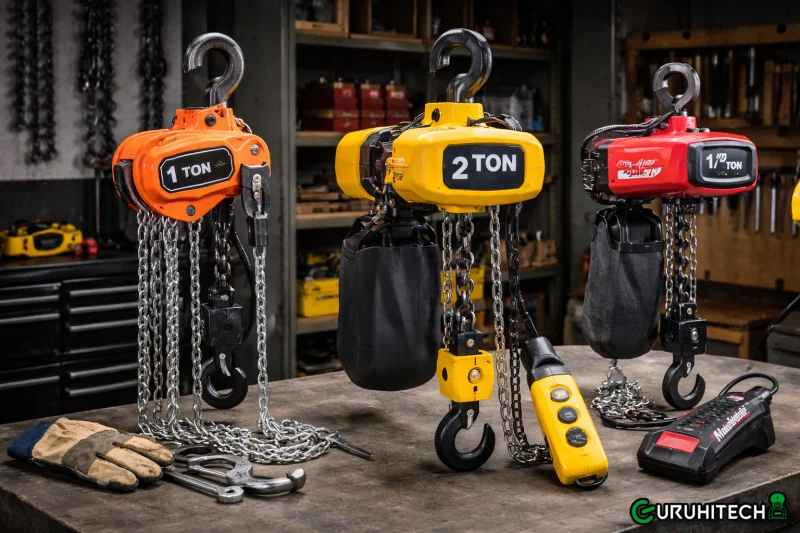
Few lifting tools match the reliability and versatility of the chain hoist. Found in workshops, warehouses, construction sites, factories, and maintenance facilities worldwide, chain hoists have earned their place as one of the most practical and cost-effective lifting solutions available. Whether you need a simple manual chain hoist for occasional use or a heavy-duty electric chain hoist running multiple shifts a day, understanding how these machines work — and what separates a good one from a great one — will help you invest with confidence.
This guide covers everything: how chain hoists work, the key differences between manual and electric models, how to select the right chain for hoist applications, and the safety and maintenance fundamentals every operator needs to know.
What Is a Chain Hoist?
A chain hoist is a mechanical lifting device that uses a chain as its primary load-bearing element. The chain passes through a lifting mechanism — either hand-operated or motor-driven — and terminates in a bottom hook that attaches to the load. The upper hook suspends the hoist from a beam, trolley, or other overhead structure.
Chain hoists are valued for their simplicity, durability, and ability to hold a load statically without continuous power input. When the operator stops pulling on a manual model, or releases the control pendant on an electric model, the load stays precisely where it is — held securely by the hoist’s internal load brake. This self-sustaining brake is one of the most important safety characteristics that makes chain hoists a trusted tool across industries worldwide.
Manual Chain Hoist vs. Electric Chain Hoist
The most fundamental choice in the chain hoist category is between manual and electric operation. Each has clear strengths, and the right choice depends on your application, frequency of use, and working environment.
Manual Chain Hoist
A manual chain hoist — also widely known as a chain fall hoist or hand chain block — is operated entirely by human effort. The operator pulls the hand chain, which drives an internal gear train that raises the load chain and lifts the load. A mechanical load brake engages automatically whenever pulling stops, holding the load securely without any ongoing effort from the operator.
The manual chain hoist is prized above all for its simplicity. There are no electrical components to fail, no batteries to charge, and no power supply to locate. A quality manual chain hoist requires only basic lubrication and periodic inspection to remain serviceable for decades. This makes it the preferred tool for remote locations, outdoor environments without power access, and infrequent lifting tasks where the investment in an electric unit is not justified by usage frequency.
Manual chain hoists are available in capacities from 250 kg to 50 tons or more, with lift heights from 3 meters to 30+ meters depending on chain length. The trade-off is effort and speed — lifting a heavy load manually is slow, and operator fatigue limits productivity over extended sessions.
The chain fall hoist — one of the oldest and most enduring names for the manual chain hoist — remains especially popular in rigging, construction, and field maintenance applications where portability and independence from power sources are essential. A chain fall hoist can be carried to any location, suspended from virtually any suitable overhead point, and put to work immediately without any infrastructure.
Electric Chain Hoist
The electric chain hoist replaces manual effort with a motor-driven lifting mechanism. An electric motor drives a gearbox that raises and lowers the load chain at a consistent, controllable speed, with pendant or wireless remote controls allowing precise load positioning without physical strain.
Electric chain hoists dramatically increase productivity over manual models. They cycle repeatedly without operator fatigue, maintain consistent lift speeds regardless of load weight, and — in higher-specification models — offer variable speed control for delicate or precise positioning work.
Electric chain hoists are the standard choice for production environments, assembly lines, manufacturing facilities, and any application where lifting frequency is high or where load weights make manual operation impractical. Modern electric chain hoists incorporate sophisticated safety features including thermal overload protection, mechanical load brakes, upper and lower limit switches, and emergency stop functions.
Hoist electric chain systems — referring to the complete powered lifting assembly including motor, gearbox, load chain, and control system — are available in single-phase configurations for light industrial and workshop use, and three-phase configurations for heavier industrial applications. Capacities for electric chain hoists range from 125 kg for compact workshop models up to 20 tons or more for heavy-duty industrial systems.
How a Chain Hoist Works: The Core Mechanics
Understanding the internal mechanics of a chain hoist helps explain why these tools are so reliable and what maintenance they require to stay that way.
Manual Chain Hoist Mechanics
In a manual chain hoist, pulling the hand chain rotates a hand chain wheel connected to a drive shaft. The drive shaft turns the load sheave through a reduction gear train — the gearing multiplies the operator’s pulling force, enabling heavy loads to be lifted with manageable effort.
The heart of the manual chain hoist is its load brake — typically a Weston-style friction brake consisting of friction discs clamped between a ratchet wheel and a friction plate. When the operator pulls the lifting side of the hand chain, the ratchet mechanism engages and the brake releases. When pulling stops, the brake re-engages automatically under the weight of the load, holding it without drift or creep.
This self-sustaining brake design is why the chain fall hoist is trusted for sustained load holding. The load cannot descend unless the operator actively pulls the lowering side of the hand chain — making accidental descent essentially impossible under normal conditions.
Electric Chain Hoist Mechanics
An electric chain hoist replaces the hand chain and manual gear train with an electric motor and enclosed precision gearbox. The motor drives the load sheave, raising and lowering the load chain at rated speed under full electronic control.
The load brake in an electric chain hoist is typically a disc or cone brake that engages mechanically when the motor is de-energized — ensuring the load is held safely even during a power failure. This mechanical load brake is a non-negotiable safety feature. Any electric chain hoist lacking a true mechanical load brake — relying solely on motor braking — is unsuitable for genuine lifting work in any professional setting.
Limit switches in electric chain hoists cut motor power automatically when the bottom hook reaches the upper or lower travel limit, preventing chain over-travel and protecting both the machine and the load.
Chain for Hoist: Selecting and Maintaining Load Chain
The chain for hoist applications is not standard hardware store chain. Load chain used in chain hoists is precision-engineered, heat-treated alloy steel, manufactured and tested to strict international standards. Using incorrect chain is one of the most dangerous modifications anyone can make to a lifting device.
Chain Grade and Standards
Chain for hoist applications is classified by grade, which reflects the steel’s minimum tensile strength relative to its diameter:
- Grade 80 (G80) — The established standard for most industrial chain hoists. Tensile strength of 800 N/mm². Typically marked “8” or “G8” on the link.
- Grade 100 (G100) — Higher strength, allowing lighter chain for the same working load limit. Increasingly specified in modern electric chain hoists to reduce suspended dead weight.
- Grade 120 (G120) — The highest available grade for lifting chain, delivering maximum strength-to-weight ratio for the most demanding applications.
Never substitute lower-grade chain — transport chain, proof-coil chain, or general hardware chain — in any chain hoist. Only manufacturer-approved replacement chain should ever be fitted. The chain must precisely match the hoist’s load sheave pocket geometry; incorrect chain will not seat properly, creating dangerous stress concentrations.
Chain Inspection
The chain for hoist applications requires regular inspection covering:
- Wear — Links worn more than 10% of their original cross-section diameter must be replaced immediately.
- Stretch — Elongation exceeding 2% of the original measured length indicates fatigue and requires full chain replacement.
- Deformation — Twisted, bent, or cracked links are grounds for immediate chain retirement, regardless of visible wear level.
- Corrosion — Surface rust requires cleaning and lubrication. Deep pitting or corrosion-induced cracking requires chain replacement without exception.
Proper lubrication of chain for hoist applications extends service life significantly. Apply manufacturer-recommended chain lubricant at regular intervals, paying particular attention to link contact points where wear accumulates fastest.
Types of Electric Chain Hoists
Not all electric chain hoists are configured the same way. Understanding the main variants helps match the machine to the application.
Hook-Suspended Electric Chain Hoist
The simplest and most portable configuration. The electric chain hoist hangs from its upper hook, which can be placed over a beam flange, trolley hook, or lifting eye. Hook suspension is the default choice for workshops, maintenance facilities, and applications where the hoist is moved between locations.
Trolley-Mounted Electric Chain Hoist
The electric chain hoist is mounted on a push, geared, or motorized trolley that travels along a monorail or bridge crane beam. This configuration transforms the hoist into part of a complete overhead handling system, allowing loads to be moved both vertically and horizontally within a work area.
Low-Headroom Electric Chain Hoist
Designed for facilities where ceiling height is limited, low-headroom electric chain hoists minimize the distance between the suspension point and the hook, maximizing available lift height within a constrained space.
Explosion-Proof Electric Chain Hoist
Specialized electric chain hoists built with enclosures and components rated for use in hazardous atmospheres — chemical plants, refineries, grain facilities, and other environments where flammable gases or dusts may be present. Standard electric chain hoists must never be used in classified hazardous areas.
Key Specifications When Comparing Electric Chain Hoists
When evaluating electric chain hoists, these specifications define real-world capability and suitability:
Capacity — The maximum rated load. Always apply an appropriate safety margin and never routinely operate at 100% of rated capacity.
Lift Speed — Measured in meters per minute. Standard electric chain hoists lift at 2–8 m/min. Variable speed models allow slower speeds for precision load placement.
Lift Height — Determined by the length of load chain supplied. Standard configurations range from 3 to 6 meters; extended chain options are available for tall facilities.
Duty Cycle — Expressed as a percentage or FEM/ASME class, duty cycle defines how intensively the electric chain hoist can operate without overheating the motor. A 20% duty cycle means the motor should not run more than 12 minutes per hour. Heavy industrial electric chain hoists are rated for continuous or near-continuous operation.
Power Supply — Single-phase 120V or 240V for light-duty workshop models; three-phase 240V or 480V for industrial electric chain hoists demanding sustained performance.
Manual Chain Hoist vs. Electric Chain Hoist: Which Is Right for You?
Use this framework when deciding between chain hoists for your application:
Choose a manual chain hoist when:
- Lifting is infrequent — a few times per week or less
- No electrical power supply is available at the lift point
- Portability between locations is essential
- The application is a chain fall hoist scenario: field maintenance, rigging, or construction
Choose an electric chain hoist when:
- Lifting frequency is high — multiple lifts per shift
- Operator fatigue and productivity are primary concerns
- Precise speed control improves safety or product handling
- The hoist will integrate into an overhead crane or monorail system
Specify industrial-grade electric chain hoists when:
- Duty is continuous or near-continuous
- Loads exceed 2 tons regularly
- The environment is hazardous and explosion-proof electric chain hoists are required
- Full certification and safety documentation are mandatory
Safety Standards for Chain Hoists
All chain hoists used in professional or industrial settings should conform to recognized safety standards:
- ASME B30.16 — Overhead underhung hoists (USA)
- ASME B30.21 — Manually lever-operated hoists (USA)
- EN 13157 — Hand-powered hoists including manual chain hoists (Europe)
- EN 14492-2 — Power-driven hoists including electric chain hoists (Europe)
- FEM 9.511 / 9.755 — European classification for hoist duty cycle and mechanism design
Certification to these standards provides assurance that the chain hoist has been designed, tested, and manufactured to meet minimum safety requirements. Always request certification documentation when purchasing chain hoists for workplace use — this is not optional in any regulated working environment.
Chain Hoist Maintenance Essentials
Consistent maintenance is non-negotiable for the safe, reliable operation of any chain hoist — manual or electric.
Before every use: Inspect upper and lower hooks for deformation, cracks, and safety latch function. Check the load chain for visible damage, kinks, or corrosion. Verify all controls operate correctly.
Monthly: Lubricate the load chain with manufacturer-approved lubricant. Inspect the hand chain on manual chain hoists for wear and deformation. Check all fasteners for tightness. Test limit switches on electric chain hoists.
Annually: A qualified inspector must perform a thorough examination of all structural components, load-bearing parts, brakes, and chain — generating a written inspection record. This formal examination is a legal requirement in most jurisdictions for workplace lifting equipment.
After any incident: If a chain hoist has been subjected to shock loading, overloading, or any event that may have compromised its integrity, remove it from service immediately. Do not return it to use until a qualified engineer has inspected and cleared it.
Conclusion
The chain hoist — in both manual chain hoist and electric chain hoist form — remains one of the most practical, reliable, and versatile lifting tools available across industry, construction, and skilled trades. Understanding the mechanics, selecting the correct chain for hoist applications, knowing when a chain fall hoist serves better than a powered unit, and distinguishing the right specification of electric chain hoists for your duty cycle — these are the decisions that determine whether your investment delivers safe, productive performance for years to come.
Match the tool to the task, maintain it rigorously, and the right chain hoist will be one of the most dependable assets in your operation.
Related topics: wire rope hoist vs chain hoist — a practical comparison, overhead crane hoist selection guide, lifting equipment inspection requirements under ASME B30 and LOLER, load chain grade selection, explosion-proof hoist selection for hazardous environments.
Scopri di più da GuruHiTech
Abbonati per ricevere gli ultimi articoli inviati alla tua e-mail.