
From Copilots to Digital Employees: The Rise of Role Based Agentic AI in the Modern Enterprise
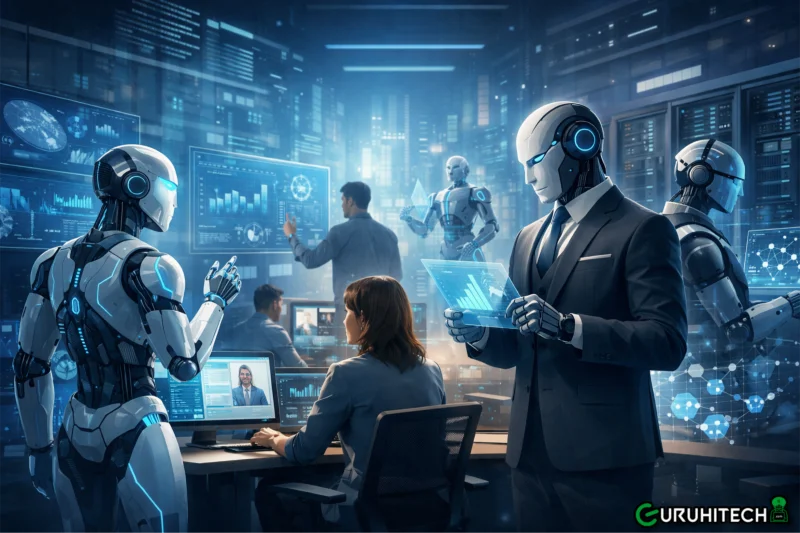
AI has served as an assistant over the years. Copilots suggest code, write content, or summarize information. They are time-saving, but they also require human stimulation to operate.
However, enterprises are no longer sticking with this model.
AI is beginning to assume specific duties rather than suggesting recommendations. Such systems are able to plan, make decisions, and perform with minimal human involvement. This is causing the emergence of role-based digital employees.
These digital employees are made to perform roles as opposed to the general AI tools. They do repeatable, business-rule-based work and collaborate with human teams in daily processes.
Read on to see how AI is evolving from copilots to digital employees, what role-based agentic AI is and why it is important in the drive of today’s modern enterprises.
How AI Copilots Help Teams Today
AI copilots assist individuals when they are working. Coders are using Copilot to write or read code. They are used by marketers to write content or summarise the data. AI is implemented by the support teams, who make suggestions while replying to the customers. In any event, a human being remains in charge and makes choices on what to utilize.
Copilots are much into accelerating work and minimizing it. However, they are reactive. They are awaiting instructions and are unable to plan, make a decision, and be owners of their work.
This is the weakness that is driving the enterprises to go past copilots and seek something more of an autonomous AI system.
Why Copilots Are No Longer Enough
AI copilots are useful, yet modern businesses are travelling at a pace that is beyond the capability of copilots. Teams work under complicated workflows, handoffs which are
repetitive, and real-time decision-making. Under such circumstances, a human prompt on each and every step slows them down.
The copilots also help, but they are not the owners of the results. They are task-oriented rather than process-oriented. This difference is more pronounced as the businesses scale.
Common limitations of AI copilots:
- They do not take their own initiative but follow orders.
- They are not able to control end-to-end workflows.
- They are unaware of business objectives and context.
- They are not decision makers and do not take responsibility.
- They enhance productivity and fail to diminish coordination efforts.
That is why nowadays, business enterprises are not only seeking copilots but also AI systems capable of acting, making decisions, and producing results on their own.
Enter Agentic AI: Systems That Can Act on Their Own
Agentic AI goes beyond copilots. Instead of waiting for prompts, it can understand goals, plan next steps, and take action independently.
You can think of it as a digital worker that keeps processes moving without constant supervision. In enterprise environments, this kind of AI is designed to operate safely, follow defined rules, and deliver dependable automation at scale.
That makes agentic AI systems for real business workflows, where security, reliability, and accountability matter just as much as speed.
What Does “Role-Based AI” Really Mean for Enterprises
Role-based AI implies the development of AI systems based on particular job positions, not on specific tasks. Rather than having a single AI attempt to do everything, every system has a specific role, as is the case with a team member.
As an example, one AI could handle incident triage, another one could monitor system health, and another one could manage routine approvals. Each of them understands its functions, its boundaries, and the time of using a human.
This approach facilitates easier trust and management of AI. Enterprises have the opportunity to regulate what every AI is permitted to do, what data it is permitted to access, and how it can be integrated into the current workflows.
Assigning AI specific responsibilities brings companies closer to the idea of digital workers who are predictable, act within limits, and do not cause misunderstandings and harm.
Real Business Benefits Enterprises Are Seeing Today
Enterprises are adopting role-based agentic AI because it delivers clear, measurable results. These systems do more than assist. They take ownership of work and help teams move faster with less effort.
Here are some real benefits businesses are seeing today:
- Faster workflows with fewer handoffs and delays
- Reduced manual effort across routine decisions and actions
- More consistent execution of processes and policies
- Better use of human time for high-value work
- Improved reliability in always-on operations
Instead of adding more tools, enterprises gain digital workers that fit directly into their processes and deliver outcomes, not just suggestions.
What the Agentic Enterprise Will Look Like in the Near Future
In the near future, enterprises will not rely on a single AI assistant. They will run with a team of role-based digital workers, each responsible for a specific part of the business. This evolution is driven by modern AI development services for building enterprise-grade autonomous systems that go beyond basic automation.
These AI systems will handle routine decisions, monitor processes, and take action when needed, while humans stay focused on strategy, creativity, and oversight. Work will move continuously, not only when someone is available to trigger the next step.
Enterprises will design workflows where people and AI collaborate by default. AI will follow rules, respect security boundaries, and know when to escalate issues to humans.
This shift will not feel radical. It will feel practical. The agentic enterprise will simply operate with less friction, faster response times, and teams that can focus on what matters most.
Final Thoughts
The rise of role-based agentic AI is changing how enterprises work. Copilots are helpful, but digital employees that act independently bring real impact by speeding up processes, reducing repetitive work, and letting humans focus on strategy and creativity.
The future of work isn’t just for humans or AI; it’s for humans with AI, collaborating seamlessly. Enterprises that embrace this partnership will gain more reliable operations, faster decisions, and a workforce that’s smarter and more agile than ever.
Author Bio: Sarah Abraham is a software engineer and experienced writer specializing in digital transformation and intelligent systems. With a strong focus on AI, edge computing, 5G, and IoT, she explores how connected technologies are reshaping enterprise innovation. Sarah works at ThinkPalm, a leading enterprise Agentic AI solution provider, where she contributes thought leadership on next-generation, AI-driven solutions. In her free time, she enjoys exploring emerging technologies and connected ecosystems.
Ti potrebbe interessare:
Segui guruhitech su:
- Google News: bit.ly/gurugooglenews
- Telegram: t.me/guruhitech
- Facebook: facebook.com/guruhitechfb
- Instagram: instagram.com/guruhitech_official/
- X (Twitter): x.com/guruhitech1
- Bluesky: bsky.app/profile/guruhitech.bsky.social
- Rumble: rumble.com/user/guruhitech
- VKontakte: vk.com/guruhitech
- MeWe: mewe.com/i/guruhitech
- Skype: live:.cid.d4cf3836b772da8a
- WhatsApp: bit.ly/whatsappguruhitech
Esprimi il tuo parere!
Ti è stato utile questo articolo? Lascia un commento nell’apposita sezione che trovi più in basso e se ti va, iscriviti alla newsletter.
Per qualsiasi domanda, informazione o assistenza nel mondo della tecnologia, puoi inviare una email all’indirizzo [email protected].
Scopri di più da GuruHiTech
Abbonati per ricevere gli ultimi articoli inviati alla tua e-mail.