
How I Use an AI Math Solver to Check My Work (Without Cheating)
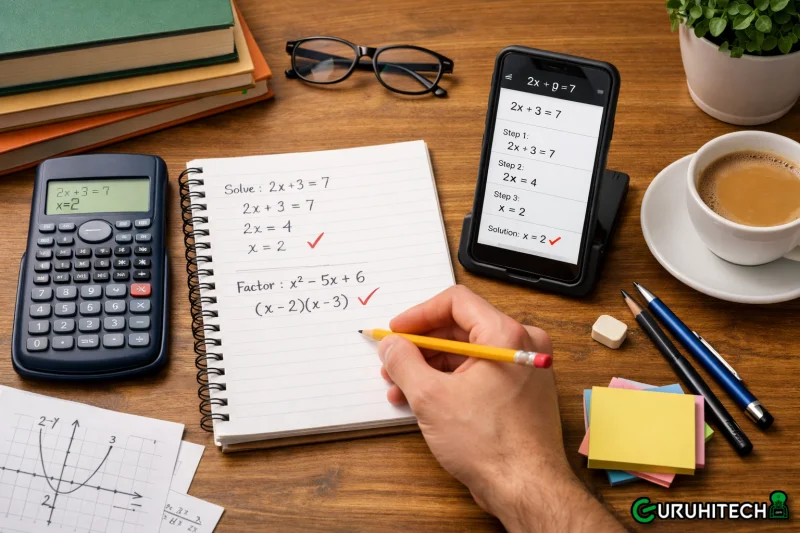
I’m going to be honest with you — the first time I used an AI math solver, I felt guilty. Like I was doing something wrong. I had this little voice in the back of my head telling me I was taking a shortcut, that I wasn’t really learning, that I was basically letting a robot do my homework for me.
But here’s the thing. I wasn’t copying answers. I was checking my own work. And once I figured out the difference between those two things, my relationship with math completely changed.
Let me explain how I got here and why I think more students should be using AI math solvers the right way — as a learning tool, not a cheat code.
It Started with a Failing Grade in Calculus
Last year, I nearly failed Calculus II. Not because I wasn’t trying. I was spending three or four hours every night on problem sets. I’d grind through integrals, double-check my steps, turn in my homework feeling pretty confident — and then get it back covered in red marks.
The frustrating part? I couldn’t always figure out where I went wrong. My professor’s feedback was usually just a circled number with “incorrect” written next to it. No explanation. No breakdown of where my logic fell apart.
I’d stare at my work and think, “But this looks right to me.” And that was the problem. When you make the same type of mistake over and over, you can’t see it anymore. You need a second set of eyes.
That’s when a friend told me about AI math solvers. She wasn’t using them to skip the work. She was using them to understand her mistakes after she’d already attempted the problems herself.
I decided to try the same approach.
My Rule: Solve First, Check Second
I set one rule for myself from the very beginning. I would never — and I mean never — look at the AI’s solution before I attempted the problem on my own. That was my line in the sand.
Here’s what my process looks like. I sit down with my textbook or assignment, and I work through every problem by hand. I show all my steps. I write out every single line of reasoning, even when it feels tedious. Then, once I’ve finished the entire assignment, I open up an AI math solver and enter the same problems one by one.
But I’m not looking for just the final answer. I’m comparing the steps. I want to see where my approach matches the AI’s approach and, more importantly, where it doesn’t.
This is the part that actually teaches you something. When I see that the AI took a completely different path to the solution, I stop and ask myself why. Sometimes my method was valid — just different. Other times, I realize I was overcomplicating things or missing a shortcut that would’ve saved me ten minutes.
And when my final answer doesn’t match? That’s when the real learning happens. I go back through my handwritten work, line by line, and hunt for the exact moment I went off track. Usually it’s something small — a sign error, a forgotten constant, a place where I applied the wrong rule. But those small mistakes are the ones that cost you points on exams if you never catch them.
Why This Isn’t Cheating
I know some people will read this and think, “You’re still using AI to get the answers.” But I’d push back on that.
Think about it this way. When you finish a set of practice problems and then flip to the answer key in the back of the textbook, is that cheating? Of course not. You’re verifying your work. You’re using a reference to make sure you’re on the right track.
An AI math solver does the same thing, except it’s better, an answer key gives you a number, an AI solver gives you a full breakdown of every step. It shows you the reasoning behind the solution, not just the destination.
The difference between cheating and learning comes down to when you look. If you pull up the solver before you’ve even picked up your pencil, you’re copying. If you pull it up after you’ve spent twenty minutes wrestling with the problem, you’re studying.
I think of it like having a tutor available at two in the morning. Because let’s be real — that’s usually when I’m doing my homework, and my professor definitely isn’t answering emails at that hour.
The Tools I Actually Use
I’ve tried a handful of different AI math solvers over the past year. Some are better than others. For straightforward algebra and calculus problems, most of them do a decent job. But when you get into multi-step problems or anything with a lot of setup — like related rates or series convergence — the quality of the step-by-step explanations starts to vary a lot.
One tool I’ve been using lately is Calculatex, which I like because the step breakdowns feel more detailed than some of the other options I’ve tried. It doesn’t just spit out an answer. It walks through the logic in a way that actually mirrors how I’d want a tutor to explain it. That’s been helpful for identifying exactly where my reasoning goes sideways.
But honestly, the specific tool matters less than the habit. Whatever solver you use, the value comes from how you use it — not from the software itself.
What I’ve Actually Learned From This Process
Here’s something I didn’t expect. After a few weeks of checking my work this way, I started making fewer mistakes. Not because I was memorizing solutions, but because I was finally building awareness of my own weak spots.
For example, I discovered that I almost always mess up when I’m integrating by parts. Specifically, I keep choosing the wrong function for “u” in the formula. I’d been making that same mistake for weeks without realizing it. But once I saw the AI consistently choosing a different setup — and getting the right answer — I understood what I was doing wrong. I adjusted, and my accuracy improved almost immediately.
I also noticed patterns in my arithmetic errors. I tend to drop negative signs when I’m working fast. It sounds minor, but in calculus, one wrong sign can cascade through an entire solution and give you an answer that’s completely off. Now I know to slow down and double-check those transitions, because that’s where my mistakes hide.
This kind of self-awareness is something I never got from just looking at an answer key. An answer key tells you that you’re wrong. An AI solver shows you why you’re wrong. That’s a meaningful difference.
How My Grades Actually Changed
I’m not going to pretend this was some overnight transformation. It took a few weeks for the habit to really click. But by midterms, my calculus grade had gone from a D+ to a solid B. By the end of the semester, I pulled it up to a B+.
More than the grade, though, I felt different walking into exams. I wasn’t anxious. I wasn’t guessing. I actually trusted my own process because I’d spent the entire semester stress-testing my work against an AI and fixing my blind spots in real time.
A Few Ground Rules if You Want to Try This
If you’re thinking about using an AI math solver the way I do, here are a few things I’d suggest.
Always do the work first. No exceptions. The moment you start looking at solutions before you attempt the problem, you lose the entire benefit. Your brain needs to struggle with the material before it can learn from the feedback.
Compare the steps, not just the answers. Getting the same final number as the AI doesn’t mean your method was correct. You might have made two errors that happened to cancel each other out. Look at the process.
Keep a running list of your common mistakes. I started a simple note on my phone where I write down every recurring error I catch. Things like “dropped the negative sign in step 3” or “forgot the chain rule on the outer function.” Before every exam, I read through that list. It’s like a cheat sheet for my own brain — except it’s the opposite of cheating because it’s built entirely from my own mistakes.
Don’t rely on any single tool. AI math solvers are good, but they’re not perfect. I’ve seen tools like Calculatex and others occasionally stumble on unusual problem formats or give explanations that skip a step. Always use your own judgment as the final filter.
The Bigger Picture
I think we’re at this weird moment where a lot of students feel like they have to choose between using AI and being honest. But it doesn’t have to be one or the other. The technology exists. It’s not going away. The question isn’t whether you use it — it’s how.
For me, using an AI math solver to check my work has made me a better math student. Not because it does the thinking for me, but because it forces me to confront the gaps in my own thinking. And once you see those gaps clearly, you can actually fill them in.
That’s not cheating. That’s just learning with better tools.
Ti potrebbe interessare:
Segui guruhitech su:
- Google News: bit.ly/gurugooglenews
- Telegram: t.me/guruhitech
- Facebook: facebook.com/guruhitechfb
- Instagram: instagram.com/guruhitech_official/
- X (Twitter): x.com/guruhitech1
- Bluesky: bsky.app/profile/guruhitech.bsky.social
- Rumble: rumble.com/user/guruhitech
- VKontakte: vk.com/guruhitech
- MeWe: mewe.com/i/guruhitech
- Skype: live:.cid.d4cf3836b772da8a
- WhatsApp: bit.ly/whatsappguruhitech
Esprimi il tuo parere!
Ti è stato utile questo articolo? Lascia un commento nell’apposita sezione che trovi più in basso e se ti va, iscriviti alla newsletter.
Per qualsiasi domanda, informazione o assistenza nel mondo della tecnologia, puoi inviare una email all’indirizzo [email protected].
Scopri di più da GuruHiTech
Abbonati per ricevere gli ultimi articoli inviati alla tua e-mail.