
Rewriting the Workflow: How Writers Are Using AI to Rethink Research and Productivity
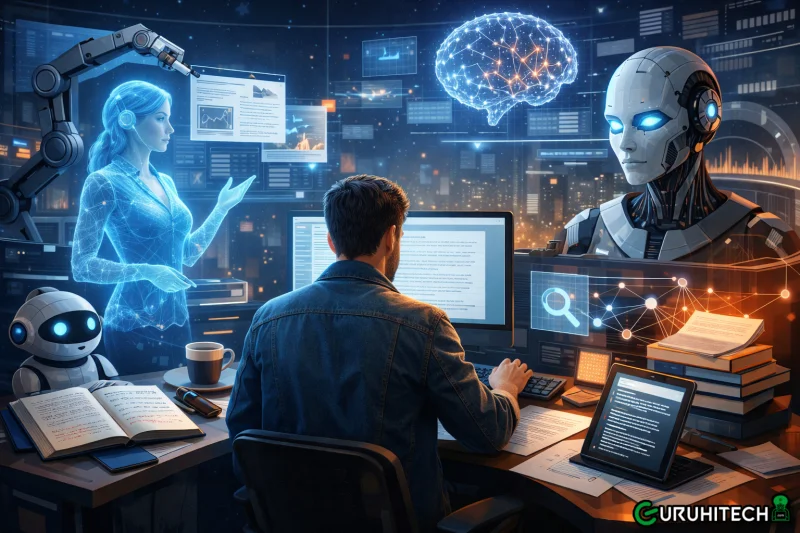
There’s a quiet shift happening in how writers work—not in what they write, but in how they structure their process.
For a long time, writing was framed as a largely linear activity. You research, take notes, draft, revise, and eventually produce something coherent. The tools were relatively simple: a browser, a word processor, maybe a citation manager if you were working academically. Everything else lived in your head, your bookmarks, or scattered across documents.
Today, that workflow is being reassembled.
Writers are increasingly building AI-assisted systems that sit on top of their thinking process—tools that don’t just help them write faster, but help them think, organize, and retrieve information differently. The shift is less about replacing writing and more about restructuring cognitive labor.
At the center of this transformation is a new category of software: AI-powered research and knowledge tools.
Tools like Notion AI, Obsidian, and NotebookLM are not simply note-taking apps anymore. They are becoming interactive thinking environments.
Take NotebookLM as an example. Instead of manually skimming through PDFs or articles, writers can upload a set of sources and interact with them conversationally. The software can summarize arguments, highlight connections, and even answer questions grounded in the uploaded material. This changes the nature of research from a passive reading process into an active dialogue with sources.
The implications are subtle but important.
Rather than spending hours locating relevant paragraphs or reconstructing arguments across multiple tabs, writers can quickly surface the structure of an idea. This allows more time to be spent on interpretation, critique, and synthesis—the parts of writing that are harder to automate.
At the same time, tools like Obsidian are being used to build long-term knowledge systems. Writers are no longer just collecting notes for a single project; they are creating interconnected databases of ideas that persist across projects. With plugins and AI integrations, these systems can suggest links between concepts, surface previously forgotten notes, and help writers revisit earlier thinking in new contexts.
This creates a different kind of workflow—one that is non-linear and cumulative.
Instead of starting from scratch each time, writers are working within an evolving network of ideas. A concept explored months ago can reappear in a new piece, not because the writer remembered it, but because the system made it visible again.
Then there are tools like Grammarly and ChatGPT, which operate closer to the drafting stage. These tools help refine language, suggest structure, or generate initial drafts. While they are often discussed in terms of efficiency, their real impact lies in how they lower the friction of starting.
Writers often struggle most at the beginning—translating abstract thoughts into concrete sentences. AI tools can provide a starting point, allowing writers to move quickly into editing and refining, which many find cognitively easier than generating from scratch.
What emerges from all of this is a workflow that looks something like this:
Research is assisted by AI tools that summarize and organize information. Notes are stored in interconnected systems that evolve over time. Drafts are generated or scaffolded with the help of language models. Revisions are accelerated through automated feedback. And throughout the process, the writer moves between tools, each handling a different layer of the task.
Importantly, this does not mean that writing becomes effortless.
If anything, the cognitive demands shift.
Writers are now required to make decisions about which tools to use, how to structure their systems, and how to evaluate AI-generated outputs. The role of the writer becomes less about producing text line by line and more about orchestrating a process.
There is also a growing awareness of the limitations of these tools. AI-generated summaries can miss nuance. Automated suggestions can introduce subtle inaccuracies or flatten complex arguments. Over-reliance on these systems can lead to a kind of homogenization, where different pieces of writing begin to sound similar.
As a result, experienced writers are developing hybrid workflows.
They use AI for speed and organization, but rely on their own judgment for interpretation and voice. They might use NotebookLM to quickly map out a set of sources, then switch to a more manual process when crafting arguments. Or they might generate a rough draft with an AI model, only to significantly rewrite it to align with their intended tone and perspective. Some also integrate multiple AI into one agent and optimize their schedule needed for tasks like college online course or remaining in a tight publication schedule for their books.
The goal is not to outsource thinking, but to reallocate attention.
Tasks that are repetitive or time-consuming—summarizing, formatting, basic editing—can be delegated to software. Tasks that require originality, critical thinking, and stylistic nuance remain firmly in the writer’s domain.
This reallocation has practical implications for scheduling as well.
Writers who adopt these workflows often find that they can compress certain stages of the writing process. Research that might have taken several days can be completed in a few hours. Drafting becomes less daunting, which reduces procrastination. Revision cycles become more targeted, focusing on higher-level issues rather than surface-level corrections.
This doesn’t necessarily mean working less. But it does mean working differently.
Time is no longer spent evenly across all stages. Instead, it is concentrated where it matters most.
There is also a broader cultural shift underlying these changes. Writing is increasingly seen not just as an individual act, but as a system-supported activity. The romantic image of the solitary writer is giving way to a more pragmatic understanding: that good writing can emerge from well-designed workflows as much as from bursts of inspiration.
For newer writers, this lowers the barrier to entry. For experienced writers, it opens up possibilities for scaling output without sacrificing quality—at least in theory.
The challenge, moving forward, will be learning how to use these tools without becoming dependent on them.
The most effective workflows are not those that automate everything, but those that strike a balance—leveraging AI where it adds value, while preserving the elements of writing that make it distinctly human.
In the end, AI is not replacing writers. It is changing the conditions under which writing happens.
And for those willing to rethink their process, that change can be both practical and creatively generative.
Scopri di più da GuruHiTech
Abbonati per ricevere gli ultimi articoli inviati alla tua e-mail.