

The Hidden Technology Behind a Spoonful of Mayonnaise
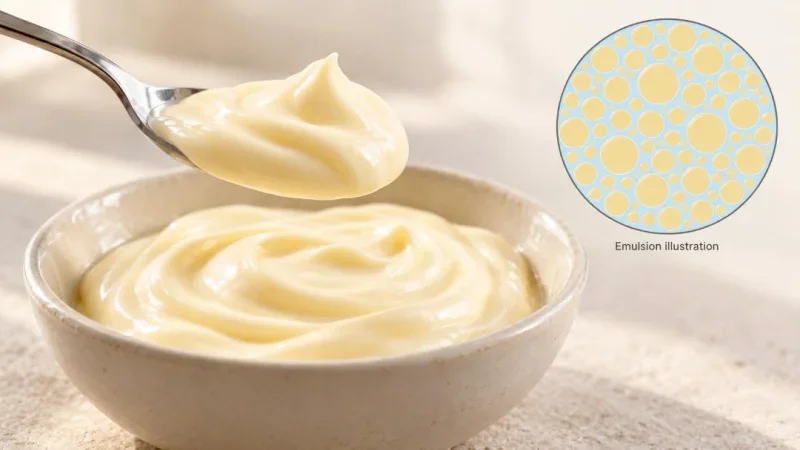
Draw a spoon through mayonnaise and it leaves a smooth little ridge. Spread it across bread and that ridge gives way easily. Add a spoonful to a sandwich filling and it brings the ingredients together with a familiar creamy texture.
These are ordinary kitchen moments, but they reveal something rather interesting about food technology. Mayonnaise gets much of its character from the way its ingredients are arranged, not just from the ingredients themselves.
Behind that glossy appearance is a microscopic structure. Behind the structure is a carefully managed mixing process. And inside the factory, equipment turns that process into something manufacturers can repeat across batches.
A spoonful of mayonnaise is a surprisingly good place to start exploring how food science becomes everyday experience.
The Tiny Droplets Behind the Creamy Texture
Mayonnaise is an oil-in-water emulsion. That means small oil droplets are dispersed throughout a water-based phase, which includes water from ingredients such as vinegar and egg.
The name can feel counterintuitive because oil may make up a large share of the recipe. Yet “oil-in-water” describes how the ingredients are arranged, rather than which ingredient occupies the most space. The oil forms droplets; the surrounding water-based phase remains continuous.
Egg yolk contributes emulsifying substances, including lecithin and proteins, that help stabilize the boundary between oil and water. This allows the mixture to develop into a uniform sauce rather than remain two separate liquids.
That structure helps explain why mayonnaise behaves so differently from its starting ingredients. Pourable oil becomes part of something that can hold a soft peak on a spoon. When spread, the sauce flows under the movement of a knife, making it easy to distribute across a surface.
Food technologists can shape that experience through both formulation and processing. The amount of oil, the emulsifying ingredients, and the size and distribution of droplets all contribute to the finished texture. Reduced-fat recipes may also use ingredients such as starches or gums to help develop body and mouthfeel.
So “creamy” is more than a descriptive word on a label. It is a physical quality that manufacturers can study, measure, and develop.
What Happens Inside an Industrial Mixer
A kitchen whisk and an industrial emulsifier share a broad purpose: they help distribute one ingredient through another. Industrial equipment gives manufacturers much more control over how that happens.
One common technology is the rotor–stator mixer. The rotor is a rotating component, while the stator stays fixed around it. As material passes through this mixing head, it experiences intense local forces that help break oil into smaller droplets and distribute them through the mixture.
This action is known as high-shear mixing. It is different from simply moving the contents around a tank. A slower agitator can keep the bulk mixture circulating, while the high-shear head performs the more concentrated work of emulsification.
The timing of ingredient addition matters too. In a typical process, the water-based ingredients are prepared before oil is introduced at a controlled rate. Depending on the recipe, powders may need time and suitable mixing conditions to disperse and hydrate.
As oil becomes incorporated, the mixture develops body. Material may circulate through the equipment so that the batch receives the intended processing treatment.
There is something satisfying about this transition: ingredients enter as separate materials, and the mixing process gives them a new collective texture. The equipment is doing more than combining a recipe. It is helping build the product’s structure.
The production settings are chosen for that structure. The aim is an appropriate balance of mixing intensity, time, and ingredient flow—not simply the highest available speed.
Two Ways to Build the Mixing System
Once the mixing action is understood, the next question becomes practical: how should ingredients travel through the equipment?
One approach connects separate components. A feed hopper or preparation tank supplies material to an inline emulsifying unit through pipework. Other components can be selected around it to suit the production process.
This modular arrangement gives manufacturers room to build around existing equipment or develop a line in stages. The components remain distinct, making their individual roles easy to see.
Another approach brings the main vessel and emulsifying equipment together in an integrated system. Depending on its configuration, the unit can combine circulation, vacuum operation, and centralized controls within a compact arrangement.
Vacuum processing is particularly interesting. It can help manage air incorporated during production, giving manufacturers another way to influence the condition of the mixture. It is a processing tool, not a substitute for recipe development or food-safety controls.
A mayonnaise mixer machine can therefore take different forms, from an inline configuration connected to separate feeding equipment to an integrated vacuum emulsifying system. Each arrangement offers a different way to organize material flow, equipment space, and operator involvement.
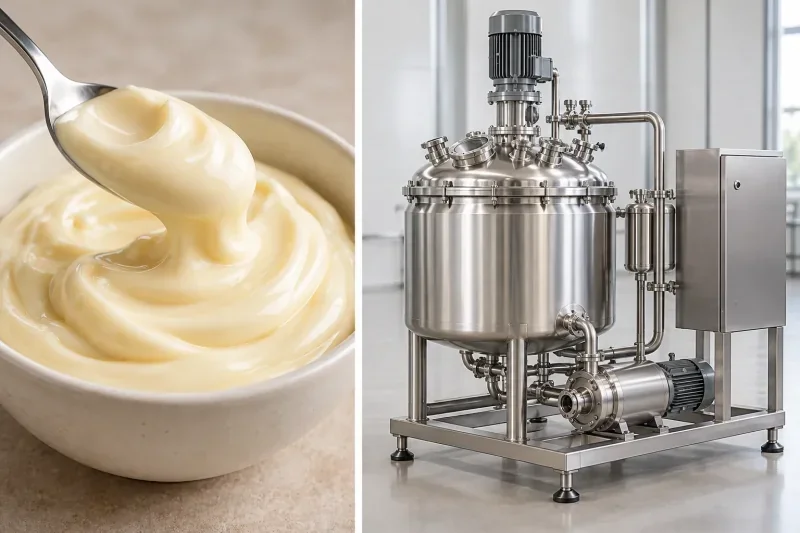
Both belong to the same broader technology story. The mixing head creates the local conditions needed for emulsification; the surrounding system determines how the ingredients reach it and how the batch moves through production.
Giving a Recipe Its Own Production Settings
A recipe tells us what goes into mayonnaise. A manufacturing process also describes how those ingredients are treated.
That includes the sequence of addition, the rate of oil intake, the duration of mixing, and the operating conditions used during emulsification. Together, these settings connect a written formula to the texture that eventually reaches the jar.
Consider a producer developing two sauces with different textures. One might be intended for easy spreading, while another is designed for a different serving application. The development work involves deciding what each product should feel like, then selecting a formulation and process that produce that result.
Control systems help make those choices usable on the factory floor. A programmable controller can coordinate supported equipment functions and allow operators to set relevant parameters. The exact level of automation depends on the machine and its configuration.
Salinovate offers both inline and integrated vacuum emulsifying configurations for industrial mayonnaise production, giving manufacturers options for matching the mixing arrangement to their production needs.
The wider point is that a factory recipe has two connected parts: its ingredients and its processing instructions. Capturing both helps turn a successful trial into a repeatable production method.
This also makes equipment trials valuable. Testing a proposed recipe on suitable machinery lets the development team examine the resulting texture and refine its settings before committing to the full production approach.
A Familiar Food, Seen Differently
Digital tools add another layer to this work. Some equipment developers use modeling to investigate how recipe and processing choices relate to qualities such as droplet size and texture.
These tools can help narrow the range of conditions worth testing. Physical trials still have an important role, especially when confirming how a particular formulation behaves on the selected equipment.
It is a useful example of computation meeting something tangible. The output is not merely a graph or a set of parameters. It is a sauce that spreads, pours, or holds its shape in a particular way.
For technology readers, that connection makes food manufacturing worth a closer look. Much of its engineering operates below the level we normally notice: inside a mixing head, within a circulation loop, or among droplets too small to distinguish by eye.
Then it becomes visible in the simplest possible form—a smooth surface in an open jar, or the soft ridge left by a spoon.
What looks like a familiar condiment is also a carefully developed material. Its everyday appeal comes from ingredients, microscopic structure, and production technology working together.
Ti potrebbe interessare:
Segui guruhitech su:
- Google News: bit.ly/gurugooglenews
- Telegram: t.me/guruhitech
- Facebook: facebook.com/guruhitechfb
- X (Twitter): x.com/guruhitech1
- Bluesky: bsky.app/profile/guruhitech.bsky.social
- Rumble: rumble.com/user/guruhitech
- VKontakte: vk.com/guruhitech
- MeWe: mewe.com/i/guruhitech
- Skype: live:.cid.d4cf3836b772da8a
- WhatsApp: bit.ly/whatsappguruhitech
Esprimi il tuo parere!
Ti è stato utile questo articolo? Lascia un commento nell’apposita sezione che trovi più in basso e se ti va, iscriviti alla newsletter.
Per qualsiasi domanda, informazione o assistenza nel mondo della tecnologia, puoi inviare una email all’indirizzo [email protected].
Scopri di più da GuruHiTech
Abbonati per ricevere gli ultimi articoli inviati alla tua e-mail.