
The Technical Docs Are in Another Language. Now What?
You know the feeling.
You’re building something. A new product, a new integration, a new system. You’ve done the research, found the perfect component, identified the ideal partner. Then they send the documentation.
And it’s in a language you don’t speak.
Maybe it’s German technical specs for a precision part, maybe it’s French research papers with data you need, maybe it’s Amharic documentation from an Ethiopian manufacturer who makes exactly what you’re looking for, maybe it’s Portuguese API docs from a dev shop in Brazil.
The information is right there. You can see it. You just can’t read it.
This Happens More Than Anyone Talks About
The tech world is global. We source from everywhere, collaborate with everyone, learn from all over. But the documentation doesn’t magically appear in English just because that’s what you speak.
German engineering firms document in German. French research labs publish in French. Ethiopian manufacturers write specs in Amharic. Brazilian developers comment code in Portuguese. Japanese hardware companies write manuals in Japanese.
If you’re waiting for everything to be translated into English before you can use it, you’re waiting forever. And you’re missing out.
What’s Actually in Those Documents
Let’s be specific about what you lose when you can’t read a technical PDF:
Spec sheets. The exact measurements, the tolerances, the materials, the performance data, the stuff that tells you whether a component will work in your design or fail catastrophically.
API documentation. The endpoints, the parameters, the response formats, the error codes, the stuff your developers need to actually make two systems talk to each other.
Research papers. The methodology, the raw data, the statistical analysis, the conclusions, the stuff that could save you months of reinventing wheels.
Safety information. The warnings, the precautions, the proper usage, the stuff that keeps people from getting hurt and keeps you from getting sued.
Compliance docs. The certifications, the test results, the standards, the stuff that keeps your product legal to sell.
Every single one of these matters. Every single one is useless if you can’t read it.
The Workarounds Are All Bad
So what do people do when they hit this wall?
Some copy and paste paragraphs into Google Translate, one by one, losing their minds and the document formatting simultaneously. This works for about two paragraphs. Then you want to throw your laptop out a window.
Some email a friend who speaks the language and hope they’re not too busy with their own life. This works if you have that friend and they owe you a favor. It doesn’t scale.
Some just… guess. They skim the document for numbers and diagrams and hope the important stuff isn’t in the words. This works until it doesn’t. And when it doesn’t, it fails spectacularly.
Some give up and find a different source. This works if another source exists. Sometimes it doesn’t.
What Actually Works
Here’s what should happen instead.
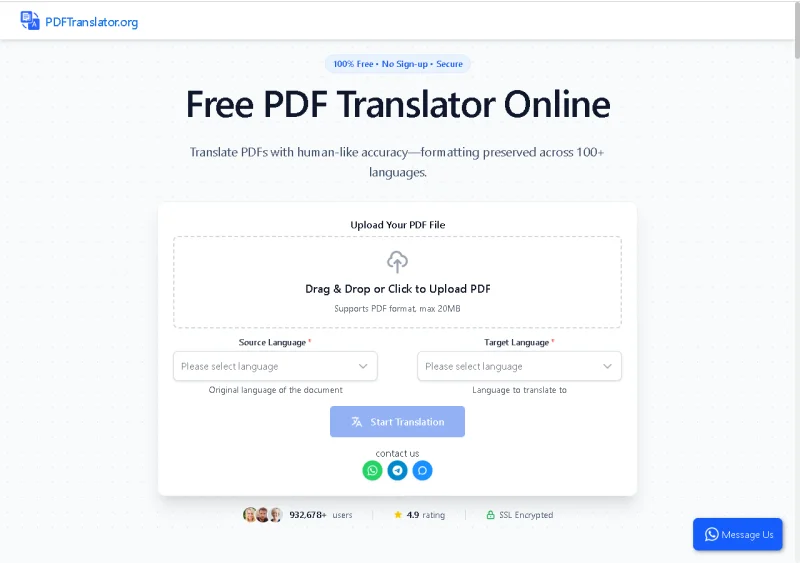
You get that German spec sheet, you open a website, you drag the file in, you tell it you need English, you wait maybe two minutes.
Then you have a new file. It’s the same document—same tables, same diagrams, same formatting. But every word is now in English. The spec sheet still looks like a spec sheet, the data still lines up, the technical terms are translated correctly, not literally.
You read it, you understand it, you make your decision, you move on.
That’s it. That’s the whole interaction. No drama, no frustration, no hours lost to manual typing. Just the information you needed, finally in a form you can actually use.
Why Technical Translation Is Different
Translating a novel is one thing. The words matter, but the formatting is just paragraphs.
Translating a technical document is something else entirely. The layout is part of the meaning. A table with misaligned columns is useless. A diagram with floating labels is nonsense. Code snippets that get reformatted wrong can break everything.
A proper translate pdf document to english tool for technical work understands this. It preserves the structure. The tables stay tables, the diagrams keep their labels in the right places, the code blocks stay code blocks.
And when you’re dealing with non-Latin scripts—like when you need to translate english to amharic pdf for a partner in Ethiopia—it handles those characters properly. The text flows right, the layout holds, the document looks professional.
The Languages That Get Ignored
Most translation tools focus on the big ones: English, Spanish, French, German. They work fine for those.
But what about Amharic? What about Bengali? What about Tamil, Swahili, Urdu, Persian?
These languages get ignored by most tools. The assumption is that if you’re reading a language with millions of speakers, you’ll find a way. But those speakers deserve access to information too. And the people trying to work with them deserve to read their documents.
A tool that actually supports rare languages isn’t a nice-to-have. It’s the difference between being able to work with Ethiopian manufacturers or not. Between reading that Bengali research paper or not. Between understanding the Amharic documentation or guessing.
The Cost of Not Translating
Here’s something people don’t calculate: not translating has a cost too.
Every time you skip a foreign-language source, you make decisions with incomplete information, every time you guess at a spec sheet, you risk a costly mistake. Every time you ignore an international collaboration because of language, you leave money on the table.
The cost of a bad translation is obvious. The cost of no translation is hidden—until something fails.
What Changes When Translation Is Easy
When language stops being a barrier, everything changes.
You find components from anywhere, you collaborate with anyone, you read research from every lab, you integrate with every API, you learn from every source.
None of this requires expensive services or weeks of waiting. It just requires a tool that actually works for technical documents.
No Strings Attached
Here’s the thing about tools like this: they should just work. No sign-up, no email required, no credit card, no spam later, no tracking, no data harvesting.
You upload a file. It translates. You download it. An hour later, your file is permanently deleted from their servers. That’s it.
When you’re dealing with proprietary specs, confidential research, or sensitive documentation, this matters.
When It Actually Counts
Most days, you’ll work in your own language and never think about translation. But then a project comes along that changes everything.
A component from a manufacturer you’ve never used, a collaboration with a team in another country, a research paper that could unlock your next product, a technical standard you need to comply with.
In that moment, the language the information is in shouldn’t matter. The information itself should matter.
And you shouldn’t have to jump through hoops to get to it.
Scopri di più da GuruHiTech
Abbonati per ricevere gli ultimi articoli inviati alla tua e-mail.