
What Are Facets in Diamonds and Their Importance
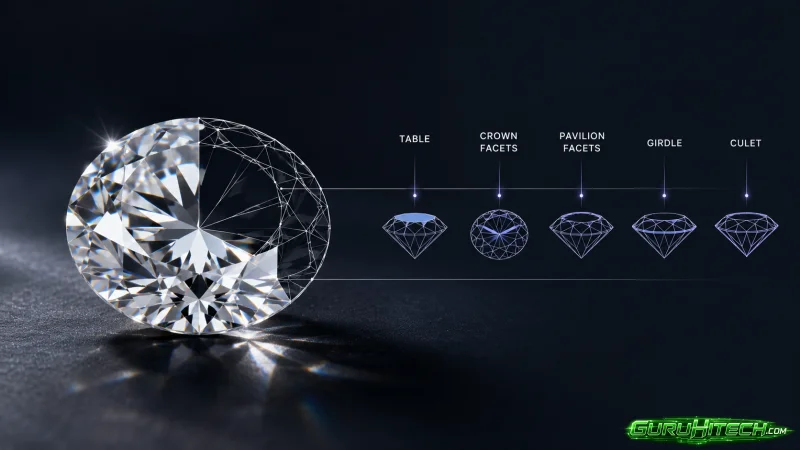
Lab diamond facets are one significant reason for sparkle and brilliance. Some shines with constant flashes whole some looks dull and lifeless. Many buyers need pay more attentions to diamond facets and precise cut in addition to carat size, clarity and color. Sophisticated cuts come to the top priority among lab diamonds engineered by lab grown diamond manufacturers for ongoing evolution of technology.
What Are Facets in Diamonds?
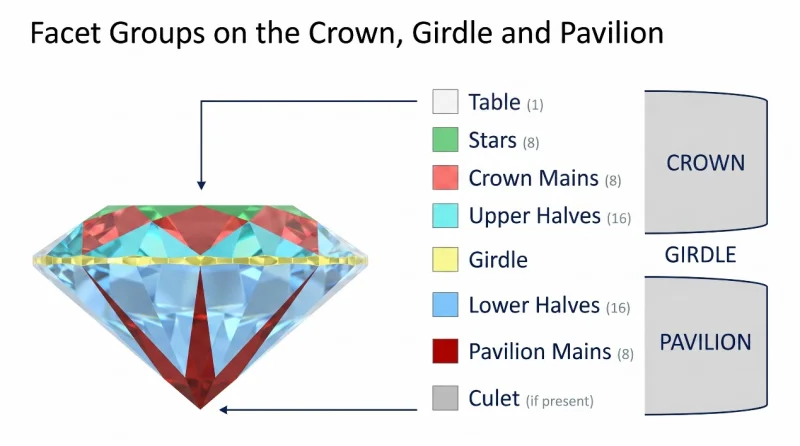
Diamond facets refer to flat and small polished surfaces cut onto diamond rough in cutting and polishing phases. They cover two main sections of diamonds – the crown and pavilion. The crown refers to the upper half above the girdle as its name suggests; the pavilion means the lower part below the girdle. All mirror-like facets are cut to capture and disperse incoming white light, bouncing focused radiance upward through the top table. Regular cuts feature a fixed or adjustable number of geometric facets, which go through precise design and engineering to maximize diamond sparkle and brilliance. For instance, classic round brilliance cut features 57 or 58 facets in typical.
Essential Factors Influencing Diamond Light Performance
Factors like facet geometry, alignment, symmetry, polish quality, length-width ratio, table percentage and pavilion depth determine light performance of a lab grown diamond jointly. Facet symmetry overweighs others in light performance optimization. Perfect symmetry guarantees even internal light reflection across the full expanse of diamonds while preventing light leakage and uniform brightness. The secondary key factor is flawless polished surfaces for fear of light scattering and blurry output.
Correlation Between Facet Symmetry and Light Return
The design intent behind scientifically engineered symmetric facets is to ensure even outbound light reflection and crisp consistent sparkle with vibrant fire. Otherwise, light may escape without even alignment from the base or sides of lab diamonds. Gemologists review symmetrical proportions through following four steps:
- Make sure a centered table without offset or deviation from the diamond’s vertical central axis;
- Confirm the culet align with the top central facet vertically;
- All paired opposing facets share same dimensions’
- Examine the full girdle perimeter in consistent thickness or not.
Poor symmetry ruins overall visual appeal of a diamond featuring dozens of facets with exquisite finishing looks. It imposes a negative effect on cut grading greatly in loose lab grown diamonds wholesale.
How Facet Geometry and Alignment Impact Visual Appeal?
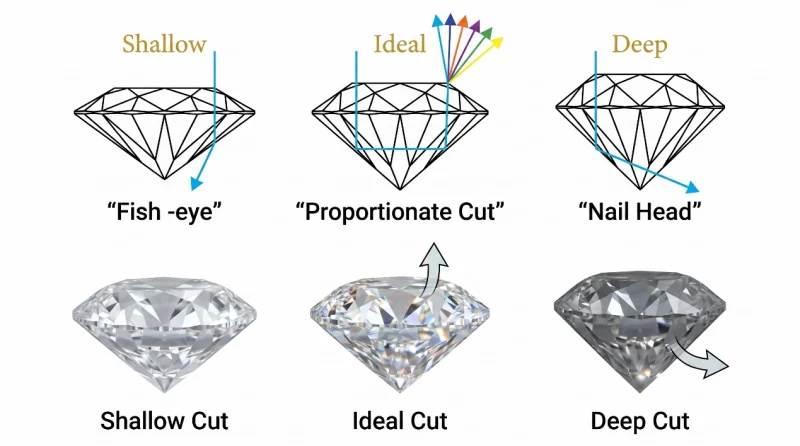
Facet geometry focuses on precise cut angles onto each planar facet with reference to table and gridle of a diamond. Crown and pavilion angle govern light retention effects. Over-shallow pavilion cut permits straight light transmission through diamond bottom; extreme-deep pavilion cut traps light inside the crystal rather than reflect back to viewers. Facet alignment works in tandem with geometry to keep consistent light pathways. Both perfect facet geometry and correct alignment aim at creating a closed light loop inside a diamond for maximum and uniform light return.
How Facets Shape Cut Grade of a Diamond?
Cut grading is closely related to facet quality. A scale from Excellent down to Poor is used to assess facet quality, involving multi-dimensional assessment of facet precision, symmetry, polish and proportions.
| Cut Grade | Core Facet Characteristics | Optical Performance |
| Excellent | Flawless proportion & symmetrical facets | Peak brilliance, fire, and sparkle |
| Very Good / Good | Minor facet imperfections and slight proportion deviations | Solid & consistent light performance |
| Fair / Poor | Uneven, misaligned faceting with significant proportion errors | Significant light leakage, overall dull appearance |
Cut grade is one direct determinant of diamonds’ market value. Prices of Excellent-cut lab diamonds are far higher than those of Poor-cut lab diamonds even though they are identical in carat, color and clarity.
Diamond Facet Varieties
Diamond facets are classified into Crown, Pavilion, Girdle and Culet facets according to their different structural position and optical function.
Crown facets refer to those above the girdle, including the largest top facet, star facets and kite facets. They absorb light from surroundings and steer them deep into the interior of diamonds. On the contrary, pavilion facets, those below the girdle, act as internal reflective zone of diamonds. Main pavilion facets extending from girdle to culet and lower gridle facets are designed to bounce trapped-in light backward to viewers for visible sparkle.
Girdle facets are those along the thin outer boundary where crown joins the pavilion. They function as protective structure for fear of unexpected chipping in setting and daily wear. Consistent girdle thickness serves as a powerful proof of uniform facet proportions. Culet is the tiny bottom tip and an oversized culet looks like a dark spot seen from the top table.
Are More Facets Equal to Better Diamonds?
It is a prevalent fallacy that more facets equal a better diamond. Over 100 uneven and misaligned facets deliver less sparkle than those with standard facets with flawless symmetry and geometric proportions. Fewer and larger step-cut facets of emerald and Asscher diamonds emit subtle and elegant flashes of light; intense scattered scintillation of round brilliant cut derives from light reflection within dozens of small facets. Disparities in facet quantity exist to complement innate geometric profile of each cut. Varying facet counts are not the sole factor elevating light performance, which is determined by precision, symmetry and polish in combination.
Tips to Choosing Suitable Facet Cuts
Read following guide for starters to choose a suitable facet and cut style matching up to individual aesthetics, lifestyles and even budgets. The top priority lies in excellent-cut grade written on IGI or GIA certificates for maximized sparkle. Fewer and larger step-cut Asscher or emerald lab diamonds stand out as a top pick for buyers whole prefer vintage and subtle elegance.
Recommend cushion, radiant and oval cuts for those who seek a balanced combination of uniqueness and brilliance. Round brilliant facets are suitable for daily wear due to chipping-resistant properties. Non-3EX round cuts deliver better value for money than perfect round brilliants if you are shopping on a tight budget.
Facet quality shapes how light channel deep into the interior of diamonds and reflect them out, delivering corresponding brilliance, fire and scintillation. Prioritize symmetrical and geometrical facets rather than carat or facet quantity alone in lab grown diamond jewelry wholesale. Professional lab grown diamond suppliers guarantee quality of lab diamonds to a great extent.
Scopri di più da GuruHiTech
Abbonati per ricevere gli ultimi articoli inviati alla tua e-mail.