
Why Text-to-Video AI Is Becoming Essential for Modern Content Teams
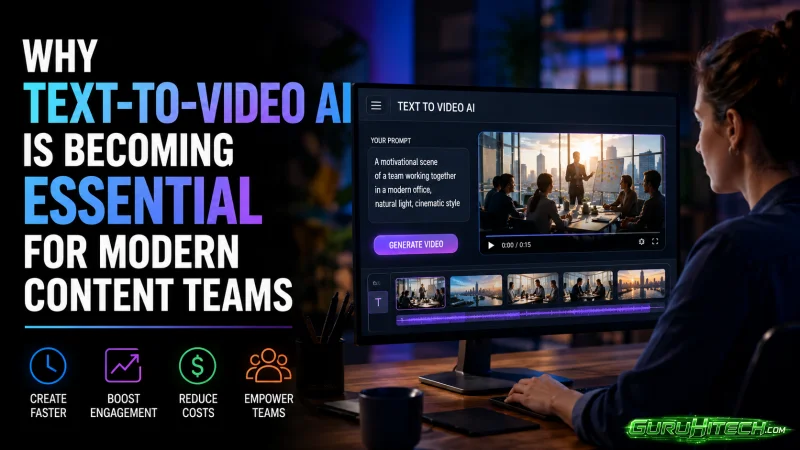
Content teams are under pressure to publish more video across more channels without sacrificing quality. A single campaign may require a product explainer, a vertical social clip, a short educational sequence, a sales presentation, and several localized variations. Traditional production still plays an important role, especially for flagship brand work, but it is often too slow and expensive for the full volume of everyday communication. Text-to-video systems are filling that gap by turning written concepts into visual starting points that teams can refine.
The value of this workflow is not that it removes creative professionals. Its real advantage is that it reduces the distance between an idea and something people can watch. A strategist can describe a scene in plain language, generate an early version, and discuss a concrete visual with designers and editors. That is more productive than debating an abstract brief. Even an imperfect draft can expose problems with pacing, tone, or structure before a team spends time on final assets.
Faster Prototypes Lead to Better Decisions
Creative work often slows down because stakeholders imagine different outcomes from the same words. One person reads “energetic” and expects rapid cuts, while another imagines bold color and sweeping camera movement. A video prototype makes those interpretations visible. Teams can compare alternatives, identify the strongest opening, and agree on the direction while changes are still inexpensive.
This is where text to video AI becomes especially useful for marketers, founders, educators, and agencies. A concise description can establish the subject, setting, mood, and movement of a scene. Users can then revise the prompt to test different approaches. The process encourages teams to treat the first generation as a sketch rather than a finished product, which leads to more thoughtful experimentation and fewer unrealistic expectations.
Prototyping also improves planning for conventional shoots. A generated sequence can function as a moving storyboard that shows approximate framing and transitions. Directors can use it to communicate ideas to camera crews, set designers, and clients. It does not need to be photorealistic to be valuable. Its purpose is to make intention visible and help everyone arrive at production with a shared understanding.
One Core Idea Can Support Many Formats
Modern campaigns rarely live in a single aspect ratio. A landscape video designed for a website must often become a vertical social clip and a square feed post. Text-to-video tools can help creators explore format-specific compositions early. The vertical version may need a closer subject, larger text-safe areas, and a faster opening, while the landscape version can use environmental detail and slower camera movement.
The same principle applies to audience segments. A software company might present one product feature as a practical time-saver for small businesses, a collaboration tool for agencies, and a reporting solution for enterprise teams. Each version can use different visual examples while preserving the same underlying message. Generative workflows make these variations more feasible, but a clear campaign strategy is still necessary to prevent the content from becoming fragmented.
Strong Prompts Begin With Strong Briefs
A weak brief cannot be rescued by a sophisticated model. Before generating anything, teams should define the audience, communication goal, key message, and desired action. They should also decide what the viewer must understand in the first few seconds. These decisions provide the foundation for useful prompts and make it easier to judge whether an output is successful.
An effective scene prompt generally includes five elements: the subject, the action, the environment, the camera behavior, and the visual mood. For example, asking for “a modern workspace” leaves too much open to interpretation. Describing a product designer reviewing a prototype in a quiet studio, with a slow sideward camera move and soft morning light, gives the system a clearer target. Constraints such as brand colors, minimal background activity, or a locked camera can further improve consistency.
Teams should document prompt patterns that work. A shared library can include approved language for camera motion, lighting, transitions, and brand style. This reduces duplicated effort and helps new team members achieve reliable results. The library should remain flexible, however, because rigid templates can make every video look the same. The goal is to capture useful knowledge while preserving room for creative exploration.
Editing Turns Generated Clips Into Communication
Generated footage is raw material. The final story emerges through selection and editing. An editor chooses which moments support the message, removes visual inconsistencies, controls rhythm, and creates a clear relationship between scenes. Short-form content may require an immediate visual hook, while an explainer needs enough time for viewers to process information. No generation model can make these editorial decisions without a well-defined objective.
Text, narration, and sound also need deliberate treatment. On-screen copy should be concise and readable on a small display. Voice-over must sound natural and match the intended audience. Music should support the emotional arc rather than compete with the message. Sound effects can make movement feel convincing, but excessive effects quickly become distracting. A final review on both headphones and a phone speaker helps catch problems before publishing.
Governance Makes Scale Possible
As more people gain access to video generation, organizations need simple governance. Brand and legal teams should define which assets may be uploaded, how synthetic people can be used, when disclosure is appropriate, and who approves public content. These rules do not have to be complicated. A short checklist can prevent many common risks while allowing teams to move quickly.
Every clip should be reviewed for factual accuracy, visual defects, trademark misuse, and misleading implications. Teams should confirm that reference images are properly licensed and that generated visuals do not imitate a living artist or identifiable individual without permission. They should also save prompts and source assets for important campaigns so decisions can be traced if questions arise later.
Measuring What Actually Improves
Speed is easy to measure, but it is not the only outcome that matters. Teams should track whether AI-assisted production improves completion rates, message recall, conversion, or the number of useful creative tests. They should also record revision time and the percentage of generated clips that are actually used. If a tool produces hundreds of options but none fit the brief, apparent productivity may hide wasted effort.
A practical approach is to start with one repeatable content type, such as short product explainers or social campaign variations. Establish a baseline for production time and performance, then compare results over several cycles. The team can expand the workflow once it understands where automation helps and where human craft remains essential.
Text-to-video AI is becoming important because it supports a more responsive way of working. It helps teams visualize ideas earlier, explore more options, and adapt content for different audiences and channels. The organizations that benefit most will not be those that automate every decision. They will be the ones that combine efficient generation with clear strategy, careful editing, responsible standards, and a strong understanding of what their audiences genuinely need.
Ti potrebbe interessare:
Segui guruhitech su:
- Google News: bit.ly/gurugooglenews
- Telegram: t.me/guruhitech
- Facebook: facebook.com/guruhitechfb
- Instagram: instagram.com/guruhitech_official/
- X (Twitter): x.com/guruhitech1
- Bluesky: bsky.app/profile/guruhitech.bsky.social
- Rumble: rumble.com/user/guruhitech
- VKontakte: vk.com/guruhitech
- MeWe: mewe.com/i/guruhitech
- Skype: live:.cid.d4cf3836b772da8a
- WhatsApp: bit.ly/whatsappguruhitech
Esprimi il tuo parere!
Ti è stato utile questo articolo? Lascia un commento nell’apposita sezione che trovi più in basso e se ti va, iscriviti alla newsletter.
Per qualsiasi domanda, informazione o assistenza nel mondo della tecnologia, puoi inviare una email all’indirizzo [email protected].
Scopri di più da GuruHiTech
Abbonati per ricevere gli ultimi articoli inviati alla tua e-mail.