
7 Best Cable Internet Providers in Montgomery Alabama for Fast Home Wi-Fi
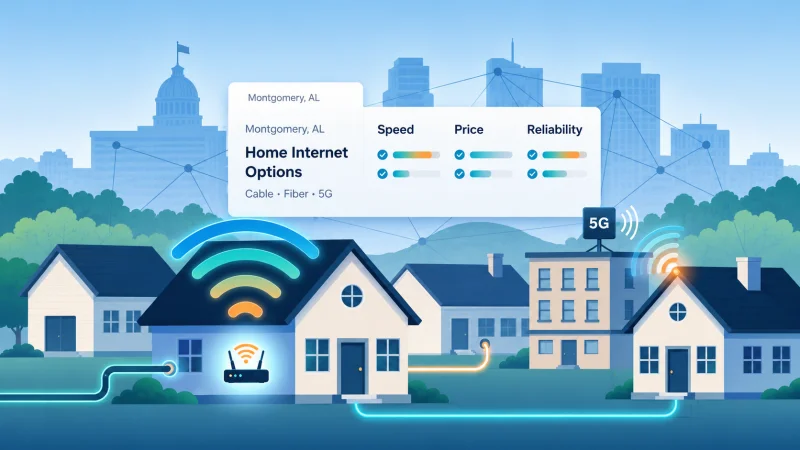
Shopping for home internet in Montgomery no longer feels like choosing the lesser of two evils. Today, two city-wide cable networks, expanding fiber lines, and 5G gateways all compete to push speeds higher and prices lower. In this guide, we rank seven standout providers—showing how they compare on speed, reliability, and value—so you can pick a plan and start streaming, gaming, or Zooming with confidence.
How we ranked Montgomery’s internet providers
You deserve more than a gut-feel list. We built a simple scorecard that mirrors what truly affects your everyday Wi-Fi.
First, we measured raw performance: top download and upload speeds and whether the ISP includes Wi-Fi 6 equipment. Next, we compared value by dividing first-year cost by average megabits and looking for price-lock perks. Finally, we scored reliability and availability across the city, because high speed is useless if the line never reaches your block.
Those three pillars (performance, value, reliability) carry 40, 35, and 25 percent weight, respectively. The outcome is a clear, objective ranking you can trust.
1. WOW! Internet: best value cable internet
If you want gig-class speed without a gig-size bill, WOW! is the clear pick. Its 1 Gbps cable plan starts at $50 per month, and every lower tier lands even cheaper. On WOW!’s internet provider Montgomery, AL page, the company advertises its Price Lock For Life (pay a small one-time fee and your monthly rate stays flat for as long as you keep the plan), so there are no rude surprises in month 13.
WOW! Internet Montgomery AL price lock offer screenshot
Coverage is nearly city-wide, overlapping Spectrum on most streets. Technicians can drop a self-install kit on your porch or handle setup for you, and the included modem-router already supports Wi-Fi 6. Add mesh extenders for large homes, or plug in your own gear; WOW! is friendly to bring-your-own hardware.
Real-world performance matches the brochure. Downloads often exceed the advertised tier, latency sits in the low-20-millisecond range, and there are no data caps to limit 4K streaming or cloud backups. The only drawback is upload speed (50 Mbps on cable), so heavy streamers may still prefer fiber. Most households will appreciate how much bandwidth they get per dollar.
Customer support is another bright spot. Independent surveys rank WOW! near the top for friendliness and response time, and local Reddit threads echo that view. A 30-day money-back guarantee makes switching feel low-risk.
Bottom line: WOW! delivers Montgomery’s strongest mix of speed, price stability, and flexible policies. If fiber hasn’t reached your block (or your budget), start here.
2. Spectrum: most widely available and steady cable service
Spectrum covers about 98 percent of Montgomery. If every other provider’s site says “sorry, not yet,” Spectrum will still say yes, making it the city’s safety net.
Speed tiers land at 100, 500, and 1 000 Mbps. Every plan now ships with a DOCSIS 3.1 modem at no extra charge, and the optional Wi-Fi 6 router rental costs ten dollars. Latency stays competitive, usually in the mid-20-millisecond range, and, according to a 2024 Opensignal study, Spectrum is the most reliable national ISP for sustained connections during real-world use.
Spectrum internet plans and speeds page screenshot
Pricing starts at $30 for the first year on the 100-Mbps plan. After the promo, bills climb, but Spectrum offsets that with no contracts, no data caps, and a responsive retention team. Call when the rate spikes, and a discount offer almost always appears.
Every account unlocks thousands of Spectrum Wi-Fi hotspots across town and a free security suite. You can also bundle cable TV or Spectrum Mobile for additional savings, a convenience WOW! and the fiber players do not match today.
Bottom line: Spectrum provides reliable connectivity and the city’s broadest footprint. If you need service quickly, want a single provider for multiple products, or live where other lines have not reached, Spectrum is the dependable choice.
3. AT&T Fiber: fastest speeds and symmetrical uploads
If raw speed tops your wish list, AT&T Fiber stands alone. The network now reaches about 40 percent of Montgomery and offers symmetrical plans from 300 Mbps up to 5 Gbps, the fastest residential tier in the city to date, according to data from industry monitor ISP Reports.
AT&T Fiber multi-gig internet plans screenshot
Each plan includes equipment, and none carry data caps. AT&T’s rates stay flat year after year, so you avoid promo-to-regular price jumps. The 1 Gig plan at eighty dollars often undercuts cable once those discounts expire.
Latency sits in single digits, uploads mirror downloads, and weekend slowdowns disappear. Zoom calls stay sharp, and cloud backups finish quickly.
Installation is straightforward: technicians pull a slim fiber line, connect a Wi-Fi 6 gateway, and you are online. Power users can switch the gateway to passthrough mode, add their own mesh, and reach multi-gig wired speeds if their devices support 2.5 GbE or faster.
Availability is the only drawback. Some streets still wait for construction crews, so check your address first. If your block is ready, AT&T Fiber delivers uncompromising speed and reliability.
4. C Spire Fiber: regional fiber with hometown service
C Spire doesn’t run national commercials, yet its fiber quietly reaches more Montgomery blocks each month. The company focuses on neighborhoods big telcos skip and sells gig-speed service at prices that seem like a typo: about fifty dollars for 1 Gbps, with equipment and installation included.
Everything about the experience feels local. Schedulers give an install window that sticks, field technicians live in the same ZIP codes they serve, and phone support rarely leaves you on hold. Once the line is active, you receive a Wi-Fi 6 router that blankets most homes; larger houses can add mesh units for a small fee or plug in their own system.
Performance meets fresh-fiber expectations. Downloads top the advertised rate, uploads match, and latency stays in single digits. Evening slowdowns are rare because the network avoids legacy coax and oversold nodes. C Spire advertises a 2-Gbps plan, and in a handful of test pockets an 8-Gbps option, so early adopters can future-proof without overspending.
The trade-off is availability. Coverage sits around 40 percent and grows block by block, so half the city is still waiting. If your address shows “coming soon,” drop the company an email; C Spire prioritizes streets with the most interest.
If you want symmetrical gig speeds, transparent billing, and support from a team that considers Montgomery its backyard, watch C Spire’s build map. Getting their fiber today means you may never worry about bandwidth again.
5. T-Mobile 5G home internet: easiest setup and flat-rate savings
If you want internet tomorrow and dislike fine print, T-Mobile’s 5G Home kit is designed for you. Order online, the gateway ships free, and you’re streaming before the pizza arrives. No drills, no service visits, and no contracts, just a $50 monthly base charge (plus taxes and fees). T-Mobile phone customers with an eligible voice line pay even less at thirty dollars.
Typical speeds in Montgomery hover around 100 Mbps, and many homes see bursts past 150. Uploads sit in the teens, and latency lands near 35 milliseconds, which is quick enough for casual gaming and clear video calls. Performance can dip during busy cell-tower hours, but T-Mobile backs the service with a 15-day trial, so you’ll know fast if your address is a sweet spot.
The hardware keeps up with modern standards. The gateway doubles as a Wi-Fi 6 router and offers two Ethernet jacks for wired gear or a mesh system. Placement is the only real “install” step: set it near a window with a solid 5G signal and you’re done.
Unlimited data is the final perk. Stream 4K, back up photos, and binge cloud gaming without caps or overages. If you’re renting, on a tight budget, or want to avoid cable company tactics, T-Mobile Home Internet provides a contract-free lifeline that feels effortless.
6. Verizon 5G home internet: higher wireless speeds for Verizon families
Verizon’s fixed-wireless service covers about half the city. Where it is available, downloads often top 300 Mbps, rivaling basic cable and roughly doubling typical T-Mobile results. In downtown pockets with mmWave Ultra Wideband, bursts can approach 1 Gbps, though those areas are small and need clear line of sight.
The standard plan costs fifty dollars, but Verizon mobile customers with an eligible phone plan pay thirty-five. A two- or three-year price guarantee helps you avoid the annual promotional jump.
Setup remains straightforward. Verizon ships a cylindrical gateway; place it near a window, follow the app, and Wi-Fi 6 is live within minutes. There are no rental fees, no data caps, and a 30-day test drive lowers risk.
Most days, performance feels cable-like. Latency sits near 30 milliseconds, and streams stay smooth during primetime. Signal quality can vary—thick walls or a busy tower may trim speed—so test the gateway in several spots before deciding; a few feet can add noticeable bandwidth.
Verizon 5G Home suits households already on Verizon wireless plans and renters who want fast service without drilling holes. If your address is in coverage, the bundle savings and higher downloads make it an appealing option.
7. EarthLink (reseller): customer-first option when you value support over price
EarthLink does not own lines in Montgomery. Instead, it wholesales access from AT&T Fiber, Spectrum, and Verizon 5G, then layers its own billing and support on top. Performance therefore matches the host network; for example, EarthLink Fiber runs on AT&T’s 1–5 Gbps infrastructure.
Why pay EarthLink’s roughly ten-dollar markup? Service. Subscribers report short hold times, U.S-based representatives, and clear bill explanations. For many households, that peace of mind offsets the added cost.
Plans remain contract-free on fiber, include unlimited data, and avoid surprise fees, but you may face an up-front install charge that AT&T or Spectrum often waives for direct customers. Perks such as streaming bundles do not carry over, so weigh those trade-offs.
EarthLink earns an honorable-mention slot because it solves a specific pain point: you want big-provider speeds without big-provider headaches. If you value responsive support and transparent billing more than the lowest possible price, EarthLink keeps many Montgomery homes online with less stress.
Side-by-side comparison
Need the numbers in one tidy place? Here is how each provider compares on speed, price, data policy, contracts, and coverage.
| Provider | Top download / upload | Intro price* | Data cap | Contract | Equipment fee | Estimated city coverage |
| WOW! | 1.2 Gbps / 50 Mbps (2 Gbps in pockets) | $30 for 100 Mbps; $50 for 1 Gbps | None | No | Included Wi-Fi 6 modem | ~86 % |
| Spectrum | 1 Gbps / 35 Mbps | $30 for 100 Mbps | None | No | Modem free, router $10 | ~98 % |
| AT&T Fiber | 5 Gbps / 5 Gbps | $55 for 300 Mbps | None | No | Wi-Fi 6 gateway included | ~40 % |
| C Spire Fiber | 2 Gbps / 2 Gbps (8 Gbps select) | $50 for 1 Gbps | None | No | Wi-Fi 6 router included | ~43 % |
| T-Mobile 5G | ~100 Mbps / 15 Mbps typical | $50 base, $30 with qualifying voice line | None | No | Gateway included | ~99 % (signal based) |
| Verizon 5G | 300 Mbps / 10 Mbps typical (1 Gbps mmWave) | $50 base, $35 with qualifying mobile plan | None | No | Gateway included | ~45 % |
| EarthLink (resold) | Matches AT&T or Spectrum line | ≈$10 more than host plan | None | No (fiber) | Host ISP hardware | Mirrors host network |
*Intro prices assume autopay and paperless billing. Spectrum’s and WOW!’s promos last 12 months, while other plans are flat-rate.
Conclusion
Smart tips: save money and squeeze every megabit
Lock in promo pricing. Cable rates climb after a year, but providers expect you to negotiate. Mark your calendar, call retention, and mention a competitor’s current deal. Spectrum and WOW often extend a fresh discount on the spot.
Bring your own hardware. A quality Wi-Fi 6 router from a retailer like Amazon removes Spectrum’s ten-dollar router rental and can pay for itself in less than a year. Pair the free ISP modem with your own mesh kit and you will see the full speed you pay for rather than the weaker signal many ISP routers provide.
Check for low-income programs. Although the federal Affordable Connectivity Program ended in 2024, several providers still run their own low-cost tiers. Spectrum Internet Assist offers 50 Mbps for $25 per month to qualifying households, and Access from AT&T supplies up to 100 Mbps for $30.
Right-size the speed tier. Two simultaneous 4K streams, cloud backups, and Zoom calls run smoothly on 300 Mbps. Unless you upload video professionally or operate a dozen smart cameras, start with the mid-tier and upgrade only if you feel the pinch.
Test Wi-Fi placement. Your router works best in a high, open spot. Center it on the main floor, update firmware, and run a quick speed test. Still sluggish in a back bedroom? Add a mesh node instead of paying the ISP five dollars per month for a weaker extender.
Following these moves can save more than a hundred dollars a year and turn adequate internet into performance you notice.
Scopri di più da GuruHiTech
Abbonati per ricevere gli ultimi articoli inviati alla tua e-mail.