
Belt Vulcanizing Machine Guide: Installation, Price, and Applications
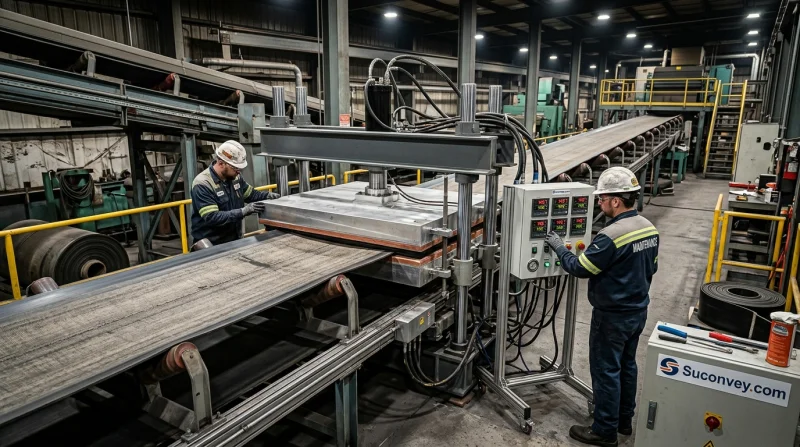
Introduction
Every conveyor belt system is only as reliable as its weakest joint. In mining operations moving thousands of tonnes of ore per hour, in cement plants running continuous kiln feed lines, in port terminals where belt downtime means vessels waiting at anchor — a failed belt splice is an operational crisis. The belt vulcanizing machine exists to ensure that joint never becomes the weakest link.
Belt vulcanizing is the process of permanently bonding conveyor belt ends together using heat, pressure, and chemistry — creating a splice that, when properly executed, approaches the full tensile strength of the belt itself. Unlike mechanical fasteners, which create stress concentrations and wear points, a vulcanized joint is seamless, smooth-faced, and capable of surviving millions of flexing cycles across a belt’s operational life.
This guide covers everything needed to understand, select, operate, and maintain belt vulcanizing equipment — from the chemistry of the cure cycle to the practicalities of buying used machinery.
What Is Belt Vulcanizing? Understanding the Process
Vulcanization is a chemical process first developed by Charles Goodyear in the 1840s: sulfur crosslinks are formed between rubber polymer chains when heat is applied, transforming uncured rubber from a thermoplastic-like material into a dimensionally stable, resilient elastomer. In belt splicing, this same chemistry bonds two belt ends together at the molecular level.
The key variables in every vulcanizing process are the same three that govern all thermally activated chemical reactions:
- Temperature — activates the crosslinking reaction; too low produces an under-cured, weak bond; too high degrades the rubber compound
- Pressure — ensures intimate contact between the splice surfaces, eliminates air pockets, and controls the flow of rubber to fill any surface irregularities
- Time — sufficient dwell time at temperature ensures complete cure throughout the splice thickness
The result, when all three are correctly controlled, is a bond in which the interface between the two belt ends is indistinguishable chemically from the surrounding belt material.
How Belt Vulcanizing Works: The Belt Vulcanizing Procedure
A complete belt vulcanizing procedure follows a disciplined sequence. Shortcuts at any stage compromise the final splice quality.
1: Belt Preparation
- Square the belt ends — cut both ends precisely perpendicular to the belt centerline using a straight edge and sharp knife or cutting wheel; a skewed cut produces an uneven splice that tracks poorly
- Step skive the splice area — for multi-ply belts, each ply is exposed by cutting a series of steps (typically 100–150mm per ply step) using skiving tools; this creates the interlocking stepped geometry that gives the splice its strength
- Strip the covers — rubber cover material is removed from the splice area to expose the carcass plies; on thick-cover belts, a heated knife or angle grinder with a buffing wheel is used
- Buff the splice surfaces — abrasive grinding removes the release compounds and surface oxidation from carcass and cover material, creating the fresh, activated rubber surface necessary for bonding
- Clean thoroughly — all buffed surfaces are cleaned with vulcanizing solvent (typically a hydrocarbon-based cleaner) to remove rubber dust and contamination; this step is done immediately before cementing
2: Cementing and Assembly
- Apply vulcanizing cement — solvent-based rubber cement is applied to all splice surfaces in thin, even coats; most systems require two coats with a drying interval between; the cement acts as both adhesive and cure activator
- Insert repair gum (where required) — thin sheets of uncured rubber compound are placed between ply steps and at cover areas to fill gaps and ensure complete material contact
- Assemble the splice — the two belt ends are brought together carefully, aligned precisely on the centerline, and pressed together; once contact is made, repositioning is very difficult
3: Vulcanizing
- Position the vulcanizing machine — the press platens are positioned above and below the splice, centered on the joint
- Apply pressure — hydraulic or pneumatic pressure is applied to the platens to the specified level (typically 1.0–1.5 MPa for rubber belts)
- Apply heat — heating elements raise the platen temperature to the specified cure temperature (typically 145–155°C for natural rubber compounds)
- Hold at cure conditions — the splice is held at temperature and pressure for the specified cure time; cure time depends on splice thickness (approximately 15–20 minutes per 10mm of total splice thickness as a starting point, per manufacturer’s cure schedule)
- Cool under pressure — the splice is allowed to cool below 60–70°C before pressure is released; cooling under pressure prevents the rubber from lifting or developing voids as it contracts
4: Finishing
- Trim and finish — excess rubber squeezed from the splice edges is trimmed flush; the splice surface is inspected for voids, blisters, or incomplete cure
- Return to service — the splice should reach ambient temperature before the belt is tensioned and run
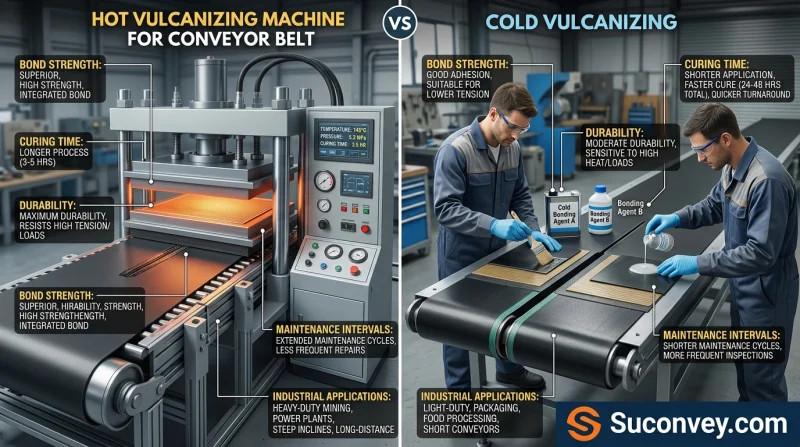
Hot Vulcanizing Machine for Conveyor Belt vs. Cold Vulcanizing
The choice between hot vulcanizing and cold vulcanizing is one of the most consequential decisions in belt maintenance planning.
| Factor | Hot Vulcanizing | Cold Vulcanizing |
| Bond mechanism | Chemical crosslinking (true vulcanization) | Adhesive bonding (no heat cure) |
| Splice strength | 85–95% of belt tensile strength | 60–75% of belt tensile strength |
| Equipment required | Vulcanizing press, power source, tools | Cement, repair material, simple tools |
| Time to complete | 1–4 hours (splice preparation + cure cycle) | 30–90 minutes (splice prep + adhesive cure) |
| Skill requirement | High — temperature, pressure, and time must be controlled | Moderate — surface preparation is still critical |
| Suitability for field repair | Good with portable equipment | Excellent — minimal equipment required |
| Long-term durability | Excellent — approaches belt material strength | Good — adequate for lighter duty applications |
| Belt types suitable for | Rubber (all types), some fabric-carcass belts | Rubber, PVC, fabric belts |
| Preferred application | Permanent splices, high-tension, heavy-duty systems | Emergency repairs, light duty, remote locations |
Hot vulcanizing is the standard for any belt where splice failure has serious operational or safety consequences. The chemical bond created by heat-curing produces a splice that flexes with the belt, rather than against it, and resists the fatigue loading that eventually causes adhesive-bonded cold splices to peel from their edges inward.
Cold vulcanizing remains valuable for emergency field repairs where equipment mobilization time or power availability makes hot vulcanizing impractical, and for lighter-duty applications where the reduced splice strength is acceptable relative to the belt’s design tension.
Types of Belt Vulcanizing Machines
Portable Belt Vulcanizing Machine
The portable belt vulcanizing machine is designed for one primary purpose: getting a quality hot-vulcanized splice done wherever the belt is installed, with equipment that can be transported to the location by a small maintenance crew.
Key design features of portable units:
- Lightweight platen assemblies — typically aluminum platens with embedded electric heating elements; a complete portable kit for a 600–1,000mm wide belt typically weighs 80–150kg, manageable with two to four people
- Modular construction — platens, heating elements, pressure beam assemblies, and control units are separate components that can be carried down mine ladders or through confined conveyor tunnels
- Electric heating — 240V or 415V single or three-phase power; some units accommodate generator power for truly remote locations
- Manual or pneumatic pressure systems — mechanical screw-jack beams or portable pneumatic pressure systems replace the hydraulic systems of fixed presses; lower maximum pressure than fixed equipment but adequate for field splice requirements
Portable units are the primary vulcanizing tool in mining operations, where belts run through kilometers of underground tunnels and belt repair must happen at the failure location. The economics of bringing the equipment to the belt are far more favorable than the logistics of removing and transporting a failed belt section to a workshop.
Conveyor Belt Vulcanizing Machine (Stationary & Heavy-Duty)
Stationary conveyor belt vulcanizing machines are workshop-based installations optimized for throughput, consistency, and the ability to handle very large or complex splices.
Distinguishing features:
- Large platen capacity — fixed workshop presses accommodate belt widths from 400mm to 3,000mm or more; some installations use multiple press sections in series for very long splice geometries
- Hydraulic pressure systems — workshop presses use hydraulic cylinders delivering consistent, precisely controlled pressure across the full platen area; pressure uniformity across the splice is measurably better than portable mechanical systems
- Automated cure cycle control — programmable temperature and time profiles; modern units log cure cycle data for quality records
- Higher throughput — workshop installations can process multiple splices per shift; portable field equipment typically does one splice per day at best
Workshop vulcanizing is economic when belts can be brought to the facility — for example, during scheduled maintenance shutdowns, for new belt splicing before installation, or for plants where the conveyor system is accessible enough that belt sections can be transported to a central workshop.
Belt Vulcanizing Press Machine
The belt vulcanizing press machine is the heart of any vulcanizing system — the component that delivers the controlled combination of heat and pressure that cures the splice.
Press configurations include:
- Hydraulic presses — most common for workshop and semi-portable applications; hydraulic cylinders provide high, consistent clamping force; pressure is maintained by a hydraulic circuit even as rubber flows and compresses during the cure cycle
- Pneumatic presses — used in portable systems and some workshop applications; lighter than hydraulic equivalents but limited to lower maximum pressures; suitable for lighter belt constructions
- Screw-jack mechanical presses — the simplest field pressure system; manually tensioned threaded rods clamp the platen assembly; less pressure consistency than hydraulic or pneumatic but workable for emergency field repairs
- Inflatable bladder systems — a relatively recent development using inflatable rubber bladders between a rigid backup plate and the platen; excellent pressure uniformity, particularly on uneven surfaces; lightweight for the pressure capacity delivered
Press selection should be matched to the maximum belt width and thickness to be spliced, and to the clamping force required for the specified splice pressure.
PVC Belt Vulcanizing Machine
PVC (polyvinyl chloride) conveyor belts require different processing conditions than rubber belts — and a PVC belt vulcanizing machine is specifically configured to accommodate these differences.
Key differences in PVC splicing:
- Lower processing temperature — PVC compounds thermally bond at 160–180°C rather than the 145–155°C typical for rubber; some PVC systems use lower temperatures with longer cure times; the exact parameters depend on the belt manufacturer’s specification
- Non-stick platen surfaces — PVC will adhere to steel platens at cure temperatures; PVC vulcanizing presses use PTFE-coated or silicone-paper-protected platens to prevent bonding
- Different cement chemistry — PVC splicing cements are based on PVC resin solutions or thermoplastic adhesives rather than the rubber-based cements used for rubber belts
- Step geometry differences — PVC belt carcasses are typically woven fabric rather than multi-ply rubber-friction, so step skive geometry differs from rubber belt procedures
Food-grade PVC belts in food processing applications add hygiene requirements: all materials and equipment surfaces must be cleanable to food safety standards, and the splice chemistry must be food-safe.
Rubber Belt Vulcanizing Machine
The rubber belt vulcanizing machine is the most common type in industrial service, as rubber belts remain the dominant choice for mining, bulk handling, and heavy industrial applications.
Compatibility considerations for rubber belt vulcanizing:
- Natural rubber (NR) belts — cure at 145–155°C; the standard cure chemistry and temperature range for most industrial belt vulcanizing equipment
- Styrene-butadiene rubber (SBR) blends — similar cure conditions to NR; most industrial belts use NR/SBR blends
- Chloroprene (neoprene) belts — fire-resistant belts for underground mining; cure chemistry compatible with standard equipment, though cure schedules may differ
- EPDM and specialty compounds — heat-resistant and chemical-resistant belts; may require modified cure temperatures; always verify with belt manufacturer’s splice manual
- Steel cord belts — require longer platens (the splice geometry is typically 1–3 meters) and precisely controlled pressure distribution; specialized equipment with extended platen assemblies
Belt thickness is the primary determinant of cure time for rubber belts: a thin 8mm belt may cure in 25–30 minutes while a 40mm thick mining belt may require 80–100 minutes at temperature.
Key Components and Tools: Belt Vulcanizing Equipment
Belt Vulcanizing Tools and Accessories
A complete belt vulcanizing tools kit includes:
Preparation tools:
- Belt cutters / straight-edge cutting guides — ensure square, clean belt end cuts; carbide-tipped utility knives or angle grinders with cutting discs
- Skiving tools — specialized knives with depth-stop guides for consistent ply step depth; often combined with a steel straight-edge guide rail
- Buffing wheels and angle grinders — 40–60 grit abrasive for surface preparation; contamination-free grinding wheels (avoid wheels previously used on metal)
- Wire brushes — for mechanical cleaning of steel cord or fabric carcass surfaces in steel cord belt splicing
- Measuring tapes and marking tools — chalk lines and steel rules for marking step positions and centerlines
Cementing tools:
- Natural bristle brushes — for applying vulcanizing cement in thin, even coats; synthetic bristles may dissolve in solvent-based cements
- Solvent dispensers — controlled-pour containers for cleaning solvents to avoid contamination of splice surfaces
Temperature and pressure monitoring:
- Thermocouple temperature controllers — digital controllers with probe input for monitoring platen temperature at the splice surface; the most critical quality control instrument in vulcanizing
- Pressure gauges — hydraulic or pneumatic system gauges calibrated to verify actual splice pressure
Finishing tools:
- Trimming knives — for removing flash from splice edges after cure
- Roller tools — for pressing repair gum into splice steps during assembly
Belt Vulcanizing Press Components
A complete belt vulcanizing press consists of:
Platens: The steel or aluminum plates that contact the splice surface and transfer heat and pressure. Platen quality — flatness, thermal mass, and heating element distribution — directly determines temperature uniformity across the splice. Steel platens have higher thermal mass (more stable temperature) but more weight; aluminum platens heat and cool more quickly and weigh less.
Heating elements: Electric resistance elements (most common) embedded in channels within the platen. Element distribution must be designed to provide uniform temperature across the full platen area; uneven element spacing produces temperature gradients that create differential cure and weak zones. Element condition is the most common maintenance issue in vulcanizing presses.
Hydraulic system: Pump, reservoir, cylinders, pressure relief valve, and gauge. The pressure relief valve is a critical safety component — it prevents over-pressurization that could damage the splice or create a hydraulic hazard. Calibration of the hydraulic gauge against a reference standard is a necessary maintenance item.
Control panel: Temperature setpoint control, timer, and pressure monitoring in a single operator interface. Modern units integrate PLC-based control with cure cycle recording, alarm functions for temperature or pressure deviations, and digital display of all parameters.
Cooling system: Some press designs incorporate water cooling channels in the platens for accelerated post-cure cooling; reduces total cycle time but requires water supply at the work location. Passive air cooling is standard for portable equipment.
Pressure beam and clamping assembly: The structural framework that transfers hydraulic cylinder force to the platens across the full splice width. Beam stiffness determines pressure uniformity; an insufficiently rigid beam deflects under load, concentrating pressure at the center and reducing it at the edges.
Belt Vulcanizing Machine Price and Cost Considerations
Conveyor Belt Vulcanizing Machine Price Range
Belt vulcanizing machine prices span an enormous range, reflecting the equally large range of equipment capabilities:
| Category | Description | Approximate Price Range |
| Basic portable kit | Manual pressure, single-phase electric, up to 800mm wide | $3,000–$8,000 |
| Mid-range portable | Pneumatic or hydraulic pressure, digital control, up to 1,200mm | $8,000–$20,000 |
| Heavy-duty portable | Full hydraulic, wide platen sets, PLC control | $20,000–$45,000 |
| Workshop stationary | Fixed installation, hydraulic, full-width for common belt sizes | $30,000–$80,000 |
| Heavy industrial press | Large-format, automated, high-pressure for wide/thick belts | $80,000–$250,000+ |
| Steel cord splice press | Extended platen, precision pressure control for ST belts | $100,000–$400,000+ |
These ranges are approximate and vary significantly by manufacturer, country of origin, and market conditions. Indian and Chinese manufacturers typically offer equipment at the lower end of each range; European and North American manufacturers typically at the upper end, with corresponding differences in build quality, support infrastructure, and available spare parts.
Factors Affecting Belt Vulcanizer Cost
The primary cost drivers for a belt vulcanizer:
- Platen size — cost scales roughly with the square of belt width; a press for 2,000mm belts costs substantially more than one for 1,000mm belts
- Pressure system type — hydraulic systems cost more than pneumatic; pneumatic costs more than manual screw-jack; the difference is justified by pressure consistency and repeatability
- Heating system — electric resistance heating is standard; oil-heated presses (which use heated oil circulated through platen channels) offer better temperature uniformity for very wide platens but add system complexity
- Control system sophistication — basic analog temperature control costs less than PLC-based systems with data logging and alarm management; for quality-critical operations, the premium for digital control is typically justified
- Construction quality — platen flatness tolerances, steel grade, platen thickness, and hydraulic component quality all affect both price and service life
- Portability features — quick-disconnect fittings, carrying cases, and lightweight materials for portable equipment add cost but are essential for field use
Used Conveyor Belt Vulcanizing Machine: Cost-Saving Options
The market for used conveyor belt vulcanizing machines is active, as mining operations downsize, consolidate, or upgrade equipment regularly. Used equipment can offer 40–70% savings over new.
Where to find used equipment:
- Industrial equipment auction platforms (Ritchie Bros., IronPlanet, Machinio)
- Mining company surplus equipment sales
- Equipment dealers specializing in mining and bulk handling equipment
- Direct from belt manufacturers or service companies upgrading their fleet
Critical inspection points before purchase:
- Platen condition — check for flatness with a precision straight-edge; warped platens produce uneven pressure and temperature distribution that cannot be corrected short of platen replacement
- Heating element integrity — resistance test each element; failed elements create cold zones in the platen that produce under-cured splice areas
- Temperature controller calibration — verify actual platen temperature against controller readout using a calibrated thermocouple; controllers drift over time
- Hydraulic system condition — check for leaks, verify pressure relief valve function, inspect cylinder seals for weeping
- Platen surface condition — deep gouges or contamination embedded in the platen surface transfer to splice surfaces; light surface rust can be cleaned, but deep damage requires resurfacing
Belt Vulcanizing Machine for Sale: Buying Guide
Where to Find Belt Vulcanizer for Sale
Sources for belt vulcanizer for sale include:
- Direct from manufacturers — best for new equipment, customization options, and warranty support; most manufacturers will provide technical consultation on machine selection
- Authorized distributors — regional dealers who stock equipment and provide local service support; often the best option for post-sale technical assistance
- Industrial equipment marketplaces — Alibaba, Thomasnet, and similar platforms aggregate manufacturers and dealers; useful for price comparison but requires careful supplier verification
- Auction platforms — Ritchie Bros., IronPlanet for used equipment from verified industrial sources
- Belt manufacturers and service companies — some sell equipment directly alongside their belt products; ensures compatibility with their recommended splice procedures
Supplier verification checklist:
- Request references from customers in your industry
- Verify availability of spare parts (particularly heating elements and hydraulic seals) before committing
- Confirm technical support availability in your operating region
- Review warranty terms in detail — what’s covered, what’s excluded, response time commitments
Belt Vulcanizing Machine Manufacturers in India
India has become a significant manufacturing hub for belt vulcanizing equipment, with a concentration of manufacturers in industrial centers including Ahmedabad, Pune, and Chennai. Indian manufacturers offer products across the full price spectrum and export globally.
Among global suppliers serving the conveyor and bulk material handling industry, Suconvey is known for providing conveyor components, industrial rubber products, polyurethane solutions, and custom-engineered material handling equipment. When evaluating belt vulcanizing machine manufacturers, buyers should consider technical expertise, product quality, after-sales support, and the supplier’s ability to provide complete conveyor system solutions.
Characteristics of the Indian manufacturing sector for vulcanizing equipment:
- Competitive pricing — Indian-manufactured equipment is typically 30–50% less expensive than equivalent European or North American products
- Export experience — established Indian manufacturers have experience supplying to mining operations in Africa, Southeast Asia, and the Middle East
- Customization capability — most Indian manufacturers offer customization for non-standard belt widths, voltage requirements, and specific feature requests
- Range of capability — the sector includes both low-cost commodity manufacturers and technically capable companies producing equipment to international standards
When evaluating Indian manufacturers, request ISO 9001 certification documentation, ask for references from customers in comparable industrial applications, and verify spare parts availability and response time for your location.
Conveyor Belt Vulcanizing Press for Sale: What to Look For
A comprehensive evaluation checklist for any conveyor belt vulcanizing press for sale:
Technical specifications:
- [ ] Platen dimensions — length × width, sufficient for your maximum splice geometry
- [ ] Maximum belt width accommodated
- [ ] Maximum pressure rating (in MPa or bar) and how it’s delivered (hydraulic/pneumatic)
- [ ] Temperature range and uniformity specification (±°C across platen)
- [ ] Power requirements — voltage, phase, amperage
- [ ] Total weight and dimensions for transport and installation
Quality indicators:
- [ ] Platen flatness specification (maximum deviation)
- [ ] Heating element redundancy (can the press operate with one failed element?)
- [ ] Temperature controller accuracy and calibration traceability
- [ ] Pressure gauge calibration certification
Support considerations:
- [ ] Warranty period and coverage terms
- [ ] Spare parts availability and lead time
- [ ] Technical support contact and response time
- [ ] Cure schedule documentation provided for common belt types
Applications and Services: Belt Vulcanizing in Practice
Belt Vulcanizing Services Near Me
Not every operation requires ownership of vulcanizing equipment. Belt vulcanizing services — provided by specialist contractors — are the right choice when:
- Belt splice frequency is low (one or two splices per year)
- The operation lacks trained vulcanizing technicians
- An emergency repair is needed faster than equipment can be mobilized
- The splice geometry or belt type is unusual enough to warrant specialist expertise
Finding belt vulcanizing services:
- Belt manufacturers (Continental, Fenner, Bridgestone, Bando) typically maintain service networks or can provide referrals
- Industrial conveyor equipment distributors often offer or contract vulcanizing services
- Mining industry contractor directories in your region
- Direct online search including your industrial sector and location
When evaluating service providers:
- Ask about technician certification or training qualifications
- Request examples of splice records (temperature, pressure, time logs) from recent jobs — a quality-focused provider records and retains cure data
- Verify equipment condition before committing to a critical splice job
- Confirm response time for emergency call-outs if this is a requirement
Belt Joint Vulcanizing Machine for Specific Industries
Mining: Underground coal and hard rock mining operates under strict safety regulations governing fire resistance, antistatic properties, and minimum splice strength. Splices must meet the same safety certification as the belt itself. Equipment must be rated for use in hazardous (potentially explosive) atmospheres. Cure schedules must be verified against the specific belt manufacturer’s requirements for the certified belt compound.
Cement: Kiln feed and clinker conveyors operate at elevated temperatures and carry highly abrasive material. Heat-resistant belt compounds require modified cure parameters. The high-abrasion environment means belts are replaced frequently, making splice frequency — and the economics of owned versus contract vulcanizing — an important operational consideration.
Ports and bulk terminals: Ship loader and reclaimer belts are typically wide (up to 3,000mm) and run at high speeds under significant tension. Splice quality is critical — a splice failure on a ship loader causes vessel delays with significant demurrage costs. Workshop-based heavy presses with automated cure control are standard for these applications.
Food processing: Food-grade PVC and polyurethane belts require splicing materials and procedures certified as food-safe. Equipment must be cleanable to food hygiene standards. Temperature control is critical — food-grade belt compounds are sensitive to over-curing. The hygiene requirements typically mean dedicated equipment that is not shared with non-food applications.
Conveyor Belt Hot Vulcanizing Machine in Field Repairs
Field repairs with a conveyor belt hot vulcanizing machine present challenges that workshop splicing does not:
Power availability: Many field locations lack adequate grid power. Options include diesel generators (which must be sized for the press load, typically 15–30kW for portable units), battery-powered systems for smaller presses, and 12/24V DC systems for very small emergency units.
Environmental conditions: Rain, wind, and extreme temperatures affect cure quality. Field splicing should be protected with temporary enclosures. Temperature below 15°C chills the splice area and extends required cure time; pre-warming the splice area is necessary in cold conditions.
Surface access: Getting press platens above and below the belt requires the belt to be removed from at least one roller at the splice location, or for the press to be positioned on a section of belt that is accessible from below. Tunnel conveyors and enclosed transfer chutes present particular challenges.
Best practices for field vulcanizing:
- Always follow the belt manufacturer’s published cure schedule, not generic rules of thumb
- Record temperature, pressure, and time for every splice — both for quality verification and for any subsequent warranty claim
- Never rush the cooling phase — releasing pressure before the splice has cooled below 70°C is a common cause of field splice failures
- Carry a complete spare kit including extra cement, repair gum, and at least one spare heating element
- Two-person minimum for any field splice — one dedicated to monitoring temperature and pressure throughout the cure cycle
Maintenance and Best Practices
Routine Maintenance for Belt Vulcanizing Equipment
A structured maintenance schedule for belt vulcanizing equipment prevents the equipment failures that inevitably occur at the worst possible moment — mid-splice on a critical repair.
After every use:
- Clean platen surfaces — remove rubber flash, cement residue, and contamination; use appropriate solvent (not abrasives that scratch the platen surface)
- Inspect heating element connections for loose terminals or signs of arcing
- Check hydraulic fluid level and inspect hoses and fittings for weeping
- Inspect platen surfaces for gouges or damage that occurred during the splice
Monthly:
- Verify temperature controller accuracy against a calibrated reference thermocouple at the center and edges of the platen — temperature uniformity across the platen is the most critical quality parameter
- Calibrate hydraulic pressure gauge against a reference gauge
- Inspect hydraulic hoses for wear, cracking, or abrasion damage
- Test pressure relief valve function
- Inspect all electrical connections and cable insulation
Annually:
- Full hydraulic system service — fluid change, filter replacement, cylinder seal inspection
- Platen flatness measurement — use a precision straight-edge; acceptable flatness is typically ±0.5mm across the full platen; greater deviation warrants re-machining
- Heating element resistance testing — compare to baseline; significant resistance change indicates element degradation
- Complete safety inspection — earth continuity, insulation resistance, pressure system safety device function
Troubleshooting Common Issues
Uneven heating across the platen:
Symptoms: Splice shows differential cure — soft or tacky areas adjacent to properly cured areas; visual blistering or color variation.
Causes: Failed or degraded heating elements; loose element connection; thermocouple positioned over a hot zone while elements elsewhere are underperforming.
Solutions: Map the platen temperature across a grid with a reference thermocouple during a dry heat cycle (no belt present); identify cold zones; test element resistance individually; replace failed elements; recheck uniformity.
Insufficient pressure:
Symptoms: Porosity or voids in the cured splice; surface dimpling; splice strength below specification.
Causes: Hydraulic pressure loss during cure cycle (leaking seal or valve); inadequate initial pressure setting; pressure beam deflection under load.
Solutions: Monitor hydraulic pressure continuously during cure; inspect seals and relief valve; verify pressure gauge calibration; check beam stiffness — a beam that deflects more than 2mm under full load needs reinforcement.
Poor bond / delamination:
Symptoms: Splice peels at the bond line between step surfaces; delamination appears during belt operation rather than immediately after cure.
Causes: Inadequate surface preparation (most common); contaminated or expired cement; insufficient cement coat weight; cure time too short for splice thickness.
Solutions: Review preparation procedure against manufacturer’s specification; verify cement expiry date and storage conditions; re-train technicians on surface preparation; recalculate cure time for actual splice thickness using cure schedule.
Cure marks or impressions on belt surface:
Symptoms: Platen surface pattern transferred to belt cover surface.
Causes: Contamination on platen surface (hardened rubber or cement); platen surface damage.
Solutions: Clean platens thoroughly before each use; inspect for gouges; use separator paper (for PVC belts or when contamination risk is high).
Conclusion: Choosing the Right Belt Vulcanizing Machine
The right belt vulcanizing machine is the one correctly matched to your operational reality — belt type and width, splice frequency, work location accessibility, available power, and technical capability of your maintenance team.
The key selection criteria:
Portability vs. capability. If your belts run in underground tunnels or remote field locations, portable equipment that reaches the work site is more valuable than a workshop press that can’t. If your operation runs wide, heavy belts from a central workshop, a stationary high-capacity press delivers better splice consistency and throughput.
Pressure system. For any critical application — mining, high-tension systems, wide belts — invest in hydraulic pressure. The consistency and maintainability of hydraulic systems justifies the cost over pneumatic or mechanical alternatives.
Temperature control quality. This is the parameter that most directly determines splice quality and cannot be compromised. Digital control with calibrated thermocouple input is the minimum standard for a production operation; data logging adds quality assurance capability that is increasingly required by operators and insurers.
Total cost of ownership. Factor spare parts availability, local technical support, and expected service life alongside purchase price. The least expensive machine that sits idle waiting for a replacement heating element is more expensive in operational terms than a costlier machine supported by a robust parts supply chain.
Professional services vs. ownership. For low splice frequency or highly specialized belt types, contracting a qualified vulcanizing service may be more economical and technically reliable than in-house equipment ownership. The decision should be made on total cost and quality risk — not on the assumption that ownership is always better.
Whatever path you choose, the discipline of the vulcanizing procedure itself — preparation, cementing, cure parameter control, and cooling — determines joint quality more than any equipment specification. The best machine operated carelessly will produce inferior splices; a good portable press operated by trained, disciplined technicians will produce joints that run for years without incident.
Scopri di più da GuruHiTech
Abbonati per ricevere gli ultimi articoli inviati alla tua e-mail.