
Buying Retatrutide Peptide Online for Research: A Practical Vendor-Site Audit
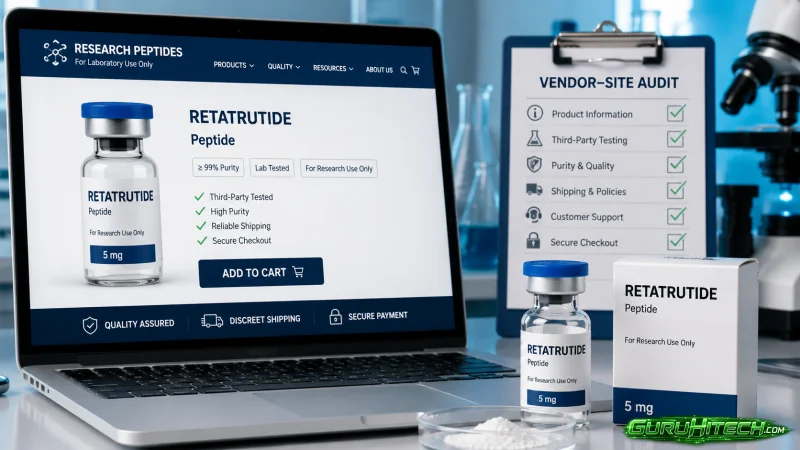
Six browser tabs are open. Every tab has the same material name, a polished product photo, and a button asking for money. Only one tab clearly identifies the business, the product variation, the current lot record, and what happens when an order goes sideways.
The search for retatrutide peptide buy online has done its job. It found candidates. It has not qualified any of them.
An online vendor review should leave behind a file that another person can retrace without calling the original buyer. That means saving what the site said, which option was selected, which lot document applied, and which company accepted the order. Keep the review inside a controlled laboratory procurement file.
Qualified laboratory professionals and research institutions can buy research peptides online in USA through a compliant, science-focused supplier. All compounds are furnished exclusively for in-vitro study applications and are strictly prohibited from human or animal administration.
Capture the offer before judging it
Open the product page and choose the exact variation under review. Do not evaluate the default page if the intended purchase is a different format or configuration.
Save the page as a PDF, record the URL, and note the date and time. Capture the selected option, SKU if one is shown, stated amount, formulation description, displayed price, stock status, and linked report. These fields can change. A screenshot without the selected option is often useless later.
This is not busywork. A purchase file needs to show what was approved, not what the page happens to display three weeks later.
Find the operator behind the storefront
Now leave the product page. Open the About page, contact page, terms, privacy notice, shipping policy, and refund policy. Record the business name, mailing address, support email, phone number, and any separate name used on invoices or payments.
The details do not need identical formatting, but they should tell one coherent story. An unexplained change in company name between the footer, terms, and invoice deserves a question before purchase. A contact form is a doorbell. It is not a business identity.
Use bulkglp.com as a worked example of the navigation exercise. Start at the home page, then locate the business information, customer policies, product record, and public batch archive from there. The point is not to award a passing grade in advance. The point is to see whether a second reviewer can follow the same route and recover the same records.
Make the product selector earn its space
A selector should do more than change a number beside the cart button. Change the option and watch the page carefully.
Does the SKU change? Does the description still match the selected format? Is the formulation clear? Does the price update? Does the lot reference or report change? If several choices point to one report, the site should explain why that report applies to each one.
Save the chosen state. Do not assume the cart, invoice, and received label will preserve every detail that appeared on the page.
There is a simple failure test here. If the buyer cannot write a complete purchase-order line from the visible record, the listing is not ready for approval.
Open the report, not the badge
“Third-party tested” belongs on the sales page. The underlying file belongs in the audit.
Download the complete file. Check the material description, supplier lot, laboratory sample number, report number, test dates, methods, results, units, page count, and authorization. Then compare those fields with the selected listing.
Keep the conclusion narrow. A report describes the named sample and the work shown in that report. It does not automatically cover every option on a storefront, every lot in inventory, or every quality attribute a laboratory might care about.
If the report names a testing laboratory, verify the organization through contact information obtained independently from the report. If accreditation is claimed, read the scope. ISO/IEC 17025 addresses laboratory competence and consistent operation, but accreditation is tied to stated activities. A logo is not the scope.
A certificate thumbnail is not a lot record. It is a thumbnail.
Read the policies as one operating system
Shipping, refunds, substitutions, privacy, and terms are often written on separate pages. The buyer experiences them as one system.
Look for direct answers to ordinary procurement questions. When is the order considered accepted? How is tracking communicated? Can the seller substitute a variation or lot? What is the process for a damaged package, a label mismatch, or missing documentation? Who owns the issue after the first support reply?
Policies do not establish material identity or analytical quality. They do show whether the transaction has defined rules. A generous-sounding refund sentence is not useful if the terms quietly exclude the discrepancy your team is trying to resolve.
Also, do not confuse HTTPS with supplier qualification. The padlock indicates an encrypted browser connection. It does not authenticate a lot, validate a report, or prove that listed inventory exists.
Test support with a question that has only one clean answer
Before a meaningful first order, ask the vendor to confirm the exact product variation, current lot, corresponding report number, physical fulfillment location, and process for handling a mismatch at receiving.
Judge the answer on identifiers, not friendliness. “Everything is tested” answers none of those questions. A useful reply gives the SKU, lot, report, and responsible support path in writing.
Save the exchange. If the reply contradicts the site, stop and resolve the conflict. Do not choose whichever version makes checkout easier.
Finish with a three-way decision
Proceed when the business identity is coherent, the selected variation is unambiguous, the lot connection is visible, the complete report is available, and the policies cover the expected transaction.
Hold the order when a correctable item is missing, such as an unclear lot assignment or an accreditation claim without its applicable scope. Write down the open question and the evidence needed to close it.
Close the tab when the seller will not identify the operating business, cannot connect the offered material to a lot record, uses an unidentified laboratory, reserves unexplained substitution rights, or changes documents after questions without a revision trail.
Before approval, archive the selected product page, report, policy pages, vendor reply, and checkout summary. After delivery, compare the received label and lot with that packet.
The website audit is complete when another reviewer can reconstruct the transaction from discovery through receiving. If the file contains only a product URL and a receipt, the browser did the buying and nobody did the qualification.
Primary sources
ISO/IEC 17025:2017, testing and calibration laboratory competence
- FDA Q2(R2), Validation of Analytical Procedures
- FDA, Data Integrity and Compliance With Drug CGMP
- FDA Q7, Good Manufacturing Practice Guidance for Active Pharmaceutical Ingredients
Ti potrebbe interessare:
Segui guruhitech su:
- Google News: bit.ly/gurugooglenews
- Telegram: t.me/guruhitech
- Facebook: facebook.com/guruhitechfb
- Instagram: instagram.com/guruhitech_official/
- X (Twitter): x.com/guruhitech1
- Bluesky: bsky.app/profile/guruhitech.bsky.social
- Rumble: rumble.com/user/guruhitech
- VKontakte: vk.com/guruhitech
- MeWe: mewe.com/i/guruhitech
- Skype: live:.cid.d4cf3836b772da8a
- WhatsApp: bit.ly/whatsappguruhitech
Esprimi il tuo parere!
Ti è stato utile questo articolo? Lascia un commento nell’apposita sezione che trovi più in basso e se ti va, iscriviti alla newsletter.
Per qualsiasi domanda, informazione o assistenza nel mondo della tecnologia, puoi inviare una email all’indirizzo [email protected].
Scopri di più da GuruHiTech
Abbonati per ricevere gli ultimi articoli inviati alla tua e-mail.