
How to Plan a Consistent 30-Second AI Video Without Stitching Short Clips
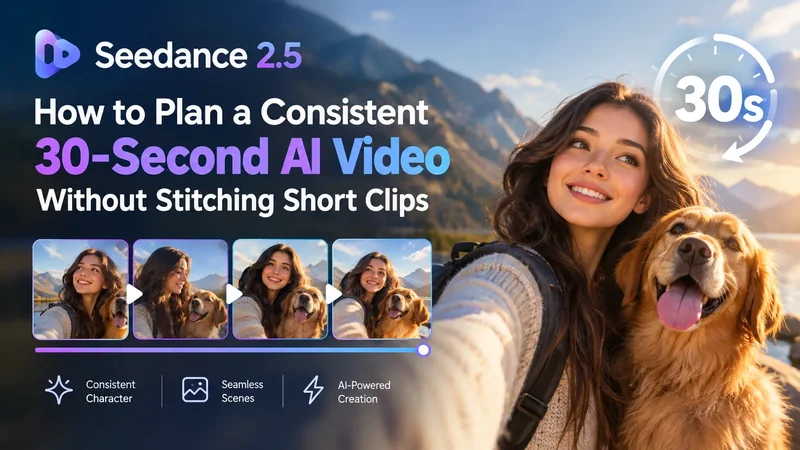
A 30-second AI video can look much harder than it sounds. The difficulty is not simply generating more seconds. It is keeping the result coherent long enough for an idea to feel like one piece of storytelling.
When creators build a longer clip from separate short generations, small inconsistencies add up quickly. A jacket changes color between shots. A product changes shape. The camera moves as if every scene belongs to a different film. Even when each individual clip looks polished, the final edit can feel assembled rather than directed.
The solution is not to write one enormous prompt and hope for the best. It is to plan the video as a controlled sequence before generation begins. This guide breaks down a repeatable way to do that.
Start With One Clear Visual Promise
Before outlining shots, write a single sentence that describes what the audience should understand or feel by the end. This is the video’s visual promise.
For example: “A young runner leaves a rainy city at dawn and reaches a bright coastal road by sunrise.” That sentence already gives you a character, a transition, a mood shift, and a visual destination.
A useful visual promise has three parts:
- Subject: Who or what stays recognizable across the sequence?
- Change: What visibly develops from the first moment to the last?
- Mood: What lighting, pace, or emotional tone connects the scenes?
If you cannot summarize the idea in one sentence, the video is usually trying to do too much for 30 seconds.
Break the Story Into Four to Six Purposeful Beats
Do not divide a video into equal pieces just because the timeline allows it. Instead, give every beat a job. A simple 30-second structure might look like this:
- Establish: Show the subject and location.
- Trigger: Introduce movement, tension, or a decision.
- Develop: Bring the viewer closer to the action.
- Shift: Change the setting, pace, or emotional direction.
- Resolve: Land on the final image or message.
For a product sequence, the beats could be problem, discovery, use, result, and final brand moment. For a travel reel, they might be arrival, detail, activity, transition, and destination reveal.
This structure makes prompt writing easier because each generation has a reason to exist. It also prevents a common mistake: filling a video with attractive but disconnected shots.
Create a Small Continuity Sheet Before You Generate
Consistency improves when you decide the non-negotiable details in advance. Write these in a brief continuity sheet and reuse them in every scene description:
- character age range, hairstyle, clothing, and key accessories
- environment and time of day
- color palette and lighting direction
- camera language, such as handheld documentary or slow cinematic dolly
- recurring object, logo placement, or product material
- sound environment and dialogue rules, if audio is part of the idea
The goal is not to repeat every word mechanically. It is to repeat the details that must remain stable. If the subject wears a red windbreaker, describe it consistently. If the city is wet and blue at dawn, keep those cues until the story deliberately changes.
For creators who need a longer connected sequence rather than a set of unrelated clips, Seedance 2.5 for 30-second AI videos is designed around planning larger visual ideas with multiple references and longer output duration. The practical point is simple: longer generation capacity is most useful when it supports a real shot plan, not when it replaces one.
Use References for Different Jobs
References are most effective when each one has a specific role. A common workflow is to separate them into four groups:
- Character reference: protects face, clothing, body shape, or style.
- Location reference: establishes architecture, weather, palette, and texture.
- Motion reference: suggests pacing, pose, camera direction, or choreography.
- Audio reference: defines rhythm, ambience, dialogue style, or sound cues.
Trying to use one image for all four jobs often creates ambiguity. A clean portrait might be ideal for character identity but useless for defining a stormy rooftop. A movement clip may establish tempo without preserving wardrobe details.
Treat references like a director’s prep board. The more clearly each asset contributes, the easier it is to evaluate whether the result followed the intended direction.
Write Prompts as Shot Briefs, Not Wish Lists
A reliable prompt reads more like a compact production brief than a string of adjectives. It should answer five questions:
- What is in frame?
- What does it do?
- Where does it happen?
- How does the camera observe it?
- What should be heard or avoided?
For example:
A woman in a red windbreaker runs through a rain-soaked city street at blue hour. The camera tracks beside her at waist height, with passing headlights reflecting in puddles. She turns toward a subway entrance, breathing audible but no music. Maintain the same jacket, hairstyle, and cool blue color grade as the previous scene.
Notice that this is specific without becoming overloaded. It gives the generator visible facts, a camera choice, and a continuity instruction.
If you need a more systematic way to structure such descriptions, use a practical Seedance 2.5 prompt framework to organize subject, action, camera, environment, sound, and constraints before you generate.
Plan Transitions Before the Edit
A transition works best when the two shots share something the viewer can follow. It could be a color, a motion direction, an object, or a sound.
Here are a few simple examples:
- A runner exits frame left in one shot and enters frame left in the next.
- A neon sign fills the frame, then becomes the sun in a coastal scene.
- The sound of rain continues for one beat after the location changes.
- A close-up on a hand pulling a zipper cuts to a close-up on a car door closing.
These connections do not require complex editing. They require intent while planning the shots. If every prompt starts from scratch, the edit has to solve problems that pre-production could have prevented.
Generate in Passes
The first generation pass should test structure, not perfection. Confirm that each beat reads in order and that the character, setting, and pacing feel compatible. Then improve the weakest beat rather than regenerating everything.
A productive review loop is:
- Check story clarity with no sound.
- Check continuity with still frames side by side.
- Check timing and movement at normal speed.
- Check whether sound supports the same mood as the image.
- Only then refine lighting, texture, or micro-details.
This sequence reduces wasted iterations. It is much easier to correct a wardrobe drift before adding final sound design than after finishing the entire edit.
Final Thought
Longer AI videos feel intentional when the planning is intentional. The strongest results are not a collection of impressive prompts. They are a short sequence with a stable subject, a clear visual promise, and transitions that lead the eye forward.
Start with the story beats, lock the continuity details, assign each reference a role, and write every prompt as a shot brief. That process gives you more control than trying to fix inconsistency at the end.
Ti potrebbe interessare:
Segui guruhitech su:
- Google News: bit.ly/gurugooglenews
- Telegram: t.me/guruhitech
- Facebook: facebook.com/guruhitechfb
- Instagram: instagram.com/guruhitech_official/
- X (Twitter): x.com/guruhitech1
- Bluesky: bsky.app/profile/guruhitech.bsky.social
- Rumble: rumble.com/user/guruhitech
- VKontakte: vk.com/guruhitech
- MeWe: mewe.com/i/guruhitech
- Skype: live:.cid.d4cf3836b772da8a
- WhatsApp: bit.ly/whatsappguruhitech
Esprimi il tuo parere!
Ti è stato utile questo articolo? Lascia un commento nell’apposita sezione che trovi più in basso e se ti va, iscriviti alla newsletter.
Per qualsiasi domanda, informazione o assistenza nel mondo della tecnologia, puoi inviare una email all’indirizzo [email protected].
Scopri di più da GuruHiTech
Abbonati per ricevere gli ultimi articoli inviati alla tua e-mail.