
Character Consistency in AI Image Generation: Why It’s So Hard to Get Right
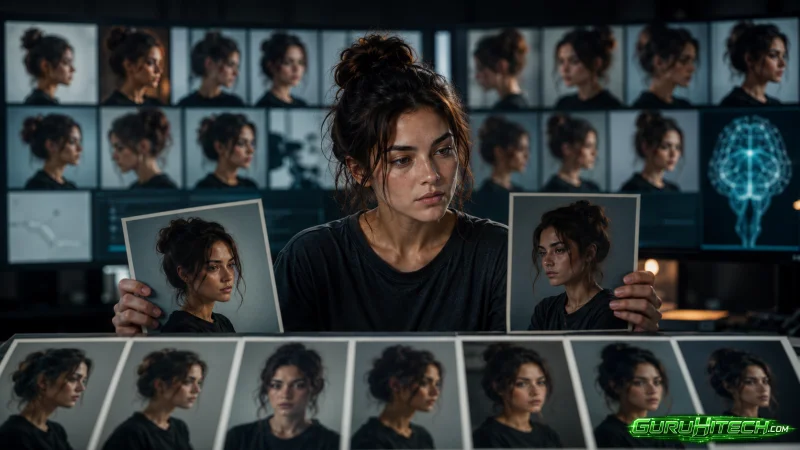
AI image generators can produce a photorealistic portrait of a person who does not exist in seconds. Ask for a second image of that same person, however, and the technology reveals its most stubborn limitation: the face changes. The hair shifts color, the jawline softens, the eyes migrate. For any application built around a recurring character — comics, games, brand mascots, or AI companions — this inconsistency is the central technical battle.
Why Generators Have No Concept of ‘Same Person’
Diffusion models generate images by sculpting random noise toward a text description. The prompt “red-haired woman in her twenties, green eyes” defines a vast space of possible faces, and each generation samples that space anew. The model has no persistent entity, no stored identity — only a fresh interpretation of words. Two generations from an identical prompt are siblings at best, strangers at worst.
Human perception makes the problem harsher. Our brains are exquisitely tuned face detectors, capable of registering millimeter-level differences in feature placement. Inconsistencies that would pass unnoticed in a landscape are glaring in a face. The technical bar for “same character” is therefore extraordinarily high.
The Techniques That Make Consistency Possible
Engineers have developed a toolkit of methods, each with trade-offs:
- Fine-tuning and LoRA training. Teaching the model a specific character by training on reference images. Highly consistent, but computationally expensive and slow to set up per character.
- Identity embeddings. Techniques that encode a face into a compact vector the generator conditions on, enabling one-reference consistency without full retraining.
- Structural guidance. Systems that constrain pose and composition, keeping the character’s build and framing stable across scenes.
- Seed and prompt discipline. Locking generation parameters and reusing detailed prompt templates — cheap, but fragile the moment the scene changes.
- Post-generation face restoration. Blending or correcting facial regions toward a canonical reference after generation.
Production systems typically chain several of these. A companion platform generating a character in a new outfit or setting may combine an identity embedding with structural guidance, then validate the output against reference features before the image ever reaches the user.
Why It Matters Commercially
Consistency is not an aesthetic nicety — it is what makes a character a character. Users form attachments to a specific face, and every off-model image erodes the sense that they are interacting with a persistent someone rather than a slot machine of strangers. Consumer platforms such as My Dream Companion have made visual consistency a core engineering priority for exactly this reason: a companion whose appearance drifts between sessions stops feeling like a companion at all.
The same logic applies across industries. Game studios need NPCs who look identical across cutscenes, publishers need protagonists stable across a hundred comic panels, and brands need mascots that are recognizable in every campaign. Whoever solves consistency most reliably owns a foundational layer of the visual AI economy.
How Users Can Judge Consistency Before Committing
For anyone evaluating a platform where a recurring character matters, a simple test protocol works well. Generate the same character across several distinct scenarios — different outfits, lighting, settings, and expressions — and examine the invariants: facial structure, eye shape and color, hair behavior, and body proportions. Strong systems hold these steady while everything contextual changes; weak ones produce attractive but unrelated strangers.
It is also worth checking how a platform handles edits over time. A character adjusted today — a new hairstyle, a changed eye color — should remain consistent in that new form tomorrow, which requires the system to version its identity representation rather than merely apply a one-off prompt. Platforms that pass both tests have solved genuinely hard problems, and the difference shows within the first dozen generations.
The Road Ahead
The frontier is moving from single images toward consistency across video, 3D, and real-time rendering, where a character must hold identity not across a handful of stills but across thousands of frames and arbitrary camera angles. Progress is rapid; the gap between one good portrait and a truly persistent visual identity is closing year by year.
Until it closes fully, character consistency remains one of the clearest examples of a problem that looks trivial to users and is anything but to engineers. Making a beautiful face is easy now. Making the same beautiful face twice is still the hard part.
Ti potrebbe interessare:
Segui guruhitech su:
- Google News: bit.ly/gurugooglenews
- Telegram: t.me/guruhitech
- Facebook: facebook.com/guruhitechfb
- Instagram: instagram.com/guruhitech_official/
- X (Twitter): x.com/guruhitech1
- Bluesky: bsky.app/profile/guruhitech.bsky.social
- Rumble: rumble.com/user/guruhitech
- VKontakte: vk.com/guruhitech
- MeWe: mewe.com/i/guruhitech
- Skype: live:.cid.d4cf3836b772da8a
- WhatsApp: bit.ly/whatsappguruhitech
Esprimi il tuo parere!
Ti è stato utile questo articolo? Lascia un commento nell’apposita sezione che trovi più in basso e se ti va, iscriviti alla newsletter.
Per qualsiasi domanda, informazione o assistenza nel mondo della tecnologia, puoi inviare una email all’indirizzo [email protected].
Scopri di più da GuruHiTech
Abbonati per ricevere gli ultimi articoli inviati alla tua e-mail.