
Engineering Micro-Accent Lighting: The Optics of 10mm Single Lenses in Jewelry Displays
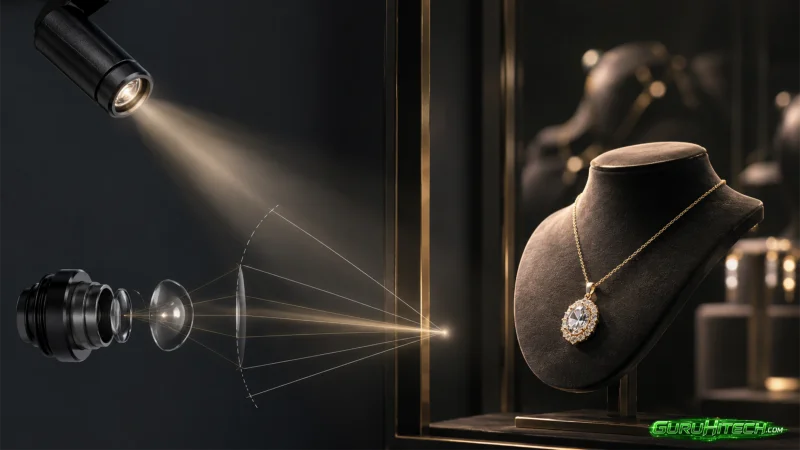
The Spatial and Photometric Conflict in Showcase Lighting
In the specialized field of high-end retail and jewelry display lighting, optical and structural engineers are tasked with resolving two directly competing requirements: generating massive Center Beam Candlepower (CBCP) to induce scintillation, while simultaneously minimizing the luminaire’s physical footprint to the point of invisibility.
Scintillation—the rapid, intense flashing of light reflected from the multiple facets of a diamond or polished metal—requires a highly concentrated, narrow beam of light. Ambient or diffused lighting flatters organic textures but renders jewelry dull and lifeless. To create the necessary visual contrast, the light source must deliver a sharp, highly directional punch.
Simultaneously, the physical constraints of modern showcase design demand extreme miniaturization. Retail architects require lighting hardware to disappear, meaning the mechanical housings for showcase stem lights or micro-track systems are often restricted to an outer diameter of just 12mm to 15mm.
This creates a severe optical conflict. To achieve high lumen output, engineers utilize high-power, single-die LED packages, such as the industry-standard 3030 or 3535 formats. However, these LEDs inherently emit light in a wide 120° Lambertian distribution. Capturing these highly divergent photons and compressing them into a tight 10° or 15° beam—all within the microscopic confines of a 12mm aluminum tube—represents one of the most demanding challenges in secondary optical engineering.
The Physical Limits of Miniaturization and the Law of Étendue
Many people believe that optical systems in luminaires can simply be scaled down without affecting performance. However, this assumption is incorrect. In reality, optical miniaturization is limited by a physical principle called Étendue.
Étendue describes how light spreads in both area and angle. Because of this law, engineers cannot reduce the beam angle unless they increase the diameter of the optic. This limitation becomes critical in compact lighting applications.
For example, a 3030 LED has a footprint of just 3.0mm × 3.0mm. When designers combine this LED with a 10mm optic, the available space becomes extremely limited. As a result, traditional optical solutions struggle to maintain proper beam control.
In many cases, engineers attempt to use a miniaturized vacuum-metallized reflector. However, this approach creates serious optical problems. The micro-reflector can only control the lateral light rays. Meanwhile, the intense forward-emitting rays escape the fixture without proper collimation.
Consequently, the beam quickly becomes too wide. Instead of producing a precise narrow beam, the light often spreads to 40° or more. This excessive spill light reduces the Center Beam Candle Power (CBCP) required for demanding applications such as jewelry display lighting.
Moreover, uncontrolled light creates strong direct glare. Customers may experience uncomfortable brightness directly in their eyes, which negatively impacts both visibility and the overall shopping experience.
For these reasons, designing effective 10mm single-lens optics requires advanced engineering solutions. Modern optical systems must optimize beam precision, glare reduction, and CBCP performance while working within extremely small geometrical constraints.
Total Internal Reflection (TIR) Collimation in a Micro-Footprint
To overcome the limitations of Étendue and eliminate uncollimated spill light within a microscopic footprint, engineers must abandon standard reflectors and utilize precision Total Internal Reflection (TIR) lenses.
A micro TIR lens is an injection-molded solid polymer optic (typically optical-grade PC or PMMA) that employs a dual-stage light-capturing mechanism. The physical structure of the lens is engineered to manipulate every single photon emitted by the LED die:
- The Central Refractive Dome: The center of the lens features a convex curve positioned directly over the LED. This refractive surface intercepts the forward-emitting rays (the light that would normally escape a reflector) and bends them into a tight, parallel beam.
- The Outer Reflective Cone: The lateral light rays emitted at high angles (from 45° to 120°) enter the solid body of the lens and strike the outer parabolic walls. Because these rays hit the boundary between the high-density polymer and the low-density surrounding air at an angle greater than the critical angle, they undergo Total Internal Reflection. They are forcefully reflected forward, joining the central collimated beam.
- By utilizing both refraction and internal reflection simultaneously, a TIR lens achieves an optical efficiency approaching 95%. Unlike a micro-reflector, there is no uncontrolled light escape. This total photon management is the only engineering mechanism that allows a lens as small as 10mm to successfully collimate a 3030 LED into a mathematically precise, ultra-narrow beam. By completely eliminating the peripheral spill light, the micro TIR lens maximizes the CBCP right onto the target merchandise, delivering the high-contrast punch required for premium retail displays without inducing occupant glare.
Photometric Versatility via Standardized Footprints
Beyond the immediate physics of photon collimation, luminaire manufacturers face a significant mechanical and economic challenge: the extreme variability of retail display geometries.
Showcase environments are not uniform. A tall, vertical museum-style jewelry case may require an ultra-narrow 10° or 15° beam to drive lux all the way down to the bottom deck without scattering light onto the glass walls. Conversely, a shallow, horizontal countertop display case might require a 24° or 36° beam to evenly wash a wider tray of watches without creating harsh, localized hot spots.
From a manufacturing perspective, designing, machining, and stocking a unique micro-aluminum housing and customized LED board for every required beam angle is financially unviable. The tooling costs and inventory overhead (BOM complexity) would immediately erode profit margins.
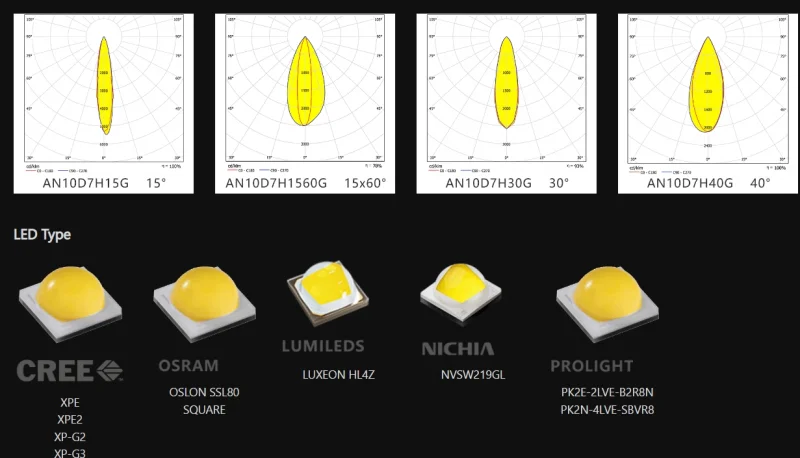
The engineering solution to this variability is the utilization of a standardized dimensional optical platform. By specifying a modular lens family, such as the AN Series-10mm, structural engineers can decouple the luminaire’s mechanical design from its optical performance.
The primary mechanical advantage of this specific series is its strict dimensional consistency. Every lens in the sequence shares the exact same 10mm outer diameter and identical mounting height. The variation in beam angle is achieved entirely through microscopic modifications to the internal refractive dome and the surface texture of the polymer during the injection molding process—not by altering the physical footprint of the optic.
This standardization allows a luminaire manufacturer to machine a single, universal micro-cylinder housing and utilize a single 3030 LED printed circuit board. On the assembly line, workers can fulfill vastly different photometric requirements simply by dropping a different 10mm lens into the fixture.
An order for a high-contrast diamond display is built with the 10° lens, while an order for a wider ambient cabinet uses the 36° lens—both utilizing the exact same metalwork and thermal management system. This modularity drastically reduces the Bill of Materials (BOM), accelerates assembly time, and significantly lowers the barrier to offering a comprehensive, professional-grade lighting portfolio.
Conclusion: Engineering the Visual Experience in Micro-Spaces
In the specialized sector of micro-accent lighting, miniaturization is not merely a design aesthetic; it is a rigid mechanical constraint that inherently fights against the laws of optical physics. As the diameter of the luminaire shrinks, the engineering barrier to controlling high-lumen LEDs rises exponentially.
Traditional reflective optics fail in these sub-15mm environments, creating severe spill light, degrading the Center Beam Candlepower, and introducing unacceptable levels of direct glare into the retail space.
By integrating precision-molded 10mm TIR lenses, structural and optical engineers can successfully overcome the limitations of Étendue. These solid-state optics capture and redirect nearly 100% of the emitted photons, allowing a highly constrained micro-fixture to output the intense, clean, and sharply defined beams required for premium displays.
Ultimately, this level of total photon management not only solves the mechanical pain points of micro-assembly but ensures that the resulting illumination precisely highlights the merchandise, locking the customer’s visual focus entirely on the product rather than the light source.
Scopri di più da GuruHiTech
Abbonati per ricevere gli ultimi articoli inviati alla tua e-mail.