
Top 3 Enterprise Post Quantum Security Solutions for DeFi on Solana (Quantum-Resistant)
Solana’s DeFi network already moves billions at lightning speed, yet quantum computing is racing even faster. Without stronger math, today’s elliptic-curve signatures will fall. The Solana Foundation previewed the fix on December 17 2025, when Project Eleven ran end-to-end post-quantum signatures at full throughput. According to a 2025 Gartner report, asymmetric encryption could be unsafe by 2029, so enterprises must start migrating before “harvest-now, decrypt-later” attacks pay off. In this guide, we rank the three most production-ready quantum-safe options and show when each one fits best.
The quantum threat to blockchain: myths vs reality
Quantum computers have left the lab and keep setting qubit records, eroding the math that protects private keys.
According to Gartner, asymmetric encryption could be unsafe by 2029, and “harvest-now, decrypt-later” attacks may already be in progress.
That matters because Solana, like most blockchains, signs every transaction with elliptic-curve math. Shor’s algorithm can reveal those private keys once hardware scales, letting attackers calculate what users never share.
Some developers shrug, saying they will patch the network when forced. According to Cointelegraph, the Solana Foundation’s Project Eleven pilot showed that swapping in post-quantum signatures is a multi-year lift that must start well before an emergency. A follow-up threat assessment by Project 11 mapped the first quantum-vulnerable surfaces—validator identity keys, replayable wallet signatures, and consensus messages—and estimated that hardening them would touch more than 20 000 lines of Solana code. The open-source Project 11 toolkit now packages the recommended Dilithium primitives into a Solana-ready SDK, so engineering teams can spin up local clusters and measure real TPS and fee impact before the mainnet fork.
Others claim the danger is decades away. Even Ethereum’s Vitalik Buterin and Blockstream’s Adam Back differ on timelines. The real risk sits in between: adversaries can record data today and decrypt it later, so postponing action invites silent compromise.
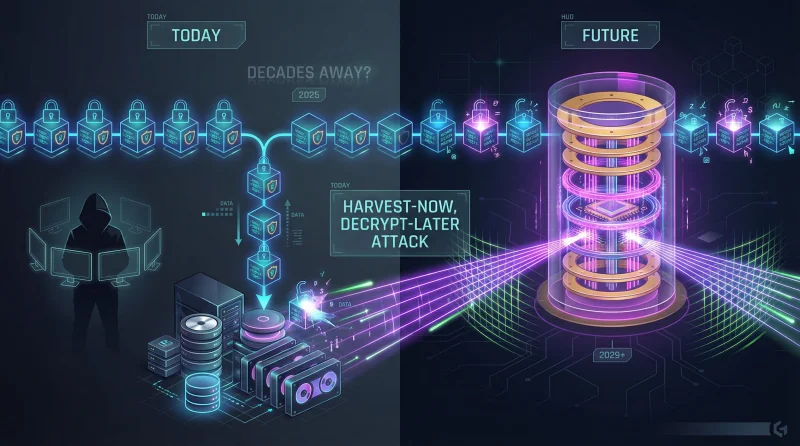
Performance anxiety is another myth. Cointelegraph reported that Solana’s testnet still pushed tens of thousands of transactions per second and verified them faster than Ed25519, even with larger post-quantum signatures.
Bottom line: quantum threats are real, the clock is ticking, and the migration will take years, not weekends. Clear criteria and practical tools are the only way to future-proof your DeFi stack before attackers future-proof theirs.
How we judge a quantum-ready solution
Before we name any front-runner, we need a yardstick.
Enterprises care about more than math proofs. They juggle uptime, user experience, audits, and board-level risk, so we built a six-point scorecard that balances technical strength with business reality.
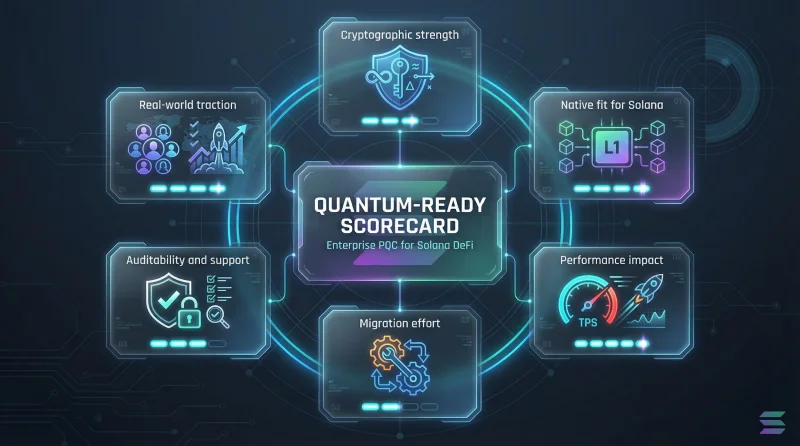
- Cryptographic strength We look for algorithms already vetted by NIST (lattice or hash based) with no red flags in the literature.
- Native fit for Solana A solution can live at layer 1, inside a smart contract, or off-chain in custody software. The deeper the integration, the wider the protection.
- Performance impact Speed defines Solana. Any fix that drags TPS or inflates fees drops in the rankings.
- Migration effort Hard forks and key rotations cost real money. We favor options that let teams roll out changes without a crisis.
- Auditability and support Open code, third-party reviews, and professional SLAs build executive confidence faster than white-paper promises.
- Real-world traction Testnets, pilots, or paying customers separate proven tools from weekend experiments.
Keep these criteria in mind as we examine each contender. They explain why some approaches look elegant on paper yet stumble in production, while others tick the boxes enterprise security teams need.
1. Project Eleven lattice-based signatures
Project Eleven stands at the front of the race. In its December 16 2025 bulletin, Post-Quantum Security for the Solana Network, Project Eleven details how it partnered with the Solana Foundation to replace Ed25519 keys with lattice signatures and run a full-scale testnet.
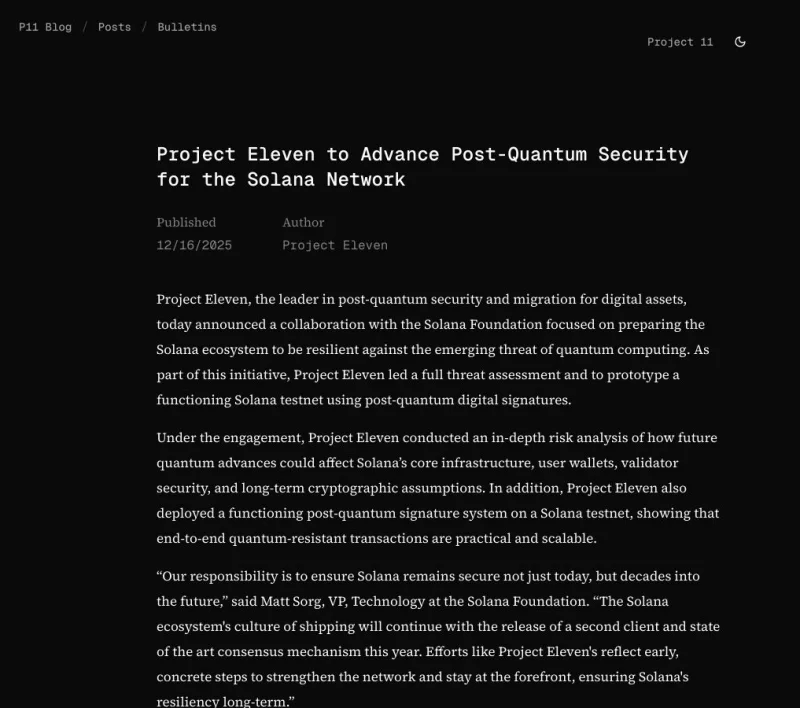
The outcome: normal block times, no backlog, and fully quantum-safe transactions. Cointelegraph’s coverage of the public demo on December 17 2025 proved that end-to-end protection can keep pace with Solana’s trademark speed.
Why it matters: lattice algorithms such as CRYSTALS-Dilithium lead the NIST shortlist. They verify quickly, resist both classical and quantum attacks, and avoid patent hurdles that slow adoption. By wiring them into Solana’s consensus layer, Project Eleven shields every wallet, contract, and validator.
Performance remains strong. Signing is about five times slower than legacy curves, yet verification runs faster, and the network still streamed more than 50 000 TPS during testing. Speed and safety coexist.
The challenge is coordination. Moving from pilot to mainnet means new key formats, wallet updates, and a carefully planned hard fork. That work will take months of testing and community approval, but the groundwork has started. Enterprises that align with the roadmap now will glide through the cut-over later.
If your business runs core infrastructure such as validators, RPC services, or high-value protocols, watch this solution closely. Join the next testnet, budget for hardware that handles larger keys, and draft a key-rotation playbook today so you are ready when Solana flips the switch.
2. Winternitz one-time vault: a hash-based safeguard for long-term funds
Not every team can wait for a protocol upgrade. Some need quantum cover now, especially for assets that rarely move. The Winternitz vault fills that gap.
Created by researchers at Zeus Network, the vault swaps Solana’s reusable public keys for one-time, hash-based signatures. Each withdrawal burns its key and creates a new one, so cracking yesterday’s math yields nothing today. The design relies on Keccak-256 hashes trimmed to 224 bits, a length that resists Grover’s quadratic speed-up and keeps brute-force attacks impractical, according to QuantumZeitgeist.
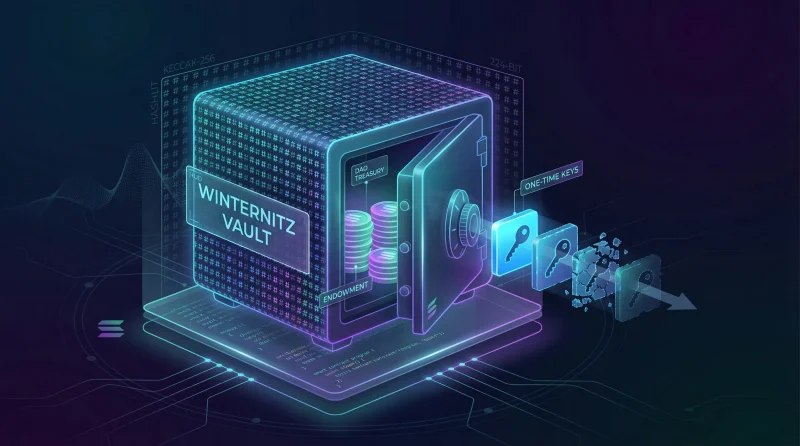
Why pick hashes over lattices? Simplicity. Hash functions are battle-tested, quantum-resistant by nature, and already accelerated in common hardware. The vault sits entirely in a Solana program, letting you deposit tokens without custom wallets or validator changes.
Trade-offs exist. Signatures swell from 64 bytes to several kilobytes, raising fees. One-time keys also need housekeeping. A busy trading desk might burn through indices quickly, but a DAO treasury or foundation endowment moves funds only a few times a year. For them, overhead stays low while security gains are high.
Getting started is direct: clone the open-source repo, commission a small audit, and migrate a slice of cold storage. You will lock those coins behind quantum-safe walls while the wider network evolves, giving you a self-managed insurance layer that does not depend on future consensus.
3. Quantum-safe custody: enterprise-grade key protection
Your private key is the crown jewel. Lose it and every other control fails.
Major custodians already weave post-quantum cryptography into their hardware security modules. Platforms such as Fireblocks pair FIPS-certified modules from vendors like Thales with dual-signature policies: one classical key for the network, one lattice key sealed inside the HSM. An attacker would need to break both cryptosystems and the tamper-proof hardware to steal a single coin.
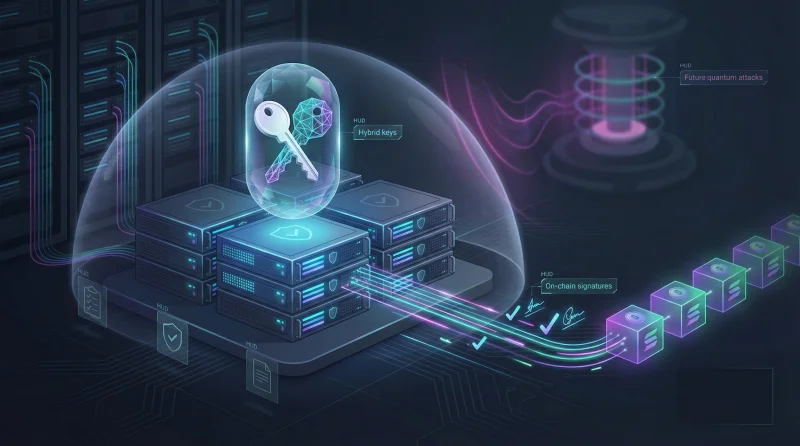
The advantage is immediacy. You keep using standard Ed25519 signatures on-chain while keys rest behind quantum-ready walls off-chain. No forks, no new wallet flows, just stronger steel around the vault.
Performance overhead is negligible. Signing happens inside the module in microseconds, well under normal network latency. Compliance teams also gain audited key ceremonies, access controls, and logs that fit existing SOC 2 and ISO frameworks.
Limitations remain. If Solana never upgrades, a future quantum computer could still forge an on-chain signature even though it cannot read your HSM. Custody alone is a shield, not a force field. As a bridge strategy, however, it buys time until the network migrates.
If you run an exchange, a lending desk, or any service that handles other people’s assets, start here. Ask your custodian for a post-quantum roadmap, insist on hybrid keys, and bake quantum-safe requirements into vendor contracts now. You will roll into the wider upgrade with no fire drills and full regulatory cover.
Comparing the contenders at a glance
We have three strong paths to quantum safety, each tailored to a different risk profile. Use the table below to match the right option to your stack.
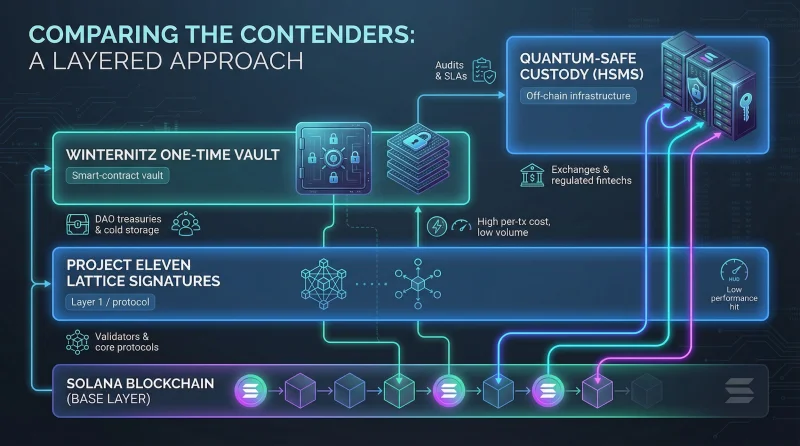
| Criteria | Project Eleven lattice signatures | Winternitz one-time vault | Quantum-safe custody |
| Cryptography | NIST-aligned lattice (Dilithium class) | Hash-based WOTS | Hybrid keys in HSM (lattice + Ed25519) |
| Integration level | Layer 1 protocol | Smart-contract vault | Off-chain infrastructure |
| Performance hit | Low (sign slower, verify faster; TPS steady) | High per transaction; fine for low-frequency moves | Negligible on-chain |
| Migration effort | Network-wide fork and key rotation | Opt-in deposit flow | Update custodian or HSM firmware |
| Audit & support | Backed by Solana Foundation | Community-audited open source | Full enterprise SLAs |
| Ideal user | Core infrastructure, high-TVL protocols | DAO treasuries, cold storage | Exchanges, regulated fintechs |
Think of these options as complementary layers rather than rivals. Many teams will start with quantum-safe custody, vault long-term funds in a hash-based contract, and adopt lattice keys at the protocol level once ready. Balance speed, cost, and longevity to stay ahead of quantum-enabled attackers.
How to choose the right quantum-resistant approach
Start by mapping your risk surface. Ask two questions: How often do we move funds, and who audits our security?
If you run validator nodes or a high-TVL protocol, follow Project Eleven’s roadmap. Join testnets, budget for hardware that can process larger keys, and line up wallet updates. Your reputation grows when the network turns quantum-safe and you helped build the fix.
Hold large but slow-moving assets, such as a DAO treasury? Route them to the Winternitz vault. Signatures are bulky, yet transaction volume is low, so the fee premium stays modest while protection remains absolute.
Operate under banking or securities rules? Secure keys with quantum-safe custody now. Regulators value preventive controls, and hybrid HSMs add an audited trail without changing end-user workflows.
Most teams choose a blend. Custody offers instant protection, the vault shields cold storage, and the protocol upgrade completes the loop. Pick your sequence, set milestones, and review progress each quarter to keep quantum risk front and center without derailing product plans.
Ti potrebbe interessare:
Segui guruhitech su:
- Google News: bit.ly/gurugooglenews
- Telegram: t.me/guruhitech
- Facebook: facebook.com/guruhitechfb
- Instagram: instagram.com/guruhitech_official/
- X (Twitter): x.com/guruhitech1
- Bluesky: bsky.app/profile/guruhitech.bsky.social
- Rumble: rumble.com/user/guruhitech
- VKontakte: vk.com/guruhitech
- MeWe: mewe.com/i/guruhitech
- Skype: live:.cid.d4cf3836b772da8a
- WhatsApp: bit.ly/whatsappguruhitech
Esprimi il tuo parere!
Ti è stato utile questo articolo? Lascia un commento nell’apposita sezione che trovi più in basso e se ti va, iscriviti alla newsletter.
Per qualsiasi domanda, informazione o assistenza nel mondo della tecnologia, puoi inviare una email all’indirizzo [email protected].
Scopri di più da GuruHiTech
Abbonati per ricevere gli ultimi articoli inviati alla tua e-mail.