
From Portraits to Personas: How AI Image Tools Are Changing Digital Character Design
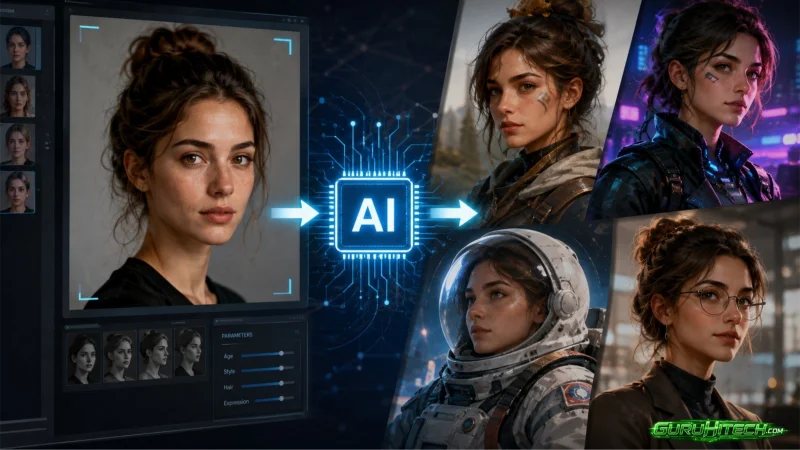
A character often starts with words, a novelist writes a few lines about a suspicious detective, a game developer sketches out an NPC. A YouTuber invents an exaggerated version of themselves for a thumbnail. Before long, the same problem appears: what should this person actually look like?
Until recently, turning that description into something visual usually meant drawing it yourself, searching through stock photos, or commissioning an illustrator. AI image tools have added another option. They make it possible to create a rough visual idea quickly, then keep adjusting it as the character takes shape.
What makes this interesting goes beyond simple image generation. Image creation and editing are starting to work more like an iterative design process, where each version builds on the last.
A first image is usually just a starting point
Anyone who has worked on a fictional character knows that descriptions tend to change. The stern-looking professor becomes younger. The jacket feels too formal. A villain who looked intimidating on paper comes across as strangely friendly once visualized.
This is where editing becomes more useful than starting from scratch each time.
With Pixlio, for example, its AI photo editor lets you both generate images from text and work from an existing image. The platform gives you access to several image models rather than locking you into a single generation system. You can also take an existing result into further editing, which keeps the experimentation in one place instead of jumping between tools.
That matters because character design rarely happens in one prompt.
Suppose a writer is developing a near-future thriller. An early reference image gets the protagonist’s face right, but the clothing feels too much like conventional science fiction. Instead of abandoning the image, the writer can ask for a more ordinary coat, different lighting, or a less dramatic setting.
The same approach works outside fiction. Streamers, indie game developers, marketers and social media creators often need recurring visual personas. Keeping a useful starting image and modifying specific details can be much faster than rebuilding the concept every time.
Exaggeration can reveal more than realism
Photorealism is not always the most useful way to understand a character.
Sometimes exaggerating a face makes certain traits clearer. A nervous expression can become part of the character’s visual identity. Thick eyebrows, an unusually sharp jawline or a carefully styled haircut may be more memorable when pushed slightly beyond realism.
Caricature has worked this way for a long time. What AI changes is accessibility.
A creator can now take an existing portrait and run it through a caricature maker without manually drawing the transformation. Pixlio’s tool is designed to preserve recognizable facial features, hairstyle, pose and overall identity while applying exaggerated linework and stylized shading. It also includes four different treatments: Classic Caricature, Editorial Cartoon, Soft Friendly Caricature and Bold Comic Caricature.
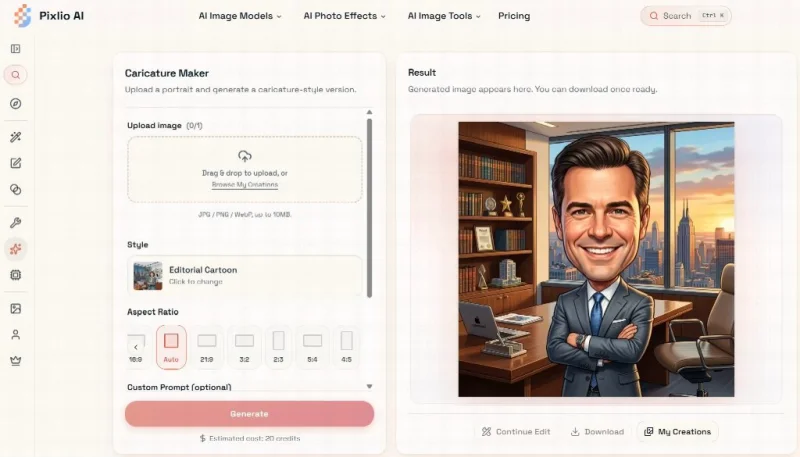
That opens up some less obvious uses.
A screenwriter might use caricature versions of characters when preparing an informal concept board, a comedy podcast could turn hosts into recurring illustrated personas. A game designer could explore whether a realistic NPC becomes more distinctive when translated into a stronger graphic style, a creator planning stickers, profile artwork or humorous thumbnails could start from the same portrait rather than commissioning each interpretation separately.
The result does not have to become the finished asset. Quite often, it is more useful as a direction.
Consistency matters more than one impressive image
AI image generation can produce a great isolated picture, but it still struggles with projects that require the same character to show up again and again.
The problem becomes obvious when creating a series. A hairstyle subtly changes, a face becomes narrower. A jacket gains different buttons. The person still looks plausible, but no longer quite looks like the same person.
A practical workflow can reduce this problem.
Instead of describing the character from zero for every image, keep a small set of approved references. Choose one image where the face works, another where the clothing is right, and perhaps a third that captures the desired mood. When making changes, alter as few variables as possible.
This is less exciting than typing one enormous prompt and hoping for perfection, but it tends to produce more consistent results.
It also helps to separate permanent traits from scene-specific ones. Face shape, hair, age range and signature accessories belong in the first category. Lighting, expression, location and clothing variations belong in the second. That simple distinction makes revisions easier to control.
The prompt should describe what can be seen
Writers naturally think in terms of personality. Image models need something more concrete.
“An arrogant man hiding insecurity” may be useful in a novel, but visually it leaves plenty of room for interpretation. A better image prompt might describe his rigid posture, carefully tailored clothes, tense mouth and habit of avoiding direct eye contact.
The goal is not to write longer prompts for the sake of length. It is to translate internal characteristics into visible clues.
This becomes especially useful when editing. Instead of saying “make him more interesting,” ask for a slightly tired expression, messier hair, a faded coat, or harsher side lighting. Each request gives the image system something observable to change.
There is also value in leaving some things unresolved. Over-specifying every detail can make exploration harder. Early character work benefits from variation, particularly when the creator is not yet sure what the final design should be.
AI references are not the final character
It is tempting to treat a polished generated image as a finished decision. That can narrow the creative process too early.
A reference image works better as a conversation between an idea and its visual interpretation. Sometimes the AI gets something unexpectedly right. Sometimes it produces a detail that looks convincing but contradicts the story. Both outcomes are useful.
Pixlio and similar browser-based image tools make this kind of experimentation much quicker, but the creative judgment still belongs to the person using them. The writer decides whether the face matches the character. So this designer decides whether exaggeration strengthens the concept or turns it into a joke. The creator decides which variations are worth keeping.
That may be the most practical role for AI image tools in character design. They do not need to replace illustrators, photographers or careful art direction to be useful. They can simply shorten the distance between “I have an idea of this person” and “now I can see what that idea looks like.”
And once the character is visible, it often becomes much easier to decide what should change next.
Ti potrebbe interessare:
Segui guruhitech su:
- Google News: bit.ly/gurugooglenews
- Telegram: t.me/guruhitech
- Facebook: facebook.com/guruhitechfb
- Instagram: instagram.com/guruhitech_official/
- X (Twitter): x.com/guruhitech1
- Bluesky: bsky.app/profile/guruhitech.bsky.social
- Rumble: rumble.com/user/guruhitech
- VKontakte: vk.com/guruhitech
- MeWe: mewe.com/i/guruhitech
- Skype: live:.cid.d4cf3836b772da8a
- WhatsApp: bit.ly/whatsappguruhitech
Esprimi il tuo parere!
Ti è stato utile questo articolo? Lascia un commento nell’apposita sezione che trovi più in basso e se ti va, iscriviti alla newsletter.
Per qualsiasi domanda, informazione o assistenza nel mondo della tecnologia, puoi inviare una email all’indirizzo [email protected].
Scopri di più da GuruHiTech
Abbonati per ricevere gli ultimi articoli inviati alla tua e-mail.