
How Automation and Injection Molding Power Modern Cosmetic Packaging
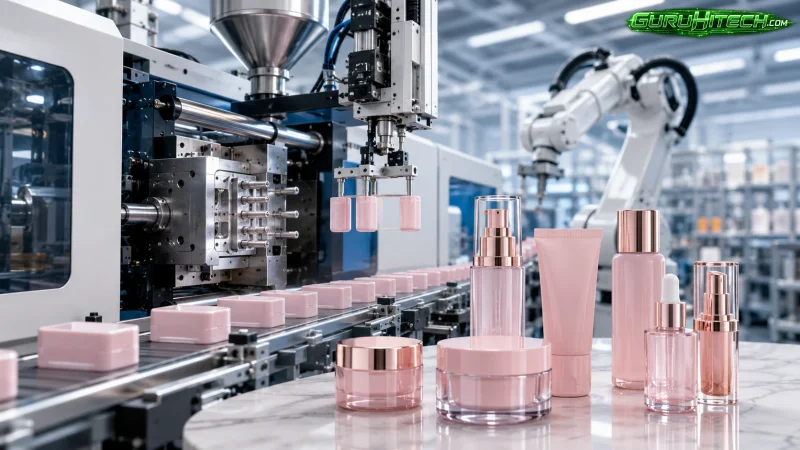
The bottle of serum on a pharmacy shelf looks simple. A cylindrical body, a pump head, a printed logo. But producing 20 million of those bottles a year — each one dimensionally identical, leak-free, and decorated to an exact brand specification — requires the same class of industrial technology that makes car components and medical devices.
This is the story of what actually happens between a bag of plastic pellets and a finished product on a beauty shelf. It is less glamorous than the branding, and more interesting than most people assume.
Injection Molding 101: From Plastic Pellets to Precise Parts
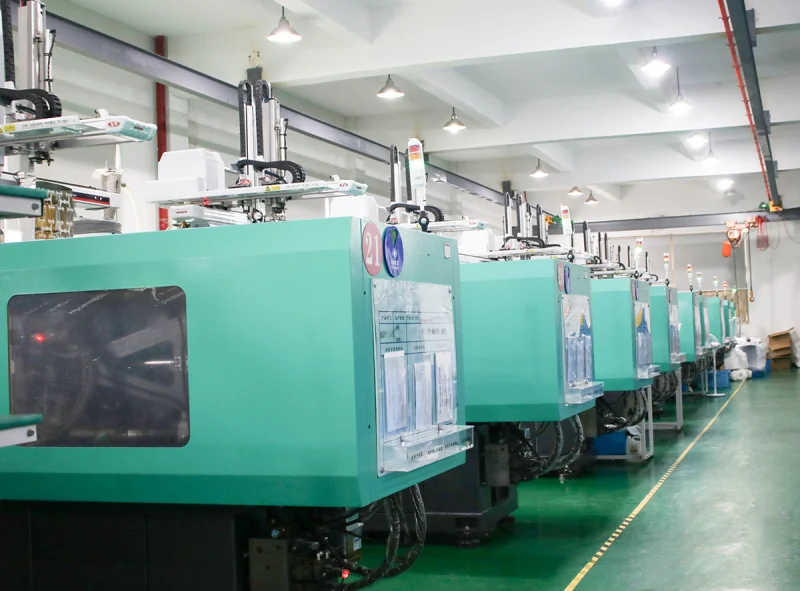
Injection molding is the dominant manufacturing process for plastic parts made at scale, and for good reason. It is fast, repeatable, and capable of holding dimensional tolerances that most other plastic-forming processes cannot match. Cycle times typically run between 15 and 60 seconds per part, depending on geometry and wall thickness. Once a mold is running correctly, every part that comes out of it is functionally identical to the last — which is exactly what cosmetic packaging requires.
The process runs in four stages:
1. Melting. Raw plastic pellets — typically polypropylene (PP), PETG, or ABS for cosmetic packaging — sit in a hopper above the injection molding machine. They feed into a heated barrel where a rotating screw applies both friction and heat, melting the resin into a viscous liquid within a controlled temperature range.
2. Injection. The molten plastic is pushed under high pressure through a nozzle into a closed steel mold, filling every cavity in the mold in seconds. The pressure ensures the plastic reaches every corner of the mold geometry before it begins to cool.
3. Cooling. The mold stays closed while the plastic solidifies. Cooling channels machined into the mold tool circulate water or oil to draw heat out of the part quickly. This is the most time-sensitive stage — cooling too fast causes warping, cooling too slowly slows throughput.
4. Ejection. The mold opens, ejector pins push the finished part clear, and the mold closes again immediately. The entire sequence begins again within seconds.
What makes injection molding technically demanding at cosmetic packaging scale is the combination of high volume, tight tolerance, and surface finish requirements. A jar or airless bottle is not just a container — it is a component that must assemble precisely with a pump head, a cap, and a piston. Every part needs to arrive from the mold within specification, batch after batch.
Multi-Cavity Tooling: Where Throughput Comes From
A single-cavity mold produces one part per cycle, a 4-cavity mold produces four, a 16-cavity mold produces sixteen — in the same machine, in the same cycle time. This is how high-volume packaging factories achieve the output numbers that make large-scale supply possible.
The economics are direct: as cavity count increases, the fixed overhead per part — machine time, operator labor, energy, material handling — is distributed across more units per cycle. Adding cavities to a mold is significantly more cost-effective than adding machines. The tradeoff is engineering complexity. A 16-cavity mold requires a perfectly balanced runner system — the network of channels that carries molten plastic from the injection nozzle to each cavity. If one cavity fills faster than another, parts vary. If cavities see different pressures, wall thickness shifts. Getting all sixteen to fill simultaneously, at the same temperature and pressure, requires precision mold design and simulation before the steel is ever cut.
| Single Cavity | 4-Cavity | 8-Cavity | 16-Cavity | |
| Parts per cycle | 1 | 4 | 8 | 16 |
| Per-unit cost | Highest | Reduced | Lower | Lowest |
| Engineering complexity | Simple | Moderate | High | Very high |
| Best for | Prototyping | Mid volume | High volume | Repeat large orders |
In a cosmetic packaging context, different components within the same bottle run in different cavity configurations. A complex pump body might run in a 4-cavity tool because its geometry limits cavitation. A simpler overcap might run in a 16-cavity tool because its geometry allows it. Managing the mix across a fleet of machines — assigning the right tool to the right press — is where production planning becomes as important as engineering.
In-House Decoration: Silk Screen, Hot Stamping, Electroplating, Spraying
Once components come off the injection molding line, they are raw plastic. Functional, dimensionally correct, but visually unremarkable. The decoration process is what transforms them into branded packaging — and it is a sequence of separate industrial processes, each requiring its own equipment and quality control pass.
| Technique | How it works | Visual result | Typical application |
| Silk-screen printing | Ink forced through a mesh screen onto the surface, one colour per pass | Matte or glossy logo, sharp text edges | Brand logos, product names, functional text |
| Hot stamping | Heat and pressure transfer metallic foil from a carrier film to the surface | Reflective metallic finish, gold or silver | Premium logo accents, cap bands, luxury positioning |
| Electroplating | Electrochemical process deposits a thin metal layer onto ABS or metal parts | High-gloss chrome or gold, corrosion-resistant | Pump heads, caps, closures where metal look is required |
| Spray coating | Atomised paint applied via spray gun, cured under UV or heat | Custom brand colour, matte, gloss, or soft-touch finish | Bottle body colour, frosted effects, velvety tactile finish |
Many finished packages layer several of these techniques on the same component. A typical sequence for a premium airless bottle might be: spray coat the outer shell in the brand’s custom colour, silk-screen the logo in one or two passes, then hot-stamp a metallic foil accent on the actuator. Each pass goes through its own line, its own curing or drying process, and its own visual inspection before the next step begins.
When decoration is handled in-house — when the same factory that runs the injection molding machines also runs the silk-screen line, the hot-stamp press, the electroplating tanks, and the spray booths — quality control stays under one roof. Defects can be traced back to a specific machine, a specific shift, a specific batch of ink or foil. When decoration is subcontracted to a separate facility, that traceability breaks. A discoloured logo or adhesion failure becomes a blame conversation between two parties, neither of which has full visibility over the other’s process.
Processing Recycled Resin: The Harder Engineering Problem
Everything described above assumes virgin plastic: a consistent resin with predictable melt flow, stable colour, and well-characterised processing behaviour. Running post-consumer recycled resin through the same equipment requires a different approach — and it is where the gap between factories that can deliver credible PCR claims and those that cannot becomes very clear.
PCR pellets are manufactured from collected consumer plastic waste. The process runs through five stages: collection from municipal recycling streams, sorting by resin type using near-infrared scanners, washing and decontamination, mechanical grinding into flakes, and re-extrusion into pellets. Those pellets enter an injection molding machine in the same way as virgin resin. But they do not behave the same way.
Three specific differences show up consistently on the production floor. First, the melt flow index varies between batches because the source material — even when sorted to a single resin type — comes from products that were made to different original specifications. Second, residual odour is common in PCR polypropylene and requires additional venting capacity in the injection barrel to prevent it from affecting the finished part. Third, colour shifts unless the factory pre-compounds the recycled pellets with a masterbatch colourant before molding begins — raw PCR PP tends toward grey or yellow tones that do not match brand colour standards straight from the bag.
Factories that manage PCR resin in-house — blending, compounding, and adjusting machine parameters for each batch of recycled feedstock — can control all three of these variables. They can document the exact recycled content percentage per production run, which is what brands need for regulatory compliance and retailer sustainability requirements. Factories that buy spot-market PCR and run it through machines calibrated for virgin resin typically cannot provide that documentation — and often cannot maintain consistent quality across runs.
A modern injection molding cosmetic packaging manufacturer such as Oulete runs 20 injection-molding machines with capacity for over 20 million sets a year, keeping forming, decoration, and PCR resin compounding under one roof at its Shaoxing, Zhejiang facility. The ZK airless series covers sizes from 5ml up to 50ml, with in-house PCR compounding delivering content from 10% to 50% recycled material per production batch. So the company states it holds ISO 9001, CE, SGS, and GMP certifications. The same integrated production model extends across its range of cosmetic tubes — where the combination of injection molding, in-house decoration, and PCR capability gives brands a single source for their full packaging range rather than managing separate suppliers for different formats.
The Unglamorous Industrial Technology Behind a Premium Shelf
When a consumer picks up a serum and notices the weight of the bottle, the precision of the pump mechanism, the cleanness of the logo, the exact colour of the cap — they are experiencing the cumulative result of steel molds machined to micron tolerances, injection cycles timed to the second, multi-cavity tooling balanced for uniform fill, and decoration lines running four separate finishing passes on the same component.
None of this is visible. None of it appears on the brand’s marketing materials. But every element of perceived quality — the feel, the weight, the dispensing precision, the shelf life — is a direct output of the industrial choices made before the product ever reached a filling line.
The global cosmetic packaging market is projected to grow from approximately USD 37.8 billion in 2025 to USD 58.7 billion by 2035, according to market analysis by Grand View Research. Behind that growth is not just consumer demand for better beauty products — it is the expansion of the manufacturing infrastructure capable of producing those products at scale, with the material sustainability and decoration quality that modern retail channels require.
The beauty shelf looks effortless. The factory making it possible is running 24-hour injection cycles, managing sixteen-cavity mold balancing problems, and figuring out how to process recycled resin that behaves differently every batch. That is the technology story behind the product.
Scopri di più da GuruHiTech
Abbonati per ricevere gli ultimi articoli inviati alla tua e-mail.