
How EdTech Quietly Rewired the Private Tutoring Market

Private tutoring is one of the oldest services in education, and for most of its history it was also one of the least visible. It ran on word of mouth, cash, and kitchen tables. It grew so quietly, and on such a scale, that global education bodies began studying it under a name of its own , “shadow education,” the private lessons that trail alongside formal schooling. What almost no one predicted was how completely technology would drag that shadow into the light.
Over the past decade, EdTech did far more than bolt a video call onto an old service. It rebuilt the market’s underlying machinery. A neighbourhood tutor became a marketplace of thousands, a monthly cash payment became a subscription. A vague sense that “the sessions are helping” became a dashboard of progress data. Most parents never noticed the shift happening , which is exactly why it worked.
This is the story of that rewiring: what changed, why it happened so quietly, and what it means for anyone who teaches, learns, or builds in the space.
A Market That Grew Up Online
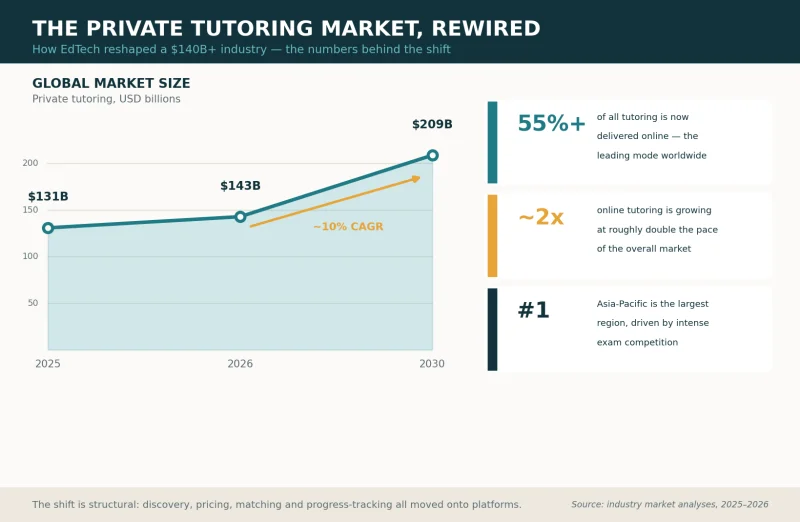
Start with the scale, because it is easy to underestimate. Analysts put the global private tutoring market at roughly $143 billion in 2026, up from about $131 billion a year earlier, with projections pushing past $200 billion by the end of the decade. Growth like that is impressive on its own. The more interesting part is where it is coming from.
- Online is the engine. Digital delivery is now the leading mode of tutoring worldwide, accounting for more than half of the market in many regions.
- It moves twice as fast. Online tutoring is growing at roughly double the pace of the industry overall, with several estimates placing its annual growth above 20 percent.
- Asia leads, America specialises. Asia-Pacific remains the largest regional market, powered by fierce academic competition, while North America leads on test preparation and AI-driven platforms.
Behind those headline figures sits a simple demand story. Academic competition keeps intensifying, standardised testing keeps expanding, and parents keep concluding that a few focused hours are worth paying for. What technology added was supply and reach: it made that demand far easier to satisfy, and far easier to scale. A tutor who once served a dozen local families can now, in principle, reach a waitlist that spans continents.
Ten years ago the picture was overwhelmingly in-person and local. Today the fastest-moving money is digital, cross-border, and routed through platforms. That single change of venue is what set everything else in motion.
What “Rewired” Actually Means
Technology did not simply digitise tutoring. It rewrote four things underneath it , and each one quietly shifted the balance of power between tutors, families, and platforms.
Discovery stopped being a neighbourhood problem
For generations, finding a tutor meant asking around. Your options were bounded by your postcode and your social circle. Search, reviews, and filters erased that boundary. A student in a small town can now book a specialist who lives three time zones away and judge them on ratings before the first session. It also broke the local pricing monopoly: when the only tutors you can reach live nearby, they set the price; when you can reach thousands, the market does. Reputation became portable, and geography stopped being destiny.
Pricing became transparent , and unbundled
Rates that were once private and negotiable are now listed side by side. That transparency pushed pricing to unbundle. Instead of one open-ended hourly rate, families can buy a single exam-cram session, a monthly subscription, a package tied to a specific syllabus, or on-demand help by the question. It let families buy exactly the help they need , and let tutors package expertise into products rather than trading pure time.
Matching turned algorithmic
The old model matched on availability and luck. Platforms match on data: subject, level, learning style, past outcomes, even scheduling patterns. A good algorithm can pair a struggling algebra student with the tutor most likely to move their grade , a decision that used to rest entirely on a parent’s guesswork. And the platforms that match best keep more of their students, a feedback loop that compounds over time.
Progress became measurable
Perhaps the deepest change is that tutoring became legible. Session recordings, practice scores, attendance, and mastery tracking turned a fuzzy relationship into a stream of evidence. Parents can see what they are paying for. Tutors can prove their impact. Platforms can optimise the whole loop. Tutoring stopped being a leap of faith and started behaving like a measurable service.
Notice what these four changes have in common. Each one took something that used to live inside a single tutor’s head , their reputation, their rate, their judgment, their results , and turned it into shared, portable information. That is the real rewiring. Once information moves freely, markets reorganise themselves around it, and tutoring was no exception.
The New Tutoring Stack
Put those four shifts together and a modern tutoring service no longer looks like a person. It looks like a stack of coordinated tools. Platforms such as Talimat Education sit at the centre of that stack, connecting learners with vetted tutors while handling scheduling, payments, progress tracking, and lesson content in one place , the kind of end-to-end experience that a lone tutor with a phone and a notebook simply cannot match.
A typical modern stack now bundles:
- A vetted tutor marketplace with ratings, credentials, and subject specialisation.
- Scheduling and payments handled automatically, removing the awkward money conversation.
- A virtual classroom with a shared whiteboard, screen sharing, and recorded sessions.
- Analytics that turn every session into progress data parents can actually read.
- Content libraries , practice sets, past papers, and adaptive exercises , attached to each subject.
None of these pieces is revolutionary alone. Bundled into one seamless experience, they change what families expect tutoring to be , and raise the bar for anyone still operating the old way.
When AI Joined the Session
The most recent rewiring is happening inside the lesson itself. Generative AI is increasingly capable of handling routine instruction , explaining a concept three different ways, generating endless practice problems, marking work instantly, and never running out of patience at 11 p.m.
That is pushing the market toward a hybrid model. AI copilots take the repetitive load, while human tutors are repositioned toward the higher-value work machines still struggle with: motivation, accountability, exam strategy, and reading the moment a student is quietly giving up. The strongest platforms are not choosing between human and machine. They are choreographing both.
For tutors, this is less a threat than a promotion. The tedious parts of the job are being automated; the parts that require judgment and warmth are becoming the product.
The Equity Question Nobody Fully Solved
Not every consequence is flattering. Shadow education’s oldest problem is fairness , tutoring has always advantaged families who can pay for it , and technology cut both ways.
On one hand, online delivery lowered real barriers. It removed travel, widened access to specialists, and pushed some prices down through competition and self-paced tools. A motivated learner far from any good tutor suddenly had options.
On the other hand, it introduced new barriers that are easy to miss: a reliable device, stable internet, a quiet place to study, and the digital confidence to use the tools. When the best instruction moves online, students without those things can fall further behind. The gap did not close. It changed shape.
What It Means for Tutors, Parents, and Platforms
The rewiring is largely finished at the infrastructure level, which makes the practical takeaways fairly clear.
For tutors
Treat technology as leverage, not a rival. Build a visible track record, specialise sharply, and let platforms handle logistics so you can focus on teaching. Generic, all-subjects tutors are the most exposed; distinctive experts are the most protected.
For parents
Ask for evidence, not vibes. The modern market lets you compare credentials, read outcomes, and watch progress data , so use it. Match the format to the child: on-demand help for quick unblocking, structured programmes for exam campaigns.
For platforms and founders
The defensible advantage is no longer just the supply of tutors. It is the quality of matching, the clarity of outcomes, and the trust that flows from both. Whoever proves impact most credibly wins the next decade.
The Quiet Revolution
The strangest thing about this transformation is how invisible it stayed. There was no dramatic disruption moment, no single app that “killed” the private tutor. Instead, the market was rewired one ordinary decision at a time , a booking here, a subscription there, a progress report that made the next payment feel justified.
The private tutor did not disappear. They were absorbed into a system that finds them faster, prices them clearly, matches them smarter, and measures them constantly. For students and families, that mostly means better, more accountable help. For everyone building in the space, it means the old advantages have quietly expired , and the new ones belong to whoever takes teaching, and trust, most seriously.
Scopri di più da GuruHiTech
Abbonati per ricevere gli ultimi articoli inviati alla tua e-mail.