
How Voice Commerce Works in Mobile Apps
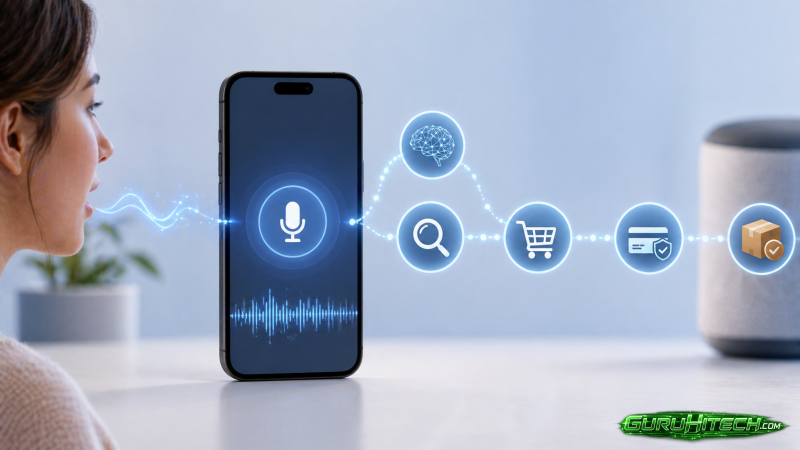
By 2026, voice commerce is projected to hit $80 billion in annual sales and yet most ecommerce brands still treat it as a “nice to have” feature rather than a revenue channel. That gap is a serious competitive opportunity. If your customers are already talking to their phones, shouldn’t your store be listening?
Voice commerce isn’t magic. It’s architecture. The brands winning in this space didn’t stumble into it. They made deliberate decisions about how their apps handle speech input, process intent, and close transactions without a single tap. Working with an ecommerce app development company that understands conversational UX is often the difference between a voice feature that gets used once and one that drives repeat purchases.
Let’s break down how it actually works and what that means for how you build or upgrade your app.
The Technical Stack Behind “Hey, Add That to My Cart”
When a user speaks into your app, they’re not triggering one system; they’re triggering four, in rapid sequence, in under two seconds. Most ecommerce teams think about the cute microphone button. Their developers are quietly sweating something much more complicated behind it.
It starts with speech recognition, converting audio into text. Sounds simple. It isn’t.
Google Cloud Speech-to-Text handles accents and background noise better than almost anything else on the market. Apple’s Speech framework is faster and works offline, which matters if your customers shop from spotty connections.
Amazon Transcribe sits in the middle. The “right” choice depends entirely on who your customers are and where they’re shopping from. If you serve international buyers, this single decision can make or break whether voice even feels usable to them.
From Speech to Intent: Where Voice Commerce Breaks
Once you have text, you have a new problem: text isn’t intent. “I want those blue running shoes I looked at last week” contains a product type, a color, a time reference, and an implied personalization request, all in one casual sentence. Here, Natural Language Processing engines like Dialogflow, Rasa, or AWS Lex earn their keep. They parse that sentence into structured data your backend can actually act on. Most voice features fail right here. They hear the words. They miss what the words mean.
Then comes the part that separates fast apps from frustrating ones: connecting that intent to your actual commerce data (your catalog, your inventory, your user’s history) in real time. This is where a mobile app development company in NYC with serious API integration experience is worth every dollar, because latency here isn’t just a technical problem, it’s a UX death sentence. Users will wait about two seconds. After that, they’re back to typing.
And finally, there’s how the app confirms and closes. The best voice commerce apps don’t just silently execute, they check in: “I found Nike Air Zoom Pegasus in size 10, $129. Add to cart?”
That one conversational step keeps the user in control and dramatically reduces accidental orders. Amazon’s Alexa skipped this early on, and the stories of people accidentally ordering $300 worth of random stuff became a punchline and eventually, a redesign.
Why Most Voice Features Fail (And How to Fix Yours)
Here’s a non-obvious insight: voice commerce fails less because of bad technology and more because of bad information architecture.
When a user says, “Order the protein powder I bought in January.” Your app needs to resolve “protein powder,” cross-reference purchase history, confirm the variant (flavor, size), check stock, and surface the right item — all before the user gets impatient. If your product taxonomy is messy or your search index isn’t well-structured, voice will expose those flaws immediately. Text search forgives vague queries. Voice does not.
The fix isn’t just better speech recognition — it’s cleaner data. Specifically:
- Product naming conventions matter. “Chocolate Whey Protein 2lb” is queryable. “SKU-4492-CHO-2” is not.
- Purchase history must be voice-accessible. Many apps store history in a silo that voice interfaces can’t easily reach. Break those walls down during your integration planning.
- Fallback flows need design love. When the voice fails to understand, what happens? A blank screen is death. A smart fallback, “I didn’t catch that. Did you mean protein supplements?” keeps the user in the funnel.
Personalization Is Where Voice Commerce Gets Interesting
Think about the last time you called a business you use regularly. If they recognized your voice and said, “same as last time?” you’d probably feel weirdly delighted by that. That’s the feeling voice commerce, done well, can create at scale.
For ecommerce businesses, this matters because your customers don’t shop in a vacuum. A user who says “I need something for a birthday gift under $50” is in a completely different buying mode than one who says “reorder my vitamins.” Your voice commerce layer should detect those differences and respond accordingly — with different product sets, different urgency messaging, and different upsell strategies.
The tech to do this exists today. Tools like Dynamic Yield and Nosto support real-time personalization APIs that can be triggered by parsed voice intent. The question isn’t whether the technology is ready. It’s whether your product team has mapped the intent signals worth responding to.
Security and Checkout: The Last Mile Problem
Getting a user to add items to a cart via voice is relatively easy. Getting them to complete a purchase is harder, and it should be, for good reason.
Voice-authenticated checkout is still maturing. Voiceprint verification (using the acoustic characteristics of a person’s voice as a biometric identifier) is available through services such as Nuance Gatekeeper and SpeechPro. Still, accuracy rates in noisy real-world environments hover around 95–97%. For a $12 coffee order, that’s fine. For a $600 purchase, most users and most fraud teams want more.
The practical solution most successful apps use today is a hybrid confirmation model: voice initiates the order, but a biometric confirmation (Face ID, fingerprint) or a quick PIN entry closes it. This adds one secure step without destroying the convenience that made voice appealing in the first place.
One thing I’ve observed working with mobile commerce teams: apps that try to make checkout 100% voice-driven tend to create more friction, not less. Users feel uneasy authorizing payments without some visual confirmation. A voice-first approach that still surfaces a clear “confirm purchase” screen consistently outperforms fully voice-only flows in both conversion and user satisfaction scores.
Building for Voice: Where to Start
Don’t start with a vision. Start with a complaint.
Pull up your last three months of customer support tickets or live chat logs and ask: what are people asking about over and over that doesn’t actually need a human to answer? Order status. Reorder requests. “Do you have this in a size 8?” Loyalty point balances. Return initiations.
That list is your voice roadmap. Those are the use cases that are high-frequency, low-complexity, and immediately valuable — to your customers and your support team. They’re also contained enough that you can build, test, and measure them quickly, without needing your whole backend to be “voice-ready” from day one.
From there, most teams naturally progress through three phases: first voice search (let people speak instead of type), then voice reorder (repeat a past purchase in one phrase), then voice discovery — the richer, more conversational browsing experience. Each phase builds on the plumbing from the last. The teams that try to skip straight to full voice assistants almost always roll back within a quarter. Not because the idea was wrong, but because the data architecture underneath wasn’t ready for it.
Crawl before you talk, basically.
The Bottom Line
Here’s the thing nobody says: voice commerce won’t save a mediocre app. If your product data is a mess, your search is broken, and your purchase history API is locked in a silo, voice will just expose all of that faster and more painfully than text ever did.
But if your foundation is solid? Voice is genuinely one of the lowest-friction ways to drive repeat purchases you can add right now. Not because it’s flashy. Because it meets people where they already are, talking to their phones, wanting things to just work.
The next step is simpler than most teams expect: spend a week auditing your product naming, your search index, and your purchase history accessibility. Those three things will tell you everything you need to know about whether you’re actually ready to build voice features or whether you have some unglamorous groundwork to do first. Either answer is useful.
Scopri di più da GuruHiTech
Abbonati per ricevere gli ultimi articoli inviati alla tua e-mail.