
How Warehouse Robotics Is Transforming Supply Chains in 2026
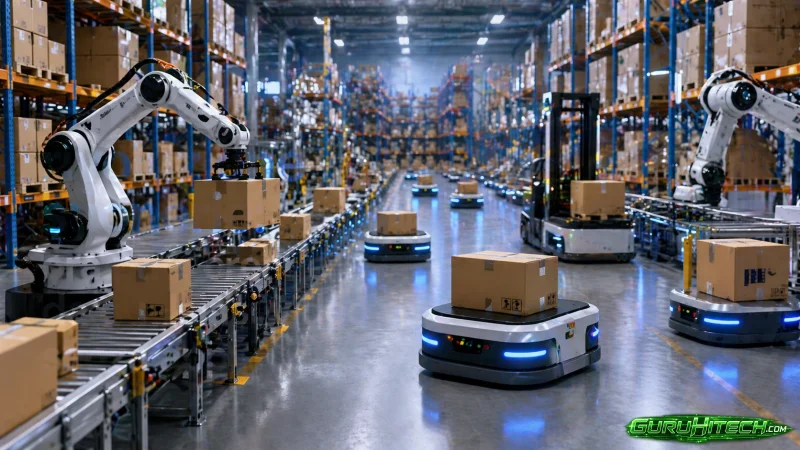
Global supply chains are under increasing pressure in 2026. E-commerce growth, labor shortages, and higher delivery expectations are forcing warehouses to operate faster and more efficiently than ever before. Traditional manual systems are struggling to keep up with these demands.
Warehouse robotics is no longer a future concept. It is now a practical solution being adopted across logistics operations worldwide. Autonomous mobile robots, automated picking systems, and AI-driven warehouse software are changing how goods are stored, moved, and fulfilled.
Warehouses are shifting from manual processes to intelligent, automated systems that can respond in real time. This change is reshaping the entire supply chain structure and setting new standards for efficiency and scalability.
The Evolution of Warehousing: From Manual to Intelligent Systems
Warehousing has changed in stages, each driven by growing demand and operational complexity.
Traditional warehouses relied heavily on manual labor. Workers handled picking, packing, sorting, and internal movement of goods. This model worked when order volumes were lower and delivery expectations were slower, but it lacked speed, accuracy, and scalability.
The next stage introduced semi-automated systems. Conveyor belts, barcode scanners, and basic warehouse management systems helped reduce manual effort. These improvements increased efficiency, but human dependency was still high and processes remained largely fixed.
Modern warehouses are now moving into intelligent systems. Robotics and AI are taking over core operational tasks, while software systems coordinate movement, storage, and fulfillment in real time. Instead of static workflows, warehouses now operate as dynamic environments that adjust based on demand and inventory flow.
What Warehouse Robotics Actually Means in 2026
Warehouse robotics in 2026 is not a single technology. It is a connected system of machines and software working together to automate warehouse operations.
Autonomous Mobile Robots (AMRs)
AMRs move goods across the warehouse without fixed paths. They navigate dynamically, avoid obstacles, and adjust routes in real time. They are commonly used for transporting inventory between storage, packing, and dispatch zones.
Robotic Picking and Handling Systems
These systems automate the process of selecting and moving individual items. Goods-to-person models are widely used, where robots bring inventory directly to workers or automated stations, reducing travel time and manual searching.
AI Warehouse Orchestration Systems
At the core of modern robotics is AI software that manages the entire warehouse flow. It assigns tasks to robots, optimizes routes, balances workloads, and adjusts operations based on demand patterns. This layer ensures that all robotic systems work together as one coordinated network.
Together, these technologies form a unified ecosystem where physical robots execute tasks and AI systems control decision-making and efficiency.
Key Drivers Behind Robotics Adoption in Supply Chains
Warehouse robotics is growing quickly because supply chains are under structural pressure, not just operational demand.
Labor shortages and rising costs
Warehouses in many regions are facing difficulty hiring and retaining workers. At the same time, labor costs continue to increase. Robotics helps reduce dependency on manual labor for repetitive and physically demanding tasks.
Growth of e-commerce demand
Online retail has increased order volumes significantly. Warehouses must now process more orders in shorter time windows. Manual systems struggle to maintain consistency at this scale.
Faster delivery expectations
Same-day and next-day delivery have become standard in many markets. This requires faster picking, sorting, and dispatch cycles, which robotics systems can support through continuous operation.
Efficiency and accuracy pressure
Even small errors in inventory or order fulfillment create delays and costs. Automated systems reduce human error and improve consistency in operations.
Space optimization challenges
Warehouses are also under pressure to maximize storage in limited space. Robotics enables more compact storage designs and better movement efficiency inside facilities.
How Robotics Is Transforming Supply Chain Operations
Warehouse robotics is not just improving existing processes. It is changing how core supply chain operations function.
Faster order fulfillment cycles
Robotic systems reduce the time required to locate, pick, and move items. Operations run continuously, which increases overall throughput and reduces delays in processing orders.
Higher inventory accuracy
Automated tracking and controlled movement of goods reduce mismatches in inventory records. This improves stock visibility and reduces errors in order fulfillment.
Dynamic warehouse flow
Instead of fixed workflows, AI-driven systems adjust operations based on real-time demand. Robots can be reassigned instantly to different tasks depending on priority and workload.
Reduced dependency on manual labor
Human workers are gradually shifting from physical execution to monitoring and supervision roles. This improves safety and allows better allocation of human effort to complex decision tasks.
More resilient operations
Automated systems are less affected by peak season pressure or sudden demand spikes. Warehouses can scale operations by adjusting robot fleets and system configurations instead of hiring large temporary workforces.
The Role of AI in Modern Warehouse Robotics
AI is the control layer that makes warehouse robotics practical at scale. Robots handle movement and execution, but AI decides how the entire system should operate in real time.
AI as the decision engine
In modern warehouses, AI assigns tasks to robots based on priority, distance, and workload. It continuously evaluates conditions and adjusts operations to avoid delays and bottlenecks.
Predictive demand handling
AI systems can analyze order patterns and forecast demand spikes. This allows warehouses to pre-position inventory and prepare robotic workflows in advance of peak activity.
Real-time optimization
Instead of fixed routes or static schedules, AI constantly optimizes robot movement. It reduces travel time, balances workload across fleets, and improves overall throughput efficiency.
Intelligent storage and slotting
AI also decides where items should be stored based on demand frequency and picking efficiency. High-demand products are placed in faster-access zones to reduce retrieval time.
Core idea: Robotics executes tasks, but AI ensures those tasks are performed in the most efficient way possible.
Real-World Impact on Supply Chains
The adoption of warehouse robotics is already producing measurable improvements across logistics operations.
Lower operational costs
Automation reduces reliance on large manual labor forces and improves process efficiency. Over time, this leads to lower cost per order and better resource utilization.
Faster delivery performance
With automated picking, sorting, and transport systems, warehouses can process orders more quickly. This directly improves shipping speed and customer satisfaction.
Scalable warehouse capacity
Instead of rebuilding infrastructure to handle growth, companies can scale by adding more robots or expanding software capacity. This makes expansion more flexible and cost-efficient.
Better peak season handling
During high-demand periods such as sales events or holiday seasons, robotic systems maintain consistent performance without the need for large temporary workforce expansion.
Improved operational reliability
Automation reduces human error and increases consistency in warehouse operations. This leads to fewer delays, fewer mis-shipments, and more predictable supply chain performance.
Challenges in Adoption
While warehouse robotics delivers strong efficiency gains, adoption is not without challenges. Many organizations still face barriers when moving from traditional systems to automated environments.
High initial investment
Robotics systems require significant upfront capital for hardware, software, and infrastructure changes. For many companies, the return on investment is strong but not immediate, which makes budgeting a key consideration.
Integration with existing systems
Most warehouses already run on legacy warehouse management systems and manual workflows. Integrating robotics into these environments can be complex and requires careful system alignment to avoid operational disruption.
Workforce transition
Automation changes job roles rather than eliminating them entirely. Employees often need retraining to shift from manual tasks to system supervision, robot coordination, and technical monitoring.
Maintenance and technical dependency
Robotic systems require ongoing maintenance, monitoring, and technical support. Any system downtime can impact warehouse flow, making reliability and service support critical factors.
Future Outlook: What Comes After 2026
Warehouse robotics is moving toward a more connected and intelligent future where automation becomes deeply embedded in supply chain infrastructure.
Fully autonomous warehouse operations
Future systems will reduce human intervention further, with robots handling most core warehouse tasks independently while humans focus on oversight and strategy.
AI-driven supply chain networks
Warehouses will no longer operate as isolated units. AI will connect multiple facilities, optimizing inventory distribution and logistics decisions across entire networks in real time.
Interconnected logistics ecosystems
Robotics, transportation systems, and inventory platforms will become fully integrated. This will allow seamless coordination between warehouses, distribution centers, and delivery networks.
Higher adaptability to demand changes
Future systems will respond instantly to market shifts, seasonal spikes, and unexpected disruptions. Flexibility will become a core advantage of automated supply chains.
The direction is clear. Warehouse robotics is evolving from operational support technology into the foundation of modern logistics systems.
Conclusion
Warehouse robotics is reshaping supply chains by replacing static, manual operations with intelligent, automated systems. In 2026, the shift is no longer gradual. It is a structural change driven by demand for speed, accuracy, and scalability.
Traditional warehouses built on manual labor and fixed processes are reaching their limits. In contrast, robotics-enabled warehouses can adapt in real time, operate continuously, and scale without proportional increases in workforce or physical complexity.
The combination of autonomous robots and AI orchestration is redefining how goods are stored, moved, and fulfilled. Supply chains are moving from reactive systems to predictive and self-optimizing networks.
This transformation marks a clear direction for the industry. Warehouse robotics is not just improving logistics efficiency. It is becoming the core infrastructure of modern supply chain operations.
Scopri di più da GuruHiTech
Abbonati per ricevere gli ultimi articoli inviati alla tua e-mail.