
Rapid Prototyping Services: Why Vacuum Casting Wins for Low-Volume Runs
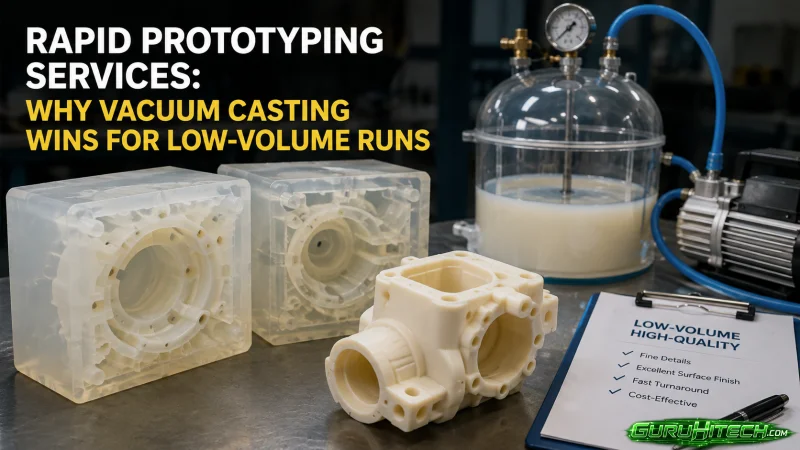
Product teams rarely have the luxury of unlimited time between “here’s the CAD file” and “here’s a part I can hand to a customer.” That gap is exactly what rapid prototyping services exist to close. Among the handful of methods available, vacuum casting has become the default choice whenever a design needs more than a one-off 3D print but doesn’t yet justify a steel mold. In fact, it sits in a strange sweet spot: cheap enough for a startup’s first 50 units, precise enough for engineers running fit and function tests, and fast enough that a redesign doesn’t blow up the whole schedule.
What a Vacuum Casting Service Actually Does
A vacuum casting service works from a single high-quality master pattern, usually machined in ABS, PMMA, or PC, or built with high-resolution SLA printing. That master gets encased in liquid silicone. The silicone then cures into a flexible mold capable of capturing undercuts and fine surface texture that harder tooling methods struggle with. Polyurethane resin then fills the mold under vacuum, which eliminates air bubbles and replicates the model’s details with a production-quality finish.
The result isn’t a rough stand-in. Engineers get vacuum cast parts that function as more than visual models — they behave like actual components simulating the mechanical properties of injection-molded thermoplastics. That matters for anyone running drop tests, snap-fit trials, or living-hinge checks before committing to hard tooling.
How Precise Is Vacuum Casting Compared to Injection Molding?
Vacuum cast parts typically hold a tolerance around ±0.5 mm per 100 mm, which trails CNC machining because the silicone mold flexes slightly during curing and part extraction. However, some shops push tighter numbers on urethane casting specifically — tolerances down to ±0.20 mm are achievable with the right resin and process controls. Either figure is more than adequate for prototype validation. Still, anyone chasing aerospace-grade tolerances should pair vacuum casting with a secondary CNC finishing pass on critical features.
Why Rapid Prototyping Services Lean on This Process
Silicone tooling is the whole reason vacuum casting earns a place in most rapid prototyping services‘ toolkits. There’s no CNC steel block to machine and no multi-week wait for a hardened mold. The upfront cost of injection molding runs higher with a lower per-unit price, while vacuum casting flips that: lower tooling cost, higher per-unit price. As a result, this makes it the more sensible option for early-stage prototypes ahead of committing to injection-molded production.
That trade-off is worth sitting with for a second, because it’s easy to misjudge. If you need 5,000 identical housings, injection molding wins on unit economics every time. But if you need 30 units to run a beta program, or 150 to stock a Kickstarter fulfillment, silicone tooling for vacuum casting will almost always beat a hard mold on total project cost. In this case, you won’t be stuck holding a $15,000 tool for a design that’s still one revision away from final.
What Volumes and Timelines Should You Expect?
Vacuum casting generally covers runs from a handful of parts up to a couple hundred. Most shops quote a working range of roughly 5 to 200 pieces per mold before the silicone degrades enough to affect part quality. However, a single mold can realistically pull anywhere from a few parts to a few dozen a day depending on cure time and resin selected. Lead times compress accordingly — functional prototypes commonly ship in 5 to 10 days, and some providers push that down further for simple geometries.
Material selection is where the process shows its versatility. Shops typically stock resins engineered to mimic ABS, polycarbonate, PP, and rubber-like elastomers, so a single mold can produce parts across a range of stiffness and finish requirements without switching processes. Post-processing options like painting, plating, and surface texturing round things out. This lets cast parts meet both aesthetic and functional specs — which is why vacuum casting shows up as often in trade-show display models as it does in engineering test rigs.
Where Vacuum Casting Falls Short
Honesty matters here, because vacuum casting isn’t a universal answer. Cast polyurethane resins, even the high-performance blends, lack the long-term UV stability and thermal resistance of true injection-molded thermoplastics, so parts destined for outdoor exposure or sustained heat cycling need a different validation path before final production sign-off. Flexible molds also degrade — expect diminishing surface quality and dimensional accuracy as a silicone tool approaches the high end of its usable part count. Furthermore, if your design calls for genuinely tight tolerances on mating surfaces, plan on a CNC-machined insert or a secondary finishing step rather than relying on the cast part alone.
Choosing a Provider
Not every rapid prototyping service handles vacuum casting the same way. Look for ISO-certified production, a documented DFM (design-for-manufacturability) review before quoting, and a materials library broad enough to match your end-use plastic. In addition, ask directly about tolerance data on comparable past jobs rather than trusting a generic spec sheet — the difference between a shop that runs proper vacuum degassing and one that doesn’t shows up as pinholes and surface defects on the parts you actually receive.
Conclusion
Vacuum casting occupies real estate that neither 3D printing nor injection molding can match: production-like parts, low-volume economics, and turnaround measured in days rather than weeks. For teams validating a design before tooling commitment, or fulfilling a limited production run, it remains one of the more dependable bridges in the rapid prototyping toolkit. If your next batch sits somewhere between “handful of test units” and “a few hundred pieces,” it’s worth getting a quote before you price out a steel mold.
Scopri di più da GuruHiTech
Abbonati per ricevere gli ultimi articoli inviati alla tua e-mail.