
Rigid-Flex PCBs in Smartwatches
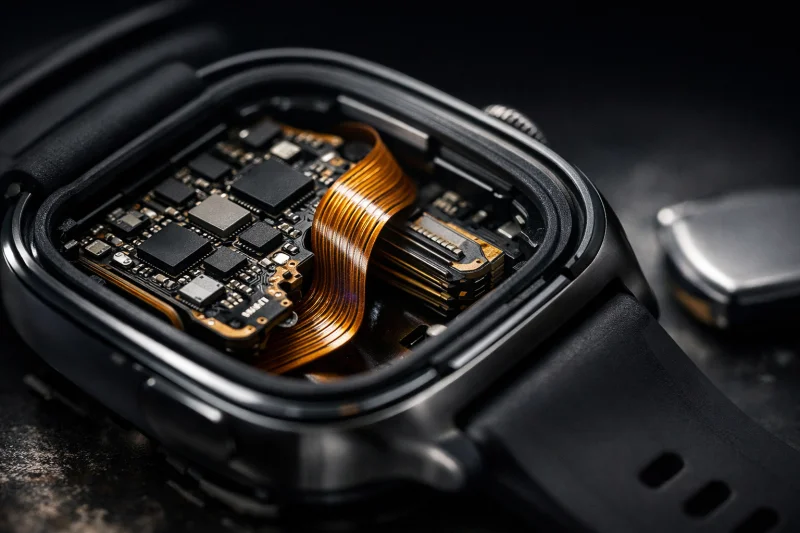
The best illustration of how contemporary electronics have been utilized to push the boundaries of design is in smartwatches. They are small, light, loaded with sensors, and designed to endure the continuous movement on a human wrist. During my time dealing with PCB-related materials and PCB manufacturers, there is no other board technology that is nearly as efficient as a rigid-flex PCB or rigid flex circuit board in fulfilling such demanding requirements. Through the addition of multilayer design principles, a multilayer rigid-flex PCB becomes a fundamental enabler of the smooth, compact, and high-performance smartwatch designs seen today.
Learning about the Rigid-Flex PCB Technology in the Wearable
Rigid flex circuit board is a composite type of circuit board that combines elements of rigid PCB with a flexible circuit into one unit circuit board. The flexible sections are used as built-in interconnections rather than connectors, cables or soldered joints to connect a number of boards together. This will enhance reliability to a great extent, which is essential in devices that are subjected to motion, vibration, and temperature shifts at all times.
Space is never wasted in smart watches. The curvilinear enclosure, interspersed parts and a tiny battery outline do not allow much room to conventional board layouts. Multi-layered rigid flex PCB enables the designer to fold and shape the circuit to fit into the enclosure allowing less space to be wasted thus making products slimmer and ergonomically fitting.
It is because Smartwatches rely on Multilayer Rigid Flex PCBs
Smartwatches are no longer mere time keeping products. They integrate displays, processors, sensors, wireless modules and power management systems in a small footprint. Multilayer rigid flex PCB architecture would be necessary to enable this kind of integration that is very hard, even impossible, to achieve without it.
Designers are also able to route complex signal paths within both rigid and flexible parts by placing several layers of conductors and ensuring the integrity of the signal through the conductors. Display high-speed data lines, low-noise paths of biometric sensors, and consistent power delivery can all be accommodated on a single board. In my view, this merger is among the largest factors that make rigid-flex solutions take over wearable electronics.
Routing, Signal Integrity and Power Delivery
Designers are also able to route complex signal paths within both rigid and flexible parts by placing several layers of conductors and ensuring the integrity of the signal through the conductors. Display high-speed data lines, low-noise paths of biometric sensors, and consistent power delivery can all be accommodated on a single board. In my view, this merger is among the largest factors that make rigid-flex solutions take over wearable electronics.
Mechanical Reliability and Long-term Durability
A connector is a weakness that always comes out as one of the lessons of real-life product failures. In smartwatches, frequent bending of the wrist may cause stress on interconnects causing temporary failures with time. By substituting connectors with flexed copper traces, wired with rigid flex circuit board do away with most of these mechanical failure points.
The stretchable layers are designed to flex to several thousand cycles without breaking and the hard parts can be used to securely hold the components, such as processors and memory chips. Such a compromise of flexibility and rigidity is particularly useful in the gadgets that people will carry with them every day, as the longevity over time is a direct factor that contributes to customer satisfaction and brand image.
Compact Design, Signal Integrity and Power Efficiency
The other benefit of a multilayer rigid flex PCB in smart watches is that the PCB would be able to deliver better electrical performance. Reduced signal loss and electromagnetic interference are caused by shorter signal routes and less connectors. This is especially necessary in the wireless communication modules like Bluetooth, GPS and NFC that need clean transmission of signals.
This design approach also has the advantage of power efficiency. In control of the impedance routing of the layer stack and optimization of the layer stacking, designers can reduce the losses of power and heat. Even minor efficiency increases, which are what every smartwatch user appreciates, can result in an increased time of use in a device with a limited battery capacity.
Manufacturing, Design and Expertise
Although there are obvious advantages in the use of rigid-flex technology, there are still some rigorous design and production skills which are required. The planning of the layer stack ups, calculation of the bend radiuses, and the selection of material are all very important in the final performances of the product. Projects fail because the flexible parts were not planned with due consideration of the stress relief aspects or even material compatibility.
In the case of smartwatches, the flexible layers are typically made of high-quality polyimide, and the rigid parts of the watch are made of FR-4 or advanced laminates. When these materials are arranged properly, the resulting rigid flex circuit board achieves unmatched reliability in miniature (wearable) applications.
Smartwatch Applications: Cost vs. Value
Although it might seem that a multilayer rigid flex PCB is more expensive than the ordinary rigid boards, it is more cost-effective. The value is, however, clear when it is looked at through the prism of the system level. Fewer connectors, fewer assembly steps, and a lower rate of failure tend to compensate the initial manufacturing cost.
The investment is justified by the long-term performance benefits and savings over a length of time compared to the smartwatch manufacturing industry because of its high volume and potential warranty expenses. Most of the major wearable brands have adopted this strategy already and established the industry standard.
The Future of Wearable Tech Rigid-Flex PCBs
The demand for thinner designs, an increase in sensors and an increase in battery life is bound to grow as the smart watches advance. Rigid-flex technology stands well to facilitate these trends. Newer material, smaller trace widths and more layers will continue to add to what a multilayer rigid flex PCB can do.
According to my professional observation, future smart watches will be even more dependent on this technology as the makers strive towards flexibility in display, enhanced health management, and integration with other smart gadgets.
Conclusion
Rigid-flex PCB has become a standard of modern smartwatch design, with manufacturers increasingly relying on experienced suppliers such as FastTurn PCB to meet tight space and performance requirements. A flexible circuit board is a multilayer electrical board that is coupled with mechanical flexibility to allow compact layouts, enhanced reliability, and effective signal routing. A multilayer rigid flex PCB enables manufacturers to fit substantial functionality into devices that are comfortable, durable, and visually appealing.
Rigid-flex technology is something that every one who is studying electronics, designing wearables, or researching on modern PCB applications must possess an understanding of. The fact that it appears in smartwatches shows that innovative board design directly influences the nature of the products that we use on a daily basis.
Frequently Asked Questions
Do all smartwatches require a rigid flex circuit board?
Although more basic designs might also involve rigid boards, the majority of complex designs are greatly advantaged by rigid-flex integration because of the space and reliability considerations.
What about repairability?
Multilayer rigid flex PCBs typically require more repair than a normal board, but are less susceptible to failure and therefore do not require repairs at all.
Do rigid-flex boards affect signal quality?
They can be designed well to enhance signal integrity, interconnects are minimized, and routing paths are optimized within a small form factor.
How resistant are rigid-flex boards to environmental factors?
The solution to smartwatches is rigid-flex, which is usually engineered to withstand moisture, sweat and similar changes in the temperatures more than the traditional multi-board assemblies.
Ti potrebbe interessare:
Segui guruhitech su:
- Google News: bit.ly/gurugooglenews
- Telegram: t.me/guruhitech
- Facebook: facebook.com/guruhitechfb
- Instagram: instagram.com/guruhitech_official/
- X (Twitter): x.com/guruhitech1
- Bluesky: bsky.app/profile/guruhitech.bsky.social
- Rumble: rumble.com/user/guruhitech
- VKontakte: vk.com/guruhitech
- MeWe: mewe.com/i/guruhitech
- Skype: live:.cid.d4cf3836b772da8a
- WhatsApp: bit.ly/whatsappguruhitech
Esprimi il tuo parere!
Ti è stato utile questo articolo? Lascia un commento nell’apposita sezione che trovi più in basso e se ti va, iscriviti alla newsletter.
Per qualsiasi domanda, informazione o assistenza nel mondo della tecnologia, puoi inviare una email all’indirizzo [email protected].
Scopri di più da GuruHiTech
Abbonati per ricevere gli ultimi articoli inviati alla tua e-mail.