
Robotic Welding: How Automation is Transforming Precision Manufacturing
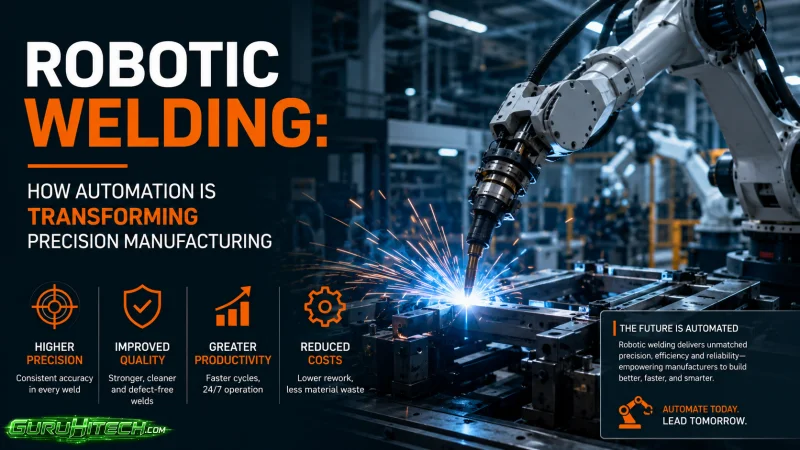
Precision is a must, not a luxury, for today’s fabricators, and is required by industries such as automotive, aerospace, and structural steel. Whether highly trained human welders become fatigued, develop hand tremors, and are inconsistent during an 8-hour shift. This is where robotic welding steps in to revolutionise the shop floor. Mechanical welding systems do the same operation at the same speed, with the same heat input, on the thousandth part as they did on the first. This article will cover five of the most important benefits of mechanical welding, including repeatability and speed, waste reduction, safety, and data integration.
1. The unmatched repeatability and consistency are the number one advantage.
Human welders fatigue.Human welders fatigue. After hours of holding a torch, their hands shake. They make judgments about how to travel because, as the day goes on. Robotic welding never has any of these. The robot will perform the same arc motion for part number one thousand as it did for part number one, as soon as the skilled programmer enters the proper parameters: voltage, amperage, travel speed, and weave pattern. The uniformity is a game‑changer in terms of quality control. Eliminates the Monday Morning-Monday afternoon effect, which is common with manual welding. This degree of repeatability in robot welding is a must in critical applications such as automotive chassis or pressure vessels. It ensures that all joints are installed to the same quality standard, minimizing the chance of failures in the field and liability claims.
2. Enhanced Quality and precision
On the factory floor, time is money. Unlike human workers, computerized welding systems do not require breaks for coffee, sleep, or shift changes. This significantly cuts production time, enabling the fabricator to accept more and bigger work. As with any welding process, the faster an automated welding project can get from the design stage to the shipping dock, the better it is for the business of a client who requires faster turnarounds.
3. Reduction of Material Waste
Scrap metal costs money when there are errors. Unlike manual welding, the robotic welding process reduces spatter, incomplete penetration, and burn-through problems. Robotics welding can decrease the need for expensive rework or scrapping of damaged parts and get the weld job correct the first time around. This waste saving amounts to huge savings on such resources as steel and filler wire over a financial period of just a quarter.
4. Enhanced Workplace Safety
Welding is a process that produces hot conditions, UV radiation, and dangerous fumes. Robotics welding eliminates the human operator from that potentially dangerous setting. The worker operates the robot from a distance, not standing in a smoking booth. This change decreases the number of workers’ compensation claims and lost work time from injuries. Factory owners safeguard their most important asset: their skilled employees by using robotics welding.
5. Superior Data Integration
Today’s Robotic welding arms come with sensors that track the heat, speed, and voltage on the spot. The data is returned to the quality control managers to ensure that each parameter is spot-on. Traceability is possible with robotics welding – you can prove the welding of a specific joint. The core of the modern smart manufacturing factory is robotics welding, which can ensure precision and safety while also providing consistency.
Scopri di più da GuruHiTech
Abbonati per ricevere gli ultimi articoli inviati alla tua e-mail.