
Seedance 2.5 and the moment AI video stopped falling apart after five seconds
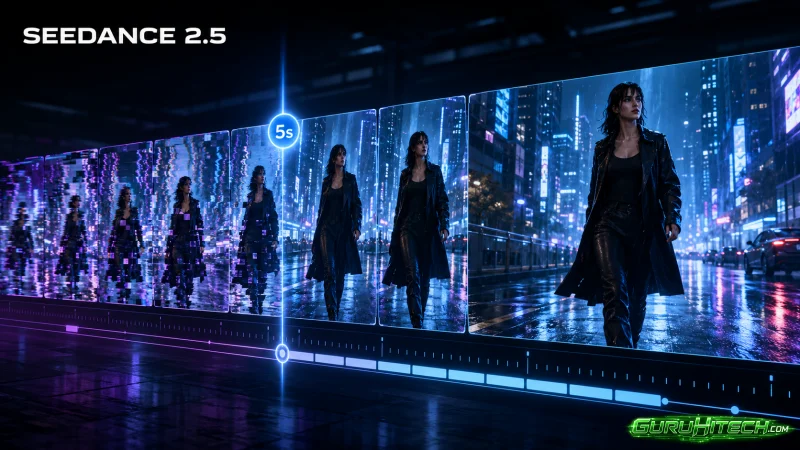
If you have followed AI video for the past two years, you have learned to watch the demos with one eyebrow raised. The clip that circulates always looks stunning for a beat or two. Then, if the reel runs long enough, you see it: the face slides, the fingers multiply, the background turns to soup. The technology was never short on spectacle. However, it was short on the boring thing that actually makes video usable. That “thing” is the ability to keep a scene from disintegrating.
That is the context for the latest release from ByteDance, the company that owns TikTok. This is why the headline number is worth taking seriously rather than dismissing as another benchmark flex. The interesting claim this time is not about how pretty a single frame looks. Instead, it is about how long the picture can hold together.
What the model does on paper
The release is Seedance 2.5, shown in June at ByteDance’s Volcano Engine FORCE conference. Reduced to specifics, it generates a single continuous thirty-second shot at native 4K with 10-bit color, from either a text prompt or a reference image. Furthermore, it produces the audio in the same pass as the video rather than requiring a separate step. It accepts up to fifty reference inputs per run, spanning images, video, audio, 3D models, and style boards. This is how it holds a given subject and look steady across the clip.
It runs in both directions, too. You can generate from a text description alone, or supply a still image and have the model animate it. This matters for anyone working from existing assets rather than starting cold. And because the sound is generated jointly with the picture, a clip returns already scored with dialogue, effects, and ambient audio in place. This collapses a step that normally means a second tool and a manual sync pass.
There is also a claim of roughly twenty percent better prompt adherence than the prior model, meaning output that tracks the written instruction more closely. Worth flagging: that figure comes from ByteDance itself, with no published methodology, so it belongs in the “vendor claim” column until someone tests it independently. The duration, resolution, and reference count, by contrast, are concrete specifications you can verify by running the thing.
The real breakthrough is consistency, not resolution
Here is the part a tech audience should sit with, because it is easy to misread. Resolution stopped being the hard problem a while ago. Models have been able to render a gorgeous still frame for some time. The wall was temporal consistency, the ability to carry that frame forward through hundreds of frames without accumulating error.
Diffusion-based video generation drifts. Each frame is predicted in relation to the last, and tiny inaccuracies compound. This is why early tools capped out at a few seconds before a face lost its identity or a hand rearranged itself. Getting from a few seconds to a stable thirty is not a linear improvement in the same axis as sharpness. Instead, it is progress on the specific failure mode that made the output a toy. Thirty seconds is also a meaningful production unit rather than an arbitrary milestone. It is a full ad, an explainer, a sustained establishing shot, the length at which a clip becomes something you can actually publish instead of a loop you hide the seams on.
How far it moved in a year
The clearest way to size the jump is to line the two versions up. Seedance 2.0, released only months earlier, produced clips of four to fifteen seconds at up to 1080p and accepted twelve reference inputs. Seedance 2.5 roughly doubles the maximum duration, moves output to native 4K, and lifts references from twelve to fifty. On paper that reads like an incremental bump. In practice, crossing from “a few seconds” to “half a minute that holds” is the difference between a demo and a tool. Moreover, the reference jump is what lets you actually control a shot instead of gambling on a vibe.
That reference count is easy to underrate. Twelve inputs is enough to suggest a direction; fifty is enough to specify one. Feed it a character design, a location, a camera-movement clip, a color reference, and a style board at once, and the model has enough constraints to keep the same subject and the same look coherent from the first frame to the last. This is precisely the kind of control that separates a reproducible workflow from a lucky roll. For developers and technical users, that predictability is often worth more than any single quality metric. This is because it is what makes the output something you can build a repeatable pipeline around.
The added audio support is more consequential than it looks, and not only for dialogue. Because the newer model takes audio as a reference input, it opens the door to music content in a way the previous generation could not manage cleanly. You can feed in a track and ask the visuals to move with it, rather than generating silent footage and wrestling it into sync afterward. For anyone who has tried to marry an AI clip to a beat in an editor, the value of picture and sound arriving from the same generation is obvious. It is also a hint at where a lot of the early real-world usage is heading. This is because short-form music and social content is exactly the territory where a thirty-second, self-scored clip is most immediately useful.
The catch the benchmarks skip
None of this makes the technology a universal replacement, and the honest read matters more than the hype. These systems still cannot act. A shot that depends on a real human performance, the precise flicker of an expression, is exactly where they fall down. If your project lives on that, a camera and a person are still the answer. The tells remain if you look, most reliably in the hands. Anyone marketing a prompt as a full substitute for a director is selling past the evidence.
There is also a resource cost the spec sheet understates. Duration and resolution are what consume credits, so a full thirty-second 4K render is not free. Defaulting to maximum settings on a first attempt is how you pay top price for a take that comes out wrong. Signing in and the starter credits cost nothing, enough to characterize how Seedance 2.5 behaves before spending, but the allocation is finite. The efficient workflow is the unglamorous one every experienced user converges on. You should draft short and low-resolution, iterate one variable at a time, and commit to a full 4K render only once the cheap version already works.
Strip away the launch theater and what is left is a specific, checkable claim: the thing that kept AI video from being useful, its tendency to come apart over time, has moved a long way toward being solved. That is a narrower statement than the marketing makes, and a more important one. Spectacle was never the bottleneck. Instead, stability was, and stability is finally where the progress is showing up in a way you can measure rather than just admire.
Scopri di più da GuruHiTech
Abbonati per ricevere gli ultimi articoli inviati alla tua e-mail.