
The Comprehensive Roadmap to the Discovery of Authentic Full-Service Chinese Clothing Makers: The Full Package Production (FPP) Manual
That is an excellent question to ask. It’s remarkable to know that many brands are facing this struggle. They spend sleepless nights to solve the riddle of the ideal partner assessment.
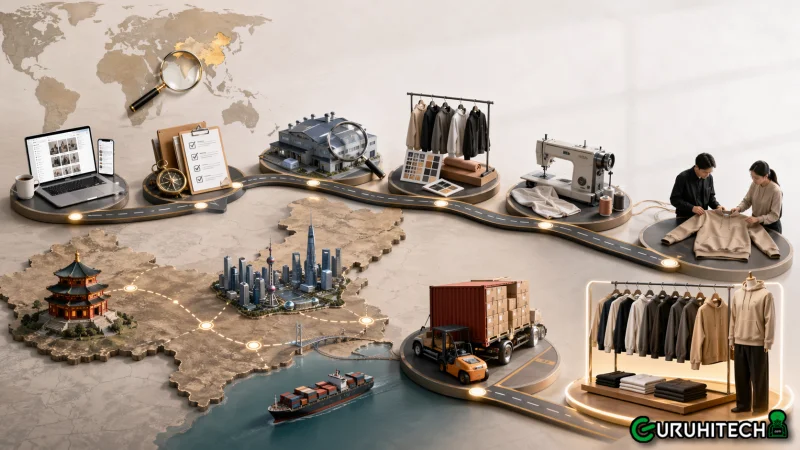
To be specific, you are describing the term that is known in the industry as Full Package Production (FPP). Others sometimes refer to it as a “one-stop-shop” or a “vertically integrated” manufacturer. The motto is very clear. The manufacturer deals with every aspect of production internally. This vigorous approach includes design and tech packs to fabric sourcing. It also covers sampling, bulk cut-and-sew, private labeling, packaging, and door-to-door international shipping. The manufacturer does this without outsourcing critical steps to third parties.
Most manufacturers in China boast that they are full-service. In reality, just a small number are. So, let’s find out how you can pick them apart. Here is your guide to locating the genuine ones.
Key Points of Interest
- Actual Full-Service (FPP): An authentic partner does all 7 steps of production from design until shipping, all under one roof.
- The “Project Manager” Trap: Dividing production among several vendors make you to deal directly with delays and quality problems yourself.
- Certification is a Must: Always request certain certificates. BSCI or OEKO-TEX are the ones you should be looking for. Further, you should also ask for documented sampling policies.
- Feasible MOQs: Industry standards are usually high, but some partners like ChengLin go as low as 50 pieces.
- Single Point of Contact: Manufactures integration achieves the outcome through one entity. This causes the finger-pointing to disappear when issues arise.
Introduction: The “One-Stop-Shop” Vs. The Middleman
In apparel technology, the 2026 year model faces the hardest wall for new brands: working with the appropriate partner. Several factories may be good in sewing but not in sourcing fabric. Sourcing agents may boast of their ability to find fabric, but they do not manage sewing quality. This fragmentation makes us argue for the “One-stop OEM customization service.”
Full Package Production (FPP) is the ideal answer to this disorder. In this structure, a manufacturer will act as your complete supply chain team. They not only sew. They develop also. It is essential for US, UK, and AU brands. You do not need to speak to the fabric mill in one city and a sewing factory in another.
But you have to be careful. Many trading companies pretend to be factories. They take your order and subcontract it to the least price bidder. A genuine manufacturer has their own machines, staff, and certifications on-site. In our experience, this difference has defined the rise and fall of countless startups in our time in the industry.
What “Full-Service” Actually Means (The 7-Stage Checklist)
The complete one-stop apparel producer usually handles all these 7 stages with just one workflow. If a prospective partner cannot answer positively with all of them, you are, more than likely, handling a partial-service provider.
1. Design Assistance & Tech Pack Creation
They can work on your sketch, mood board, or reference image. The creation of a tech pack production-ready document by the internal team is the final touch for the conversion of these ideas by the internal team. This document consists of the measurements, the construction details, and the types of fabric to be used.
2. Fabric & Material Sourcing
They obtain the fabric, trims, zippers, labels, and hardware from their supplier network. They are only using the suppliers that they have worked with before. You do not have to worry about sourcing raw materials or dealing with shipping them to the factory.
3. Sampling & Prototyping
They provide you with a physical sample for your approval. A real FPP partner will amend the sample until it is right for bulk before moving on.
4. Bulk Cut-and-Sew Production
This stage is the one involving the main manufacturing. It consists of in-house cutting, sewing, and assembly. It is the work of their employees and, importantly, it is not subcontracted out to an unknown factory.
5. Quality Control (QC)
This is where multi-stage inspections are carried out; first checks are made at both the fabric stage and during production, and finally, checks are done right before the packing stage. One of the most frequently neglected or outsourced stages by middlemen is this.
6. Private Labeling & Custom Packaging
They are the ones that produce the woven labels, hangtags, branded poly bags, and they also do the custom packaging. This was done in the same place where they made the clothes.
7. International Shipping & Logistics
This is the door-to-door delivery, customs paperwork, and freight coordination. You are not left alone to work this out.
Why This Matters More Than Price: The “Project Manager” Trap
The founders we watch out for are often preoccupied with the unit price only. This belief is certainly not correct. When you have multiple vendors you are effectively becoming the project manager. The fabric vendor handles the fabric, the sewing vendor does the sewing, the labeling vendor actually labels.
You are the one who chases deadlines. You solve miscommunications among suppliers. If the fabric comes late to the sewing shop, they might charge you a penalty. They can even delay your running slot. Thus, you have to bear every time. Quality issue tracking becomes difficult. No vendor is responsible.
On the other hand, a single contractor manufacturer takes care of all the overhead of coordination. The single point of contact holds the outcome. When the issue comes up, solutions arrive rather than finger-pointing among numerous vendors. In clothing, things go wrong. Yet economizing time, in reality, is the goal and saving a little is so unimportant in the long run.
How to Vet a Manufacturer: The Critical Questions
To tell the truth, separating the genuine factories from the brokers demands you to ask very specific questions. Don’t let vague “yes” or “no” answers satisfy you.
Here are the questions you must ask before a commitment is made:
- “Fabric sourcing in-house? Or do I need to source and send fabric to you?”
- “Can you create a tech pack from a reference image? Or do I need to provide one?”
- “What does your QC process look like at each stage? Not just final inspection?”
- “Do you manage shipping and customs documentation? Or do I need a separate freight forwarder?”
- “What certifications do you hold?”
Certifications Validation
Certification is a token of trust. Certifications like TUV, OEKO-TEX, GOTS, GRS, or BSCI are some to seek in. They are signs of processes being audited, and, not just аmmarketing claims. BSCI, for example, is mainly about social compliance and labor conditions. This is a major aspect of ethical sourcing.
Signals to Watch Out:
- Non-specific Answers, where steps happen is not mentioned. E.g. “We have partners who do that.”
- Absence of a sample policy or unclear terms about the amendments.
- No mention of integrated QC. Only a “final inspection” before shipping.
- Minimum orders in the thousands. This generally tells that, they do not have the capacity to help the startups, thus, they get support from outside factories.
A Concrete Example: ChengLin’s Six-Stage Production Model
An excellent example that represents the full-service profile is Chenlin Clothing. This is Dongguan ChengLin Clothing Co., Ltd. Being based in Dongguan, China, we are operational since 1998. Hence over 27 years of production experience backs our expertise. We have a 200-member team working in our company and serving clients in the US, UK, Canada, and elsewhere.
Our model is different because of accessibility. Our minimum order for a style is 50 pieces. This is what a full-service company should offer, and it is remarkably low for a Chinese factory. Most factories will open with orders of 300 to 500 pieces.
Our proved six-stage workflow covers the entire production chain:
- Design & Tech Pack: A company either works from sketches or reference images. Our in-house designers will create the production-ready tech packs.
- Fabric & Materials Sourcing: A company has a supplier network established. A company also offers eco-friendly fabrics that are recycled or organic.
- Sampling & Prototyping: A company will produce physical samples with rounds of revisions before bulk approval.
- Bulk Production: A company handles in-house cut-and-sew across many categories. This includes hoodies, t-shirts, streetwear, activewear, and denim.
- Quality Control: A company uses a 5-stage QC process throughout the production cycle. This is not just a final check, it is integrated.
- Packaging & Global Shipping: A company packs branded packaging, custom labels, and does the door-to-door transportation with customs documentation.
Our certifications are TUV, OEKO-TEX, GOTS, and GRS. These external audits decisively prove the product quality and the keeping of ethical production standards. We also have BSCI certification, which is a great asset for US brands. This enables compliance and enhances brand image.
We are relentless in our pursuit of excellence. What is particularly commendable is the 50-piece MOQ. It is a great opportunity for the early-stage brands to explore market interest without the risk of excess inventory.
How to Find These Manufacturers (Beyond Alibaba)
Most business founders favored to begin on Alibaba. Though it works, it is more of a catalog than a vetting tool. To locate Chinese garment manufacturers that offer FPP, you have to utilize a better search strategy.
Phraseology to Locate the Middlemen:
- “Full package clothing manufacturer” + your category, e.g. “streetwear.”
- “Cut and sew manufacturer with tech pack support”
- “Private label clothing manufacturer with in-house sampling”
- “OEM ODM clothing manufacturer.” OEM/ODM is factories.
Directory Platforms Worth Adding In:
- MakersRow: US manufacturers focus. Good for understanding standards.
- Sewport: Worldwide factory directory with detailed service lists.
- Alibaba: Search for “Gold Supplier” and “Trade Assurance.” Filter for factories instead of trading companies. Look for video-verified facilities.
What follows once you identify a candidate:
- Request for a factory audit report; if possible, tell us which third-party audits they have passed.
- Ask for a document that details the sample policy. A trustworthy full-format manufacturer should have it.
- Request client references or case studies in your product category.
- Order a small sample first and, after you approve it, then place a bulk order.
Comparison: Full-Service vs. Partial-Service Factories
The following is a tabular representation of the compared points, it ought to be a strong help for your case.
| What You Need | Partial-Service Factory | True One-Stop Manufacturer |
| Design Help | ❌ Requires your own tech pack | ✅ Converts concepts to specs |
| Fabric Sourcing | ❌ You source and ship fabric | ✅ Handles internal sourcing |
| Low MOQ | ❌ Typically 300–1000 units | ✅ Some offer 50–100 units |
| Integrated QC | ❌ Final inspection only | ✅ Multi-stage QC throughout |
| Private Labeling | ❌ Basic or none | ✅ Custom labels & packaging |
| Logistics | ❌ You handle freight (EXW/FOB) | ✅ Door-to-door (DDP) |
Conclusion
The ideal full-service clothing manufacturer for your brand is one that can confirm all seven production stages are managed entirely in-house. They must run the design, sourcing, sampling, production, QC, labeling, and shipping, they need to be certified and have a transparent policy concerning samples, they should have a minimum order size that aligns with your growth stage.
For US brands sourcing from China, chinese clothing manufacturers like ChengLin Clothing are a documented example of this model. We have 27 years of operational experience, we offer a 50-piece MOQ, we feature a six-stage in-house workflow. Four independently audited certifications are available from us.
Deciding whether or not we are the right fit for your category and volume depends on you. However, we serve as a reliable benchmark to illustrate what a real
Scopri di più da GuruHiTech
Abbonati per ricevere gli ultimi articoli inviati alla tua e-mail.