
The Top 5 Software Development Mistakes Businesses Make
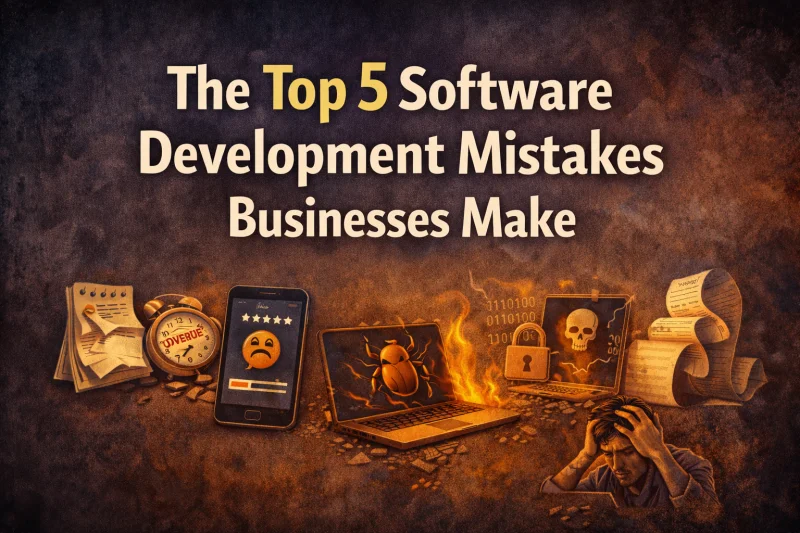
Building software looks straightforward on the surface. You have an idea, a budget, and a team. What this really means is that many businesses jump in, assuming execution will naturally fall into place. That assumption is where problems begin.
Software projects fail not because of bad intentions, but because of avoidable mistakes made early and repeated often. These mistakes cost time, money, and credibility. Worse, they can stall growth or force complete rebuilds.
Let’s break this down clearly. Below are the five most common software development mistakes businesses make, why they happen, and how to avoid them before_ they turn into expensive lessons.
Mistake #1: Starting Development Without Clear Requirements
This is the most common and most damaging mistake.
Many businesses rush into development with only a rough idea of what they want. A few features written on a doc. Some competitor screenshots. Maybe a verbal explanation shared during a call. That is not a product plan.
When requirements are unclear, development teams make assumptions. Assumptions lead to rework. Rework leads to delays and budget overruns. Over time, the product drifts away from the original business goal.
In professional software development services, requirement clarity is treated as a non-negotiable phase. It includes functional flows, user journeys, edge cases, admin needs, and future scalability considerations. Skipping this step often results in features that look good but fail in real-world use.
Another hidden issue is internal misalignment. Stakeholders think they are on the same page until the first demo arrives and everyone reacts differently. That friction slows decision-making and erodes trust within the team.
How to avoid it
- Invest time in detailed requirement documentation
- Validate assumptions with wireframes and user flows
- Lock the scope for the first version before writing code
Clarity upfront always costs less than fixes later.
Mistake #2: Choosing the Wrong Development Partner or Team Structure
Not all development teams are built the same. Some are strong in UI but weak in architecture. Others move fast but lack long-term thinking. Many businesses select partners based on cost alone and pay for it later.
A common scenario looks like this: a company hires a generalist team to build a complex mobile or web application. The team delivers something functional, but it struggles under real user load, lacks clean documentation, and becomes hard to maintain.
This problem becomes more serious when businesses hire Android app developers without evaluating platform expertise, performance optimization skills, or experience with app store compliance. Android apps that work on limited devices but fail across versions and manufacturers often come from shallow technical planning.
Another issue is engagement models. Fixed-cost projects without flexibility can restrict iteration. On the other hand, unmanaged hourly models can spiral without accountability.
How to avoid it
- Evaluate past projects similar to your product type
- Assess communication, not just code samples
- Choose a team structure that supports iteration and growth
Your development partner should think like a product owner, not just a vendor.
Mistake #3: Ignoring Scalability and Technical Architecture Early On
Many businesses build for today and forget about tomorrow.
The first version works. Early users are happy. Then adoption grows. Suddenly, the app slows down, crashes increase, and simple updates take longer than expected. At that point, fixing architecture means rewriting major portions of the system.
Scalability is not only about handling more users. It’s also about adding features, integrating third-party services, and supporting new platforms without breaking existing functionality.
When companies rely on short-term thinking, they often end up with tightly coupled systems, hard-coded logic, and fragile APIs. These technical debts accumulate quietly until they become impossible to ignore.
This mistake is especially common in startups rushing to launch. Speed matters, but speed without structure creates bottlenecks that slow you down later.
How to avoid it
- Design modular and loosely coupled systems
- Plan database structure with growth in mind
- Think about future integrations during initial architecture
Good architecture gives you options. Bad architecture locks you in.
Mistake #4: Underestimating Testing and Quality Assurance
Testing is often treated as an afterthought. Something to be done if time allows.
That mindset is risky.
Bugs in production damage user trust immediately. Performance issues frustrate users quietly until they abandon the product. Security gaps can lead to far more serious consequences.
Many businesses rely only on basic functional testing. They skip load testing, security testing, and real-device testing. As a result, issues surface only after launch, when fixing them is costlier and more visible.
Quality assurance is not about finding mistakes. It is about protecting the business from preventable failures.
How to avoid it
- Integrate testing throughout the development cycle
- Test on real devices and real environments
- Prioritize performance and security, not just functionality
A stable product converts better, retains users longer, and reduces support overhead.
Mistake #5: Launching Without a Post-Development Plan
Launching software is not the finish line. It is the starting point.
Many businesses focus all their energy on development and treat launch day as the final milestone. After release, updates slow down, feedback is ignored, and maintenance becomes reactive instead of proactive.
User behavior after launch reveals insights you cannot predict during development. If you are not tracking metrics, collecting feedback, and iterating regularly, your product stagnates.
Another issue is neglecting maintenance. OS updates, security patches, and third-party API changes require ongoing attention. Ignoring them leads to sudden failures that feel unexpected but are completely avoidable.
How to avoid it
- Plan regular updates and improvement cycles
- Monitor performance and user behavior continuously
- Allocate budget for long-term maintenance and support
Successful products evolve. Stagnant ones disappear quietly.
How Businesses Can Get Software Development Right?
Avoiding these mistakes is not about perfection. It is about awareness and planning.
Strong software products come from disciplined decision-making. Clear requirements, the right team, scalable architecture, consistent testing, and long-term thinking create a foundation that supports growth rather than restricts it.
When businesses treat software as a strategic asset instead of a one-time project, outcomes improve dramatically. Timelines become predictable. Costs stabilize. User satisfaction increases.
Conclusion
Software development mistakes are rarely technical alone. They are usually strategic, stemming from rushed decisions, unclear expectations, or short-term thinking.
Businesses that slow down at the right moments move faster in the long run. By focusing on clarity, choosing capable partners, planning for scale, prioritizing quality, and committing to post-launch growth, companies can avoid the most common pitfalls.
The difference between failed software and successful products is not luck. It is informed decision-making at every stage of the journey.
Scopri di più da GuruHiTech
Abbonati per ricevere gli ultimi articoli inviati alla tua e-mail.