
Volumetric vs Coulometric Karl Fischer Titration: Choosing the Right Karl Fischer Titrator
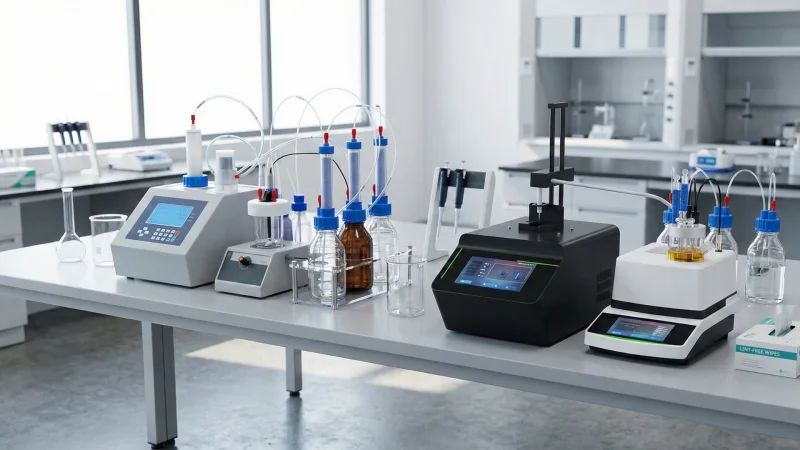
Moisture content can compromise the stability of a pharmaceutical tablet or the insulation properties of transformer oil. To maintain rigorous quality control, a reliable karl fischer titrator is the industry standard for specific water content determination. However, selecting the wrong methodology volumetric or coulometric can lead to inaccurate results or wasted reagents. Understanding the chemical requirements of your sample is the first step in choosing the right Karl Fischer moisture analyzer for your laboratory.
Karl Fischer Titration Basics: What Moisture Testing Measures
At its core, Karl Fischer titration is a redox reaction that uses iodine, sulfur dioxide, a base, and an alcohol to react specifically with water molecules. Unlike “loss on drying” methods, a Karl Fischer titration instrument measures only water, providing a much higher degree of specificity.
The process relies on precise endpoint detection via platinum electrodes. When all water in the sample has reacted, the presence of excess iodine is detected electronically, signaling the end of the test. Modern instruments also account for drift and blank values to ensure that environmental humidity does not skew the results, making it the most trusted method for moisture content analysis across global industries.
Volumetric Karl Fischer Titrator: Best-Fit Use Cases and Moisture Ranges
Volumetric Karl Fischer titration is the preferred method for samples where water is a major component, typically ranging from 1% up to 100%. In this setup, the iodine is added via a mechanical burette. The amount of water is calculated based on the volume of the Karl Fischer reagent (such as Hydranal) consumed during the reaction.
This method is highly versatile and is frequently cited in standards like ASTM E203 and ISO 760. It is ideal for:
- Chemicals and Polymers: Where moisture levels are relatively high.
- Food Ingredients: Such as syrups or fats that require specialized solvents.
- Solubility Challenges: Samples that need complex sample introduction methods, like a titration cell with a high-capacity heater.
Coulometric Karl Fischer Titrator: Best-Fit Use Cases and Trace Moisture Sensitivity
For trace moisture determination, where water content is between 1 ppm and 5%, coulometric Karl Fischer titration is the superior choice. Instead of adding iodine via a burette, the iodine is generated electrochemically directly within the titration cell by a generator electrode.
This method is prized for its extreme sensitivity and accuracy at very low levels. The instrument measures the total electrical charge (coulombs) used to generate the iodine, which is directly proportional to the amount of water. Common applications include:
- Petrochemicals: Testing for trace water in fuels and insulating oils.
- Pharmaceuticals: Ensuring GMP compliance for moisture-sensitive active ingredients.
- Gases: Utilizing a gas inlet to measure humidity in compressed air or industrial gases.
How to Choose by Sample Type, Workflow, and Accuracy Requirements
Choosing between these two methods requires a clear understanding of your sample’s characteristics and your lab’s volume.
| Criteria | Volumetric | Coulometric |
| Moisture Range | 100 ppm to 100% | 1 ppm to 5% |
| Iodine Source | Mechanical Burette (Reagent) | Electrochemical Generation (Anolyte/Catholyte) |
| Sample State | Solid, Liquid, or Gas | Primarily Liquid or Gas |
| Accuracy | High for macro moisture | Exceptional for trace moisture |
If your lab processes a wide variety of materials with varying water levels, a volumetric system offers more flexibility. However, if you are strictly focused on high-purity liquids or oil analysis where every ppm counts, a coulometric system is non-negotiable for water content determination.
Common Decision Mistakes and How to Avoid Them
The most frequent mistake is ignoring the sample’s chemistry. Some samples contain interfering substances that can react with the iodine, leading to a false “drift.” In these cases, using a Karl Fischer oven for sample introduction can prevent the sample from touching the reagents directly.
Another error is overestimating the moisture range. Using a coulometric instrument for a sample with 20% water will quickly exhaust the anolyte and result in very long titration times. Conversely, using a volumetric system for 10 ppm samples often results in poor repeatability. Always match the karl fischer titrator to the expected moisture concentration of your most frequent samples.
Why Qualitest Is the Smart Choice for Karl Fischer Titrator Solutions
Accuracy in moisture analysis is not just about the chemistry; it is about the reliability of the hardware and the support behind it. Qualitest provides state-of-the-art karl fischer titrator solutions designed to meet the rigorous demands of QC and R&D environments.
Our instruments feature advanced endpoint detection and user-friendly interfaces to streamline your moisture content analysis. From pharmaceuticals to petrochemicals, Qualitest ensures your laboratory stays compliant and efficient. Choose the precision you deserve choose Qualitest for your next Karl Fischer titration instrument.
Scopri di più da GuruHiTech
Abbonati per ricevere gli ultimi articoli inviati alla tua e-mail.