
Why Small Diesel Engines Get Misdiagnosed: 5 Parts That Often Take the Blame Too Soon
The operator says the starter motor is bad. The machine is needed today, so you approve the order.
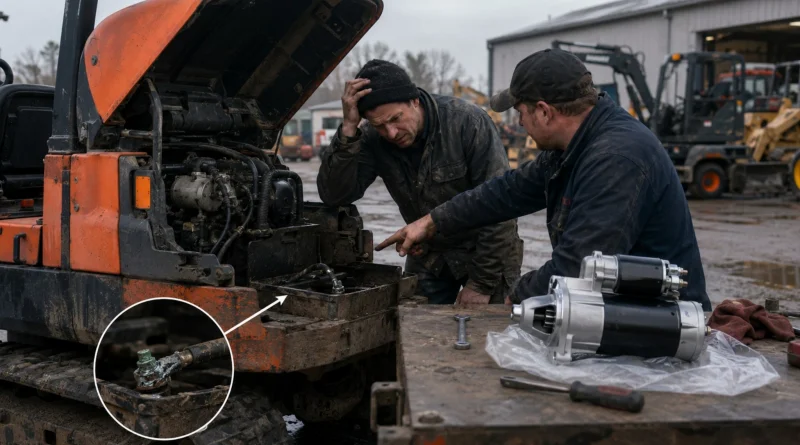
A replacement arrives, the starter is installed, and the engine still cranks slowly. Only then does someone trace the circuit back to a broken ground cable under the battery tray. It was a small electrical fault, not a failed starter.
The cost was not just the part. It was two days of downtime, extra labor, and a good component removed before the real cause was found.
That is how small diesel repairs often become expensive. The most visible part gets blamed first, especially when the machine is holding up mowing, loading, grading, generator work, or a rental job. But a symptom is only a clue. It is not proof that one specific part has failed.
The Kubota D902 is a useful example because the same engine may be found in mowers, generators, compact tractors, utility vehicles, rental fleets, and small construction machines. Different applications create different failure patterns, even when the symptoms look similar.
Start With the System Before Choosing D902 Kubota Engine Parts
Parts are easy to blame because they are visible, searchable, and replaceable. But many engine problems begin at the system level, not the part level.
A starting problem may involve the starter motor, or it may come from the battery, relay, ground strap, or cable resistance. Smoke may lead people toward injectors, but fuel quality, air in the fuel line, compression, and preheating all deserve attention too. Overheating may bring the head gasket to mind, yet the radiator, water pump, thermostat, fan, coolant level, and airflow path may be more practical places to begin.
That is why a better repair path starts with the affected system, not the most suspicious-looking part. Once the likely system has been narrowed down, a model-specific parts reference can help. For a D902-powered machine, checking related d902 kubota engine parts—such as starter motors, injectors, cylinder head components, connecting rods, or crankshafts—makes more sense after the symptom has been tied to the right system.
1. Starter Motor: The Problem May Be Upstream
Starter motors get blamed quickly because they are close to the complaint. The engine cranks slowly, the key turns, and from the operator’s point of view, the starter looks weak.
Sometimes it is. But often, the starter is only revealing a problem elsewhere in the starting circuit.
A machine that sat through winter may have a weak battery or corroded terminals. Rental equipment adds more uncertainty, since the current user may not know how the machine was stored or shut down before.
Before calling the starter bad, check battery condition, cable ends, ground points, relay operation, and voltage drop during cranking. If those checks pass and the starter still drags, overheats, makes unusual noises, or fails to engage cleanly, replacement becomes a stronger call.
2. Fuel Injectors: Smoke Can Be Persuasive
Few things push people toward injector replacement faster than smoke.
White smoke, rough idle, hard starting, and loss of power all make injectors look suspicious. Injectors can cause those problems, especially if spray pattern, leakage, or cylinder contribution is uneven.
Still, smoke is not a diagnosis. White smoke often means fuel is entering the cylinder but not burning well. That can involve injector performance, but it can also involve weak preheating, low compression, poor fuel condition, air in the fuel system, or coolant entering the combustion chamber.
The setting matters too. A standby generator may have old fuel, a farm machine coming out of storage may have moisture or air in the system, a compact loader working in dust may have a filter restriction that gets overlooked because injectors are the more obvious suspect.
Injector replacement makes sense when there is evidence behind it: poor spray, leakage, one cylinder behaving differently, or other fuel-system checks pointing in that direction. Without that groundwork, new injectors may simply become an expensive test.
3. Head Gasket: Overheating Has More Than One Path
When a small diesel engine overheats, “head gasket” tends to appear quickly. A failed head gasket can be associated with coolant loss, white smoke, compression problems, overheating, and milky oil, so the concern is understandable.
But overheating by itself does not prove a head gasket failure.
Many D902-powered machines work in messy environments. Mowers collect grass clippings and dust around cooling surfaces. Compact excavators and loaders work in mud and debris. In those conditions, a partially blocked radiator or poor airflow may be the beginning of the problem.
A weak water pump, low coolant level, stuck thermostat, or fan issue can also send temperatures upward without the head gasket being the original cause. Opening the engine too early adds labor and risk without fixing the reason it overheated.
Stronger signs should guide that decision: coolant loss with no visible leak, persistent bubbles in the radiator, milky oil, white smoke paired with coolant consumption, abnormal compression results, or inspection evidence of warping, cracks, or sealing failure.
4. Connecting Rod: A Knock Needs Supporting Evidence
A connecting rod is not a casual replacement item. If the repair really involves the rod, the engine is already moving toward internal inspection or major work.
The reason it enters the conversation early is usually noise. Knocking sounds serious, especially on a jobsite, in a shop yard, or on a farm where downtime creates pressure.
But small diesel engines are noisy machines. Cold starts, uneven fuel delivery, load changes, low oil pressure, valve clearance issues, or external vibration can all create sounds that worry operators.
A rod-related concern becomes more convincing when other signs are present: a persistent heavy knock, abnormal oil pressure, metal in the oil, bearing damage, unusual compression results, or excessive bearing clearance. Without that support, the connecting rod should stay on the list of possibilities, not jump straight to the top.
5. Crankshaft: A Serious Part Needs Serious Evidence
The crankshaft is one of the most important rotating components in the engine. If it is worn, scored, or damaged, the repair is usually significant. That is why it should not be judged too quickly.
Severe noise, low oil pressure, vibration, loss of power, or uneven operation can make the crankshaft sound like a possible culprit. But crankshaft replacement is not routine and should not be based on noise alone.
More persuasive signs include ongoing low oil pressure, visible metal particles in the oil, bearing failure, crankshaft journal wear, binding when rotating the engine, or measurements that show the part is outside acceptable limits.
Until those signs are present, it is better to keep looking at lubrication condition, bearing health, oil pressure, accessory noise, and other internal or external causes.
The Same Thinking Applies to Other Small Kubota Diesel Engines
The Kubota D902 is only one example. Other small Kubota diesel engines used in agricultural equipment, generators, construction machinery, and industrial applications can follow the same diagnostic pattern.
The same approach also applies to the Kubota V2203. Before comparing replacement parts and specs for the Kubota V2203 engine, confirm the application, engine identification, and symptoms behind the repair.
Different engine models have different power ranges, design details, and applications. Still, the repair logic is similar: document the conditions, identify the system, run basic checks, and then decide whether a specific part should be replaced.
Replace the Right Part at the Right Time
Small diesel engines are not misdiagnosed because they are unusually mysterious. They are misdiagnosed because symptoms overlap and downtime makes people rush.
A starter, injector, head gasket, connecting rod, or crankshaft can be the right answer in the right situation. The key is proving it before replacing it.
After a machine breaks down, the most expensive part may not be the one that failed. It may be the one that was blamed first.
Scopri di più da GuruHiTech
Abbonati per ricevere gli ultimi articoli inviati alla tua e-mail.