
7 JavaScript Frameworks Worth Learning in 2026
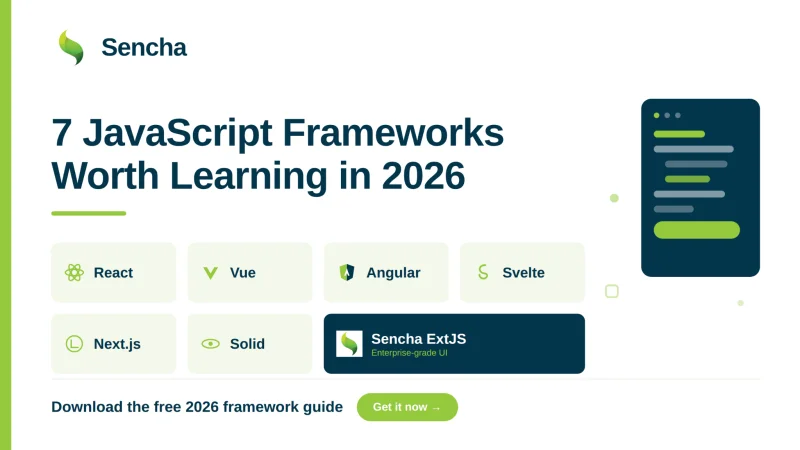
JavaScript framework selection in 2026 depends heavily on what is being built. React continues to lead the consumer and startup ecosystem, Angular suits structured enterprise teams, Vue offers a strong developer experience, and Ext JS is built specifically for data-intensive enterprise applications. Svelte and Solid are gaining traction for performance-critical work, and Next.js extends React with full-stack capability.
Three older approaches, Ember, Backbone, and jQuery-based solutions, no longer make sense for new projects. Key Takeaways Ext JS is built for data-intensive enterprise applications, with 140+ pre-built components and a high-performance data grid. React has the largest ecosystem and hiring pool, but enterprise feature parity often requires significant third-party integration. Angular provides a complete framework with TypeScript by default and suits large, structured teams.
Vue offers an approachable developer experience and works well for teams modernizing legacy stacks. Svelte and Solid are interesting choices for performance-critical applications, though their ecosystems are smaller. Next.js extends React with server-side rendering, static generation, and built-in API routes. Ember, Backbone, and jQuery-based frameworks are no longer good choices for new projects.
What Makes a JavaScript Framework Worth Learning in 2026?
JavaScript Framework selection depends on what is being built and who is building it. The factors that matter most for an enterprise team are different from those that matter for a small consumer-facing startup, and the most popular framework is not automatically the right one for every project.
Performance at scale matters for any application handling large datasets, complex form validation, or real-time updates. Component library depth affects how quickly a team can build, because pre-built components save months compared to building grids, charts, and complex forms from scratch. Backward compatibility protects investments in applications that run for many years, since breaking changes in major versions create technical debt that compounds over time.
Security and compliance matter in regulated industries such as financial services, healthcare, and government, where applications must meet specific standards. Vendor support provides peace of mind for mission-critical work, because production issues need defined response paths rather than reliance on community forums. With those criteria in mind, here are seven frameworks worth learning in 2026.
The 7 JavaScript Frameworks Worth Learning in 2026
1. Ext JS: The enterprise framework
Ext JS is built specifically for data-intensive enterprise applications, with a long history of use in financial services, manufacturing, government, and other regulated industries. It ships with 140+ pre-built UI components, including a high-performance data grid, enterprise charts, tree panels, and form controls, so teams configure existing components rather than building from scratch. Ext JS 8.0 introduces a responsive Digital Signature Pad with multiple export formats and a QR Code Reader and Generator supporting many common formats.
Enhanced grid performance delivers horizontal buffering and column virtualization, which keep scrolling smooth across wide datasets. The Lockable Grid plugin provides native column locking with synchronized scrolling. Font Awesome 7 is now the default icon set, and ECMAScript support extends through ES2025. The Modern toolkit includes ARIA accessibility built into every component, which supports WCAG 2.2 compliance work without retrofitting. The overall advantages are a complete component library, strong scalability for large data volumes, long backward compatibility, and commercial support with direct engineering access.
Best for: enterprises building data-intensive dashboards, financial trading platforms, healthcare management systems, and complex form-driven applications.
2. React: The ecosystem leader
React remains the most widely adopted JavaScript tool, with strong job market demand and an extensive component ecosystem. Recent versions introduced Server Components, automatic batching improvements, and concurrent features that improve performance for complex UIs.
The strengths are a large third-party component selection, broad hiring availability, mature tooling, and a flexible architecture that supports many application patterns. The trade-offs for enterprise teams include the need to integrate many libraries to reach enterprise functionality, fragmentation across the component library landscape, and the depth of framework knowledge required to optimize performance for data-intensive scenarios.
Best for: startups, consumer-facing applications, content websites, and teams with strong React expertise comfortable assembling component libraries.
3. Angular: The complete framework
Angular provides a complete framework with built-in routing, forms, an HTTP client, and testing utilities. Google’s backing supports long-term stability and regular updates.
The strengths are a complete solution that reduces architectural decisions, strong TypeScript integration from the start, excellent testing tools, consistent release cadence with clear upgrade paths, and enterprise-grade security practices. The trade-offs are a steeper learning curve than React or Vue, an opinionated architecture that some teams find restrictive, and larger bundle sizes than lighter alternatives.
Best for: large enterprise teams building complex applications, government projects that require structured architecture, and teams that prefer comprehensive framework solutions over assembling parts.
4. Vue: The developer experience option
Vue offers an excellent developer experience through the Composition API and script setup syntax. The framework balances simplicity with capable features, which makes it approachable for developers moving from other frameworks or modernizing older codebases.
The trade-offs include a smaller enterprise component ecosystem compared to Ext JS, fewer mature commercial component libraries, and a smaller pool of large-scale enterprise case studies than React or Angular.
Best for: mid-size companies building modern web applications, teams transitioning from jQuery or legacy frameworks, and projects that need rapid development with a path to production scale.
5. Svelte: The compile-time optimizer
Svelte takes a different approach by compiling components to optimized JavaScript at build time. This eliminates the runtime framework overhead that affects other solutions and produces smaller bundles and strong runtime performance.
The trade-offs are a smaller ecosystem than React or Angular, limited enterprise component libraries, less tooling and IDE support than the established frameworks, and a smaller but growing job market.
Best for: performance-critical applications, teams building custom component libraries, and projects where bundle size has a meaningful impact on user experience.
6. Solid: Fine-grained reactivity
Solid delivers a React-like developer experience with a different runtime model based on fine-grained reactivity. Rather than re-rendering components, Solid updates only the specific DOM nodes that change, which avoids virtual DOM overhead and provides strong performance for applications with frequent state updates.
The strengths are excellent performance benchmarks and familiar syntax for React developers. The trade-offs are a small but growing community, a limited ecosystem of third-party libraries, and less enterprise adoption than the established frameworks. Solid is a strong technical choice when the application’s profile justifies adopting newer technology.
Best for: performance-sensitive applications, teams with React experience looking for better performance characteristics, and projects where fine-grained update control matters.
7. Next.js: Full-stack React
Next.js extends React with server-side rendering, static site generation, and API routes. The framework handles much of the complexity of modern web application deployment and optimization, including automatic image optimization, built-in CSS support, and deployment optimizations. Server-side rendering improves SEO and initial page load performance, while static generation enables fast content delivery through CDNs.
The trade-offs are the additional complexity over plain React and a tight coupling to specific deployment patterns when using some features.
Best for: content-heavy applications, e-commerce platforms, marketing sites that need SEO optimization, and teams building full-stack React applications.
Framework Comparison: Enterprise vs Startup Priorities
| Framework | Enterprise fit | Startup fit | Component library | Learning curve | Performance | Support |
| Ext JS | Very strong | Moderate | 140+ built-in | Moderate | Excellent | Commercial |
| React | Strong | Very strong | Ecosystem-based | Moderate | Good | Community |
| Angular | Strong | Moderate | Angular Material | Steep | Good | Google-backed |
| Vue | Moderate | Strong | Growing | Gentle | Good | Community |
| Svelte | Moderate | Strong | Limited | Gentle | Excellent | Community |
| Solid | Emerging | Moderate | Limited | Moderate | Excellent | Community |
| Next.js | Strong | Very strong | React ecosystem | Moderate | Good | Vercel |
Enterprise priorities tend to favor component completeness, proven scalability, commercial support, backward compatibility, and security compliance. Startup priorities tend to favor developer velocity, ecosystem size, hiring availability, community support, and rapid iteration. The right choice depends on which set of priorities best matches the project.
3 JavaScript Frameworks to Avoid for New Projects in 2026
1. Ember.js
2. Backbone.js
3. jQuery-based frameworks
Conclusion
JavaScript framework selection in 2026 comes down to matching framework capabilities to the project’s profile rather than to framework popularity. Ext JS, React, Angular, and Vue all earn their places for different reasons, while Svelte, Solid, and Next.js bring useful capabilities for specific scenarios. Three older approaches, Ember, Backbone, and jQuery-based frameworks, no longer serve new projects well.
For enterprise teams building data-intensive applications, Ext JS continues to provide capabilities that would otherwise require assembling many separate libraries. Teams ready to evaluate Ext JS can start a free trial and assess it against their own requirements.
Frequently Asked Questions
What is the most popular JavaScript framework in 2026?
React continues to lead developer adoption across most surveys and is the most widely used framework for new consumer-facing and startup applications.
Should I learn multiple JavaScript frameworks?
Focus on one framework first, then expand based on career direction and project needs. Enterprise developers benefit from Ext JS expertise for data-intensive applications.
How do I migrate from an older framework to a modern one?
Start with a migration assessment that scopes the work involved. For Ext JS applications, the Sencha Upgrade Adviser scans existing codebases and identifies the changes needed for newer versions.
Scopri di più da GuruHiTech
Abbonati per ricevere gli ultimi articoli inviati alla tua e-mail.