

AI-Generated Receipts and Doctored Claim Photos: How Finance and Insurance Teams Fight Back
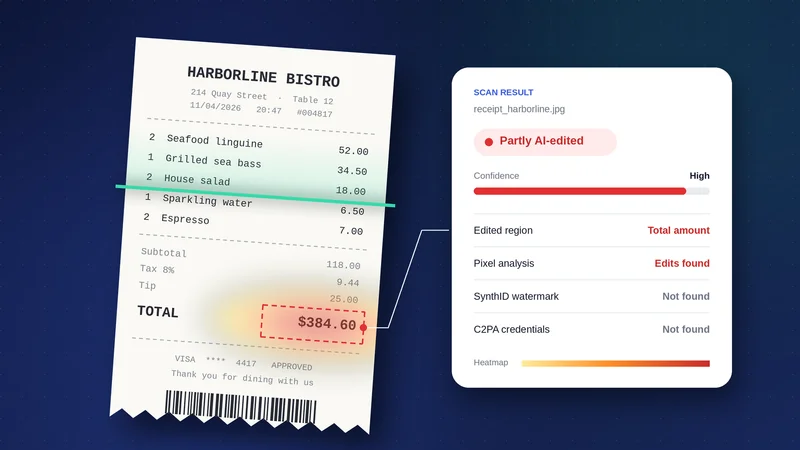
The receipt looks perfect. Crumpled slightly at one corner, a faint coffee ring, the restaurant’s real address, a tip line filled in with a slightly shaky hand. It was made in eleven seconds by an image model, and it’s sitting in an expense queue with forty other claims an approver will clear before lunch.
That scenario went from rare to routine in about a year. According to AppZen data reported by Accounting Today in June 2026, AI-generated documents made up 0% of the fake receipts its system flagged in March 2025. By mid-May 2026, the share was 70.8%. A separate Emburse survey published the same month found four in ten US employees admitted using AI to create a fake expense receipt.
Insurance is seeing the same shift with claim photos. The tools that create these fakes are free and fast, the good news is that the tools to catch them are, too.
The New Face of Document and Photo Fraud
Expense and claims fraud used to require effort. Someone had to edit a PDF, borrow a receipt, or stage damage. Generative AI removed nearly all of that friction. Now anyone can describe a receipt or a dented bumper and get a realistic image back.
Screening Images Before Approval
The first line of defense is an automated check on the image itself. Phrasly’s free AI Image Detector gives finance and claims teams a quick way to screen suspicious receipts, damage photos, and supporting documents. Upload, paste, or link a JPG, PNG, WebP, HEIC, AVIF, or GIF up to 20 MB, and it returns a verdict of AI, real, or partly AI-edited, a confidence score, and a heatmap of generated regions.
The heatmap matters most here. Insurers call lightly edited real photos “shallowfakes”: a genuine car photo with a dent added, or a real receipt with the total changed. A heatmap highlighting just the damaged panel or the amount line tells a reviewer exactly where the edit is. The tool also checks for SynthID watermarks and C2PA signatures, either of which confirms AI origin outright. It’s free, no account is required, and the page says images aren’t stored.
Expense Fraud Has Gone Generative:
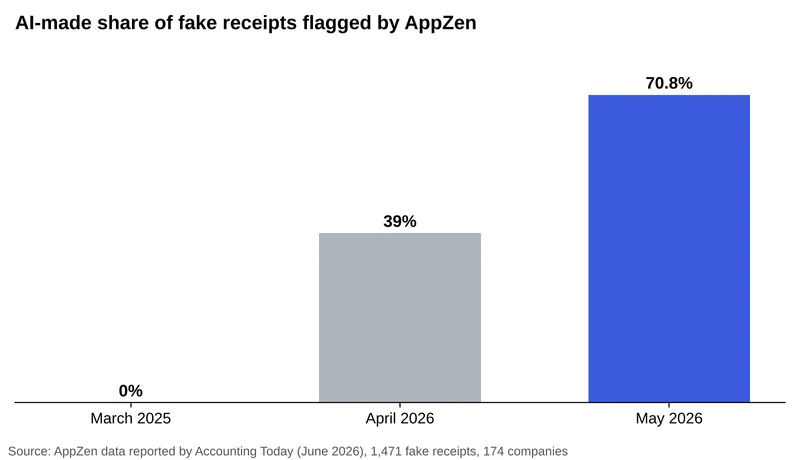
The AppZen figures cover 1,471 fake receipts across 174 companies, so they show a trend rather than a census. But the direction matches what other companies report. SAP Concur said in December 2025 that about 1% of receipts its system reviewed were flagged as potentially AI-generated, and that its new checks were catching 18 times more suspected AI receipts than earlier methods.
People inside finance teams are worried about their own ability to spot the fakes. A Medius survey of 1,000 finance professionals in the US and UK, conducted in July 2025, found 32% said they wouldn’t recognize a fake expense report, and 30% had seen fake receipts increase since 2024.
Why small amounts add up
AI receipt fraud tends to be high volume and low value. A padded dinner here, an invented taxi ride there. Individually, each claim slips under review thresholds. Across a large workforce and a full year, the totals become significant, and the behavior spreads when nobody gets caught.
Insurance Claims Are Under the Same Pressure
Insurers are reporting the same pattern with images. Aviva said in June 2026 that it detected more than 18,400 suspect claims worth £233 million in 2025, and specifically noted a growing number of claims supported by AI-generated images and manipulated documents.
Allianz UK, in June 2026, pointed to a quieter risk: photos people post online. Car pictures shared on social media or sales listings can be lifted and edited into fake damage claims. In its survey, 73% of drivers said they had no idea posting car photos could expose them to fraud.
Across the UK industry, detected insurance fraud reached £1.34 billion in 2025, up 14% from £1.18 billion the year before, according to Association of British Insurers figures reported by Insurance Business in October 2026. The number of cases actually fell, while the average fraudulent claim rose to about £14,300. Fewer, bigger, better-faked claims is exactly what you’d expect when convincing evidence becomes cheap to produce.
A Practical Screening Workflow
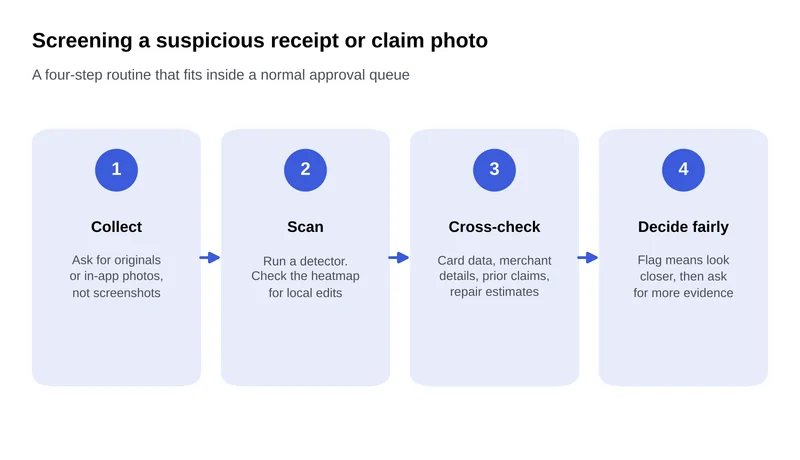
Most organizations don’t need a huge new system. They need a few habits built into the approval process.
For Expense Teams
- Require original files or photos taken through the expense app, not screenshots or forwarded images
- Run receipts flagged by policy rules through an image detector and check the heatmap
- Cross-check merchant names, addresses, tax numbers, and card transactions against the receipt
- Watch for receipts that look too clean, too uniform, or suspiciously similar across claims
- Track repeat claimants, since a small group often accounts for a large share of fakes
For Claims Handlers
- Ask for multiple angles and a wide shot showing the location or vehicle plate
- Request the original image files with metadata intact, and check camera data and timestamps
- Reverse search damage photos to catch images lifted from listings or other claims
- Use detector heatmaps to spot localized edits on the damaged area
- Compare against prior claims, repair estimates, and telematics data where available
Provenance helps when it’s there
More images now carry SynthID watermarks or C2PA Content Credentials, which record how and with what tool an image was made. SynthID hides an invisible signal in the pixels, while C2PA attaches a signed record to the file. A watermark hit is strong evidence. A missing one proves little, because many tools don’t add them and many platforms strip them.
Signals at a Glance
| Signal | Expense receipts | Claim photos |
| Detector flags AI or edited regions | Strong reason to investigate | Strong reason to investigate |
| No matching card transaction | Major red flag | Not applicable |
| Image found elsewhere online | Rare, but serious | Common with car and property photos |
| Original file unavailable | Suspicious if repeated | Suspicious, request again |
| Repeat pattern across claims | Very common in AI fraud | Common in organized fraud |
Keep the Process Fair
A flagged image is a reason to look closer, not a conviction. Detectors give probabilities, and genuine photos sometimes score oddly, especially after heavy compression. Build in a step where the employee or policyholder can supply more evidence before any decision. Fair processes also hold up better if a case ever reaches HR, a tribunal, or a court.
Clear policy helps as much as detection. When employees know receipts are screened for AI generation, many simply won’t try. Deterrence is cheaper than investigation.
Make Every Image Earn Its Approval
Fake receipts and doctored claim photos used to take effort. Now they take a prompt, and the data from AppZen, Emburse, Aviva, and the ABI shows people are using that shortcut in growing numbers.
The response doesn’t have to be complicated. Ask for originals, screen suspicious images with a detector that shows exactly what was edited, cross-check against transaction and claim records, and watch for repeat patterns. Treat flags as prompts for a closer look, and tell people the checks exist. A few minutes of screening per suspicious claim is far cheaper than paying out on a picture that was never real.
Ti potrebbe interessare:
Segui guruhitech su:
- Google News: bit.ly/gurugooglenews
- Telegram: t.me/guruhitech
- Facebook: facebook.com/guruhitechfb
- X (Twitter): x.com/guruhitech1
- Bluesky: bsky.app/profile/guruhitech.bsky.social
- Rumble: rumble.com/user/guruhitech
- VKontakte: vk.com/guruhitech
- MeWe: mewe.com/i/guruhitech
- Skype: live:.cid.d4cf3836b772da8a
- WhatsApp: bit.ly/whatsappguruhitech
Esprimi il tuo parere!
Ti è stato utile questo articolo? Lascia un commento nell’apposita sezione che trovi più in basso e se ti va, iscriviti alla newsletter.
Per qualsiasi domanda, informazione o assistenza nel mondo della tecnologia, puoi inviare una email all’indirizzo [email protected].
Che ne pensi?
Scopri di più da GuruHiTech
Abbonati per ricevere gli ultimi articoli inviati alla tua e-mail.