
Choosing the Right AI Video Engine for Business: A Practical Framework
Most companies approach AI video generation completely backward. They watch a viral, cherry-picked demo on social media, immediately purchase API credits for that specific model, and then wonder why their actual product videos look like a glitching, unusable mess. The reality of production-level generative AI is far less glamorous than the marketing suggests.
A video generator does not magically “know” what your brand guidelines entail, nor does it inherently understand the physical constraints of your product. Before a single pixel is rendered, your text prompt must be decoded into spatial dimensions, object relationships, and physical rules. The architectural intelligence of any AI video engine is fundamentally bound by the supported LLM models working behind the scenes. If that language layer fails to accurately parse the semantic intent of your prompt, you will burn through your compute budget generating high-resolution garbage.
Choosing an AI video engine for a commercial workflow is not an aesthetic choice; it is an infrastructure decision. You are evaluating a rendering pipeline. Currently, the market is highly segmented. Deploying a physics-heavy engine for a simple social media ad is a waste of money, while deploying a fast, commercial model for a complex cinematic sequence will result in broken physics.
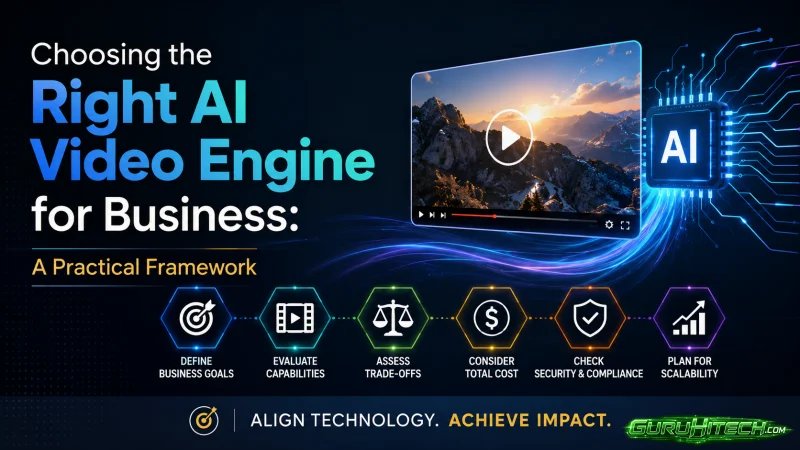
To build a reliable, automated content pipeline, technical directors and marketing leads must evaluate engines based on a strict framework: Business Use Case, Quality Metrics, and Infrastructure Scalability. Here is how to navigate that selection process.
1. Aligning the Engine with the Business Use Case
There is no “best” model in 2026. There is only the right model for the specific job. Different engines are trained on different datasets with distinct optimization goals.
High-Volume Performance Marketing (The “Scroll-Stopper”)
If your core objective is generating hundreds of localized video ads for TikTok, Instagram Reels, or e-commerce product pages, your primary metric is Speed-to-Market. You need an engine optimized for vibrant saturation, sharp subject focus, and extremely fast generation times. Models like Alibaba’s Wan 2.6 dominate this category. They are designed to output “commercial aesthetics” almost instantly. In a performance marketing pipeline where you need to A/B test fifty different video hooks by tomorrow morning, waiting five minutes per render is unacceptable. You trade hyper-realistic physics for throughput and visual punch.
Brand Narrative and Cinematic B-Roll
If you are producing a hero video for your homepage, a luxury product showcase, or a documentary background, your primary metric is Environmental Realism. This is where OpenAI’s Sora 2 remains the heavy hitter. It treats video generation as a world simulation. If you need a camera to track through a rain-soaked street while reflecting neon lights accurately in the puddles, this engine calculates the fluid dynamics and ray-tracing better than anything else. The trade-off is cost and latency. It is a slow, expensive engine, but it saves thousands of dollars in traditional VFX rendering.
Human-Centric and Instructional Content
If your video requires a human character to walk, point at a product, or show complex facial expressions, your primary metric is Anatomical Stability. Most generic video engines fail spectacularly here—hands merge into objects, and faces morph during camera pans. Models like Kling 2.6 have been specifically tuned to solve skeletal tracking. If your business use case involves “talking head” tutorials or lifestyle acting, you must prioritize an engine that explicitly safeguards human coherence, even if its background generation is slightly less detailed.
2. Evaluating True Video Quality (Beyond Resolution)
When reviewing an AI Video Engine, do not look at the resolution. Upscaling a 720p video to 4K is trivial. Instead, stress-test the engine against three critical failure points:
Temporal Consistency: Does the asset hold together over time? If you generate a 10-second clip of a car driving, does the license plate scramble? Do the hubcaps change design? Poor temporal consistency forces your video editors to spend hours manually masking and fixing mistakes in post-production, wiping out any cost savings the AI provided.
Physics Compliance: Generative AI notoriously struggles with inertia, mass, and gravity. Observe how the engine handles object interaction. Does a heavy steel ball bounce like a balloon? If a model is interacting with your physical product, the physics must look correct to the human eye, or the viewer will immediately register the video as “fake,” destroying consumer trust.
Prompt Adherence (The Semantic Gap): This ties back to the language parsing mentioned earlier. If you request a “wide-angle shot from a low angle,” does the engine actually change the virtual focal length, or does it just give you a standard medium shot? An engine that requires ten different prompt rewrites to achieve the desired framing is operationally inefficient.
3. The Infrastructure Bottleneck: Cold Starts and Concurrency
Finding the right engine is only step one. The operational nightmare begins when you try to integrate it into a live application.
Most research labs provide APIs designed for testing, not enterprise traffic. If you hardcode a direct connection to a specific model and your app experiences a traffic spike, you will immediately hit strict rate limits. Your API calls will return 429 Too Many Requests errors, and your application will stall.
Furthermore, AI video models suffer from severe “Cold Starts.” A 30GB model cannot be loaded into a GPU instantly. If a model endpoint has been idle, the next user who requests a video might have to wait 30 to 45 seconds just for the model weights to load into VRAM before the actual generation even begins. In a consumer-facing app, a 45-second delay equals a lost customer.
The Aggregator Solution
This operational reality is why production-grade applications are moving away from direct single-model APIs and utilizing unified infrastructure platforms like WaveSpeed.
WaveSpeed acts as a load-balancing abstraction layer. Instead of your team managing rate limits and serverless GPU instances, the platform handles the execution. Because it aggregates massive volume, it keeps top-tier video engines permanently “warm” in its GPU clusters. This eliminates the cold start delay, delivering instant inference.
Additionally, by routing requests through an infrastructure built for scale, businesses gain the ability to process thousands of concurrent video generations asynchronously via webhooks. You gain the exact visual output of the world’s best models, wrapped in the stability of enterprise-grade server architecture.
Conclusion
Stop evaluating AI video models based on isolated Twitter demos. The success of your automated content pipeline depends on matching the specific rendering logic of an engine to your exact business needs.
Define your use case. Stress-test for temporal consistency and prompt adherence. And most importantly, ensure your underlying infrastructure can actually handle the massive compute requirements of video generation at scale without bottlenecking your user experience. The companies that dominate video marketing in 2026 will not be the ones with the cleverest prompts; they will be the ones with the most robust, dynamically routed API architecture.
Ti potrebbe interessare:
Segui guruhitech su:
- Google News: bit.ly/gurugooglenews
- Telegram: t.me/guruhitech
- Facebook: facebook.com/guruhitechfb
- Instagram: instagram.com/guruhitech_official/
- X (Twitter): x.com/guruhitech1
- Bluesky: bsky.app/profile/guruhitech.bsky.social
- Rumble: rumble.com/user/guruhitech
- VKontakte: vk.com/guruhitech
- MeWe: mewe.com/i/guruhitech
- Skype: live:.cid.d4cf3836b772da8a
- WhatsApp: bit.ly/whatsappguruhitech
Esprimi il tuo parere!
Ti è stato utile questo articolo? Lascia un commento nell’apposita sezione che trovi più in basso e se ti va, iscriviti alla newsletter.
Per qualsiasi domanda, informazione o assistenza nel mondo della tecnologia, puoi inviare una email all’indirizzo [email protected].
Scopri di più da GuruHiTech
Abbonati per ricevere gli ultimi articoli inviati alla tua e-mail.