
How AI Voice Cloning and Talking Avatars Are Changing Online Education
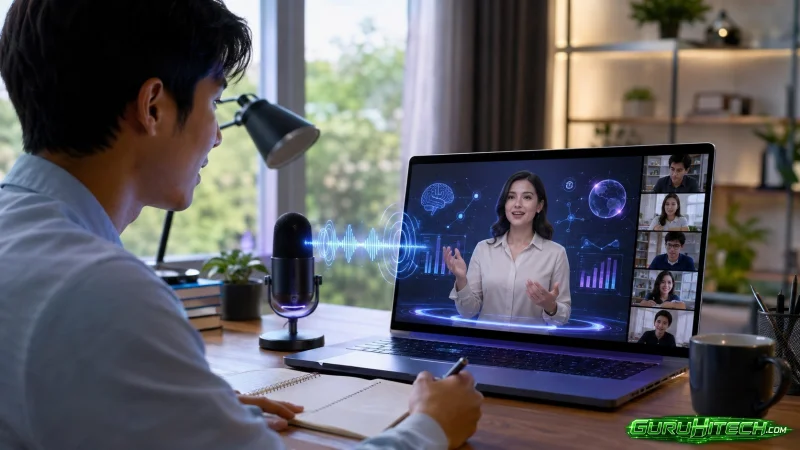
Online education has a retention problem. Most course completion rates hover between 10% and 15%. Students sign up, watch a few videos, and disappear. The reasons are well-documented: content feels impersonal, the instructor’s voice becomes monotonous after hours of lectures, and there’s no human connection to keep learners engaged.
Two technologies are starting to change that: AI voice cloning and talking avatars. Together, they let course creators produce content that feels personal at scale — the instructor’s actual voice, delivered through a virtual presenter that looks and moves like a real person. It’s not quite the same as a live classroom, but it’s a lot closer than a slide deck with voiceover.
Clone Your Voice Once, Teach in Every Language
Recording a course is time-consuming. Recording the same course in multiple languages is nearly impossible for independent instructors. Most settle for English and hope for the best. But the global e-learning market is projected to hit $457 billion by 2026 (Global Market Insights), and the fastest-growing segments are in non-English-speaking regions.
AI voice cloning solves this by creating a digital copy of your voice from a short audio sample. Once cloned, you can type any script and generate speech that sounds indistinguishable from your real voice — same tone, same rhythm, same personality. That means you record your course content once, in one language, and the AI voice cloning tool generates versions in Spanish, French, Mandarin, Japanese, and any other language your students speak.
For course creators on platforms like EDUCBA, this changes the economics of international expansion. Instead of hiring native speakers to re-record every lecture, you let AI handle the voice work. Your students hear your voice — not a generic text-to-speech robot — in a language they understand. That builds trust and improves completion rates.
Virtual Instructors That Students Actually Watch
Voice is half the equation. The other half is presence. Even the best audio narration struggles to hold attention for a 45-minute lecture. Students need a visual anchor — someone to look at, someone whose facial expressions and body language reinforce the lesson.
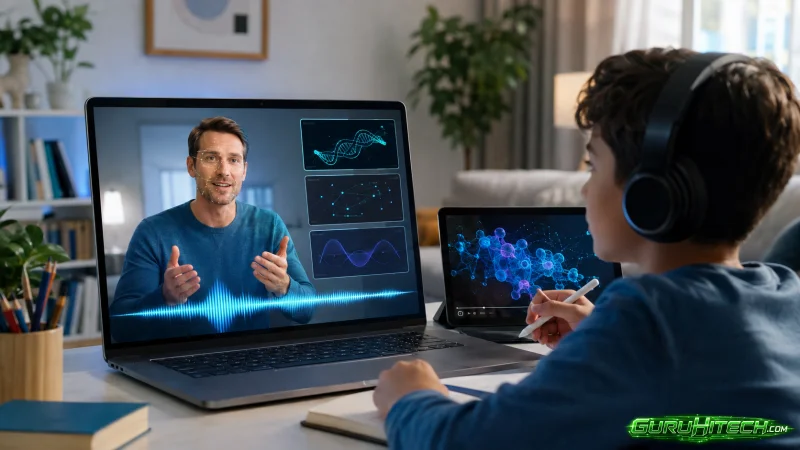
A talking avatar provides exactly that. It’s a virtual presenter that syncs lip movements to your audio, gestures naturally, and maintains eye contact with the viewer. You write the script, provide the voice (or let AI generate it), and the avatar delivers the lecture as if it’s speaking directly to each student.
This matters more than you’d think. Research from the University of California found that students who watched avatar-delivered lectures scored 23% higher on retention tests than those who watched the same content as a slideshow with voiceover. The avatar creates a social presence — a sense that someone is actually teaching you — that triggers the brain’s attention systems in ways that disembodied audio can’t replicate.
Building a Course That Works in Every Market
Here’s what a multi-language course production pipeline looks like with AI tools:
Start by recording your original lectures once — in your native language, with your natural delivery. Don’t worry about perfection. The AI voice cloning tool will clean up background noise and smooth out inconsistencies.
Next, clone your voice. Upload a clean 30-second sample, and the AI builds a voice model that captures your unique speaking style. This takes seconds.
Then, generate multi-language versions. Feed your lecture scripts into the voice cloning tool for each target language. The AI produces audio that matches your voice’s tone and pacing, but delivers the content in fluent Spanish, German, or Japanese.
Finally, pair each language track with a talking avatar. The same virtual instructor can present every language version, creating a consistent learning experience across markets. Students in Mexico and Munich both feel like they’re getting the real course — not a dubbed afterthought.
The entire process costs a fraction of what professional translation and re-recording would run. And it scales. Once your voice model is trained, generating new language versions of future courses takes the same amount of effort as clicking “generate.”
Frequently Asked Questions
How accurate is AI voice cloning for non-English languages?
Modern voice cloning tools achieve over 95% pronunciation accuracy for major languages including Spanish, French, German, Japanese, Korean, and Mandarin. Regional accents are preserved. The cloned voice maintains your natural speaking style regardless of which language it’s generating.
Does a talking avatar look realistic enough for professional courses?
Yes. Current avatar technology uses 3D rendering with real-time lip-sync. The movements are smooth, expressions are varied, and eye contact is consistent. Most students watching on a laptop or phone won’t realize it’s not a real person. The quality is ready for commercial course production.
How long does it take to clone a voice?
With a clean 10 to 30-second audio sample, voice cloning takes about 30 seconds. After that, generating speech from text is nearly instant. You can produce an entire 30-minute lecture in a new language within five minutes of starting the process.
Can I use AI-generated voices for paid courses?
Most AI voice cloning platforms include commercial usage rights with their paid plans. Free tiers typically restrict commercial use. Check the specific platform’s terms before using cloned voices in monetized courses.
What This Means for Independent Course Creators
The biggest winners from AI voice cloning and avatars aren’t large platforms. They’re independent instructors — the people who teach niche skills, specialized professional topics, and local-language content that big platforms ignore.
An independent Excel instructor based in Brazil can now sell the same course to students in Mexico, Spain, and Argentina without recording a single new lecture. Their cloned voice handles the Spanish and Portuguese versions. A talking avatar delivers the visual component. One recording session becomes a multi-market course catalog.
This changes the economics of course creation entirely. Instead of spending $2,000 to $5,000 on professional translation and re-recording per course, the cost drops to a monthly AI tool subscription — typically under $50. For instructors who’ve been limited to a single-language audience because of production costs, that’s the difference between staying local and going global.
The Future of Online Education Is Personal
Online education succeeded at making knowledge accessible. But it failed at making learning feel personal. Students sign up for courses because they want to learn from a specific instructor — not because they’re excited about a PowerPoint presentation.
AI voice cloning preserves that personal connection across languages. Talking avatars add the visual presence that keeps learners engaged through long sessions. Together, they bring online courses closer to the classroom experience than anything that’s come before.
The tools are ready. Your voice is waiting. The students in every country who would benefit from your course are already searching for content like yours — in their language. Time to reach them.
Ti potrebbe interessare:
Segui guruhitech su:
- Google News: bit.ly/gurugooglenews
- Telegram: t.me/guruhitech
- Facebook: facebook.com/guruhitechfb
- Instagram: instagram.com/guruhitech_official/
- X (Twitter): x.com/guruhitech1
- Bluesky: bsky.app/profile/guruhitech.bsky.social
- Rumble: rumble.com/user/guruhitech
- VKontakte: vk.com/guruhitech
- MeWe: mewe.com/i/guruhitech
- Skype: live:.cid.d4cf3836b772da8a
- WhatsApp: bit.ly/whatsappguruhitech
Esprimi il tuo parere!
Ti è stato utile questo articolo? Lascia un commento nell’apposita sezione che trovi più in basso e se ti va, iscriviti alla newsletter.
Per qualsiasi domanda, informazione o assistenza nel mondo della tecnologia, puoi inviare una email all’indirizzo [email protected].
Scopri di più da GuruHiTech
Abbonati per ricevere gli ultimi articoli inviati alla tua e-mail.