
How Cloud Security Mitigates Distributed Denial of Service Attacks
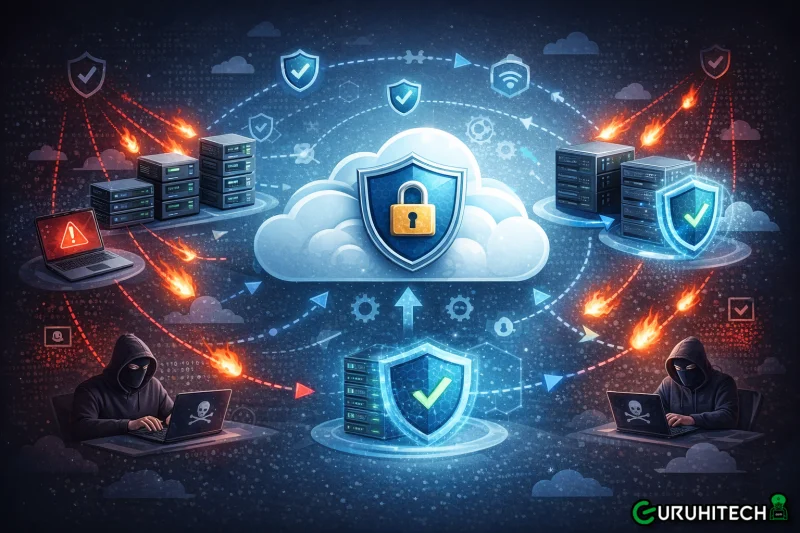
A formal guide on how cloud security reduces the impact of DDoS attacks through architecture, controls, and response practices.
Introduction
Distributed Denial of Service (DDoS) attacks aim to disrupt services by flooding networks or applications with traffic. Organizations rely on a mix of network design, controls, and operational readiness to sustain availability during such incidents.
This article explains how cloud security principles reduce the risk and impact of DDoS attacks. It covers technical controls, operational practices, and policy considerations in clear, formal language.
Overview of DDoS Attacks
A DDoS attack uses many compromised systems to send large volumes of requests or traffic to a target. The goal is to consume resources, exhaust capacity, or exploit service dependencies so legitimate users cannot connect.
Attack vectors vary. They include volumetric floods, protocol attacks, and application-layer floods that are harder to distinguish from normal traffic.
Cloud Security Approaches and Service Models
Modern cloud architectures can isolate and contain the effects of DDoS events through distributed resources and service models. Cloud services and security against DDoS, as well as cloud providers and operators, use network edge controls and traffic inspection to reduce exposure before traffic reaches core assets.
Traffic Filtering and Rate Controls
Cloud platforms enable filtering at multiple layers: at edge routers, load balancers, and application gateways. These controls drop or challenge suspicious traffic patterns and preserve capacity for legitimate requests.
Effective filtering relies on clear policies, up-to-date signatures, and anomaly detection to remove malicious packets without blocking valid users. For official guidance on mitigating volumetric attacks.
Elastic Capacity and Auto Scaling
One advantage of cloud systems is elastic capacity that absorbs traffic spikes without service loss. Auto scaling adds compute and network resources in response to load, which reduces the chance that an attack will exhaust available capacity.
Proper configuration is essential to prevent scaling from resulting in runaway costs or uncontrolled resource allocation during sustained attacks.
Redundancy and Geographic Distribution
Placing resources across multiple regions and availability zones helps maintain service when a single location is targeted. Traffic can be routed away from congested points and directed to healthy endpoints.
Redundancy reduces single points of failure and shortens recovery time by enabling failover and regional mitigation.
Edge and Content Delivery Networks
Content delivery networks (CDNs) and edge caching reduce load on origin servers by serving static and cacheable content close to users. This lowers the volume of traffic reaching critical back-end systems.
Edge nodes can also enforce request validation and present challenges, making it harder for attackers to reach the application layer.
Segmentation and Access Controls
Network segmentation limits the blast radius of an attack by isolating critical services from less sensitive components. Access control lists and security groups restrict which systems can communicate directly with each other.
Combining segmentation with strict ingress and egress rules helps contain malicious traffic and prevents lateral movement triggered by service disruption.
Zero Trust and Identity-Based Policies
Identity-based policies and zero-trust principles ensure that only authenticated and authorized requests reach protected services. Verifying identity and intent reduces the effectiveness of simple volumetric attacks.
Applying least privilege to APIs and management interfaces reduces the attack surface that can be used to amplify or sustain DDoS campaigns.
Traffic Shaping and Prioritization
Traffic shaping and quality of service controls help prioritize critical traffic during congestion. Reserving bandwidth or prioritizing health-check and management flows keeps operational channels open.
These policies require careful planning to avoid unintentionally denying service to valid users and to confirm that priority rules match business needs.
Behavioral Detection and Anomaly Analysis
Monitoring tools that analyze traffic patterns help detect attacks early. Behavioral baselines, flow telemetry, and request profiling reveal deviations that may indicate active DDoS attempts.
Alerts should trigger automated and manual responses to reduce time to mitigation and to refine detection rules for future incidents.
Automation and Orchestrated Response
Automated playbooks can apply protective controls quickly, such as enabling additional filtering or redirecting traffic to scrubbing centers. Orchestration reduces human error and shortens response windows.
Automation must be tested and include safeguards to prevent false positives from blocking legitimate traffic.
Scrubbing Services and Third-Party Mitigation
Scrubbing services inspect and remove malicious traffic before it reaches the target environment. These services operate at scale and can identify and drop attack traffic while passing valid requests.
When integrating third-party mitigation, verify that contractual terms, data-handling practices, and failover mechanisms align with operational and compliance requirements.
Logging, Forensics, and Evidence Preservation
Comprehensive logging supports incident analysis and legal or regulatory actions after an attack. Preserve network flows, firewall logs, and application traces to reconstruct events and identify vulnerabilities.
For guidance on incident response processes best practices, consult standards such as NIST SP 800-6.
Operational Preparedness and Playbooks
A tested incident response plan clarifies roles, escalation paths, and mitigation steps. Playbooks should include communication plans, traffic rerouting steps, and restoration priorities.
Regular tabletop exercises help teams practice responses and update procedures to reflect changes in architecture or threat trends.
Cost and Billing Controls
DDoS events may trigger significant resource consumption and unexpected billing. Set spend limits, alerts, and policies to control costs during large-scale mitigation events.
Budget planning should include contingency funds for emergency mitigation and for contracting with specialized protection services when required.
Legal, Compliance, and Regulatory Considerations
Different jurisdictions have varied requirements for incident notification and data handling. Align DDoS response plans with legal obligations and regulatory expectations.
Engage legal and compliance teams early in the planning process to avoid delayed reporting or mismanaged evidence during a response.
Collaboration with Providers and ISPs
Work closely with service providers and internet service providers to implement upstream filtering and emergency routing. Providers can apply broad filters that prevent malicious traffic from traversing core networks.
Clear contacts and escalation procedures with providers speed coordination when large-scale network mitigation is required.
Testing and Continuous Improvement
Regular testing, including controlled load tests and red team exercises, verifies that mitigation measures work as intended. Post-incident reviews identify gaps and update controls.
Continuous improvement cycles ensure that defenses keep pace with evolving attack methods and changes in the application environment.
User and Customer Communication
Transparent communication during and after incidents preserves trust and reduces confusion. Provide status updates, timelines, and guidance to affected users.
Include communication templates in incident playbooks to speed messaging and reduce errors under pressure.
Metrics and Service Level Objectives
Establish measurable objectives for availability, recovery time, and acceptable degradation under attack. Monitor these metrics to determine whether mitigation is succeeding.
Metrics also support investment decisions and prioritization of controls based on business impact.
Threat Intelligence and Sharing
Sharing threat intelligence with peers and industry groups improves detection and informs protective rule sets. Intelligence can reveal attacker techniques and indicators of compromise.
Participate in trusted communities and information sharing programs to receive timely alerts about new DDoS trends.
Business Continuity and Recovery Planning
Integrate DDoS scenarios into business continuity planning so critical operations can continue with minimal interruption. Define recovery priorities and alternative service paths.
Practice switching to backup systems and validate that recovery steps restore essential functions within acceptable timeframes.
Financial and Insurance Considerations
Consider cyber insurance and financial protections that cover losses from service outages and mitigation expenses. Policies vary in scope and require clear documentation of controls and response practices.
Work with insurers to ensure coverage aligns with the organization s risk profile and mitigation investments.
Summary of Key Defensive Layers
Effective defense against DDoS attacks combines prevention, detection, and response. Edge filtering, scaling, scrubbing, monitoring, and robust operational procedures form a layered defense.
Cloud security practices, when planned and exercised, reduce risk and improve resilience against both volumetric and application-layer attacks.
Conclusion
Cloud security offers practical tools and operational models to reduce the impact of DDoS attacks. By combining architectural design, automated controls, monitoring, and tested response plans, organizations can sustain availability and recover more quickly. Ongoing testing, collaboration with providers, and adherence to incident response standards help maintain readiness. Implementing these measures supports a resilient posture and protects business continuity.
FAQ
Can cloud scaling stop all DDoS attacks?
Scaling can absorb many traffic spikes but is not a complete solution. Scaling must be combined with filtering, traffic management, and upstream mitigation to manage large or sustained attacks.
What is the role of a scrubbing service?
A scrubbing service inspects incoming traffic at scale and removes malicious flows before forwarding clean traffic to the target. It is useful for handling very large volumetric attacks.
How quickly should an organization detect and respond to a DDoS attack?
Early detection and rapid response are crucial. Automated detection and pre-planned playbooks reduce time to mitigation and limit service disruption.
Are there regulatory requirements for reporting DDoS incidents?
Reporting requirements depend on jurisdiction and industry. Organizations should consult legal counsel and compliance teams to determine obligations and include them in response plans.
How often should DDoS response plans be tested?
Response plans should be reviewed regularly and tested at least annually, with additional tests after major architecture changes or when new threat patterns emerge.
Scopri di più da GuruHiTech
Abbonati per ricevere gli ultimi articoli inviati alla tua e-mail.