
The Future of AI and Blockchain: How Intelligent Decentralization Is Transforming Industries
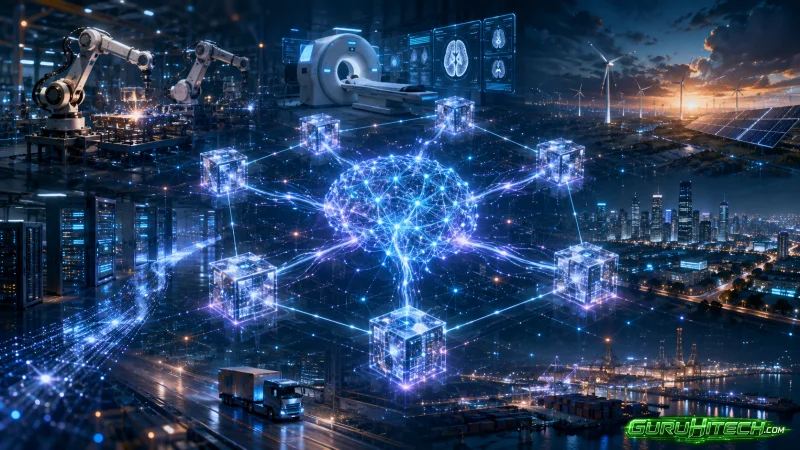
Among the many revolutionary advancements in technology during the current century, Artificial Intelligence and Blockchain Technology can easily be named as the two major ones. Each one on its own has played an important role in the manner in which information is being processed and stored in the digital world. Blockchain Technology gained its recognition as a platform for transparency and decentralization. Meanwhile, Artificial Intelligence brought about revolutionary changes in many different fields through prediction and automation.
Although each of these innovations possesses its own great strength individually, the true potential of these two lies in their combination.
The fusion of AI’s algorithmic capabilities and blockchain’s cryptography leads to an environment where the data becomes not only unbreakable and verified but also able to optimize itself as well as execute in real time.
Understanding the Relationship Between These Technologies: Why Blockchain Requires AI?
To understand the nature of the relationship between these technologies, one must first take a look at their fundamental architectures. The concept of the blockchain is that of a decentralized ledger system which uses cryptography to verify transactions made on multiple nodes. Information entered into the ledger cannot be modified unless it has been agreed upon by the whole network.
Despite all these advantages, traditional blockchain technology encounters the following operational problems:
Scalability Problems: With an increase in transactions, the blockchain network becomes congested and suffers from slow speed along with expensive gas charges.
Data Storage: The blockchain technology is very good for storing the data safely, but the data stored in the blockchain cannot be analyzed.
Complex Security Monitoring: Monitoring multi-stage cyber-attacks or smart contracts’ vulnerabilities on functioning chains needs continuous monitoring, which traditional rule-based programs cannot handle well.
This is where the role of AI comes in. Through the incorporation of machine learning algorithms into the blockchain structure, one can develop AI-integrated blockchain systems (http://Lunapr.io) that can easily monitor the network traffic and process on-chain data.
Key Principles Behind the Integration
This interaction between AI and blockchain technology is one of mutual benefit. Blockchain offers high-quality and uncorrupted data, which is necessary for AI for machine learning processes, while AI offers the required speed and intelligence to operate the complex network.
1. Threat Prediction and Cyber Security
Classical approaches to cybersecurity have been based mostly on reactive actions because they could recognize intrusions only after they occurred. AI allows changing this approach.
In this way, the machine learning algorithm can detect any fraudulent activity, including attacks like flash loans, by monitoring the transaction flow in real-time. The implementation of blockchain security methods (http://Lunapr.io), which utilize artificial intelligence algorithms, guarantees protection from attacks that are constantly developing.
2. Intelligent and Adaptive Smart Contracts
The smart contract is the backbone of the decentralized web where it executes certain automated processes based on predefined criteria. Nevertheless, conventional smart contracts are inflexible and operate on elementary “if/then” logic. By combining AI models into smart contracts, one enables their adaptability since they can take into account outside information—dynamic pricing on the market, dynamic insurance risk or changing weather conditions—and agree upon an agreement.
3. Resource Optimization and Green Computing
The proof-of-work and similar resource-intensive consensus mechanisms have long been criticized for their high energy usage and latency in processing. Through AI-powered prediction of node traffic, workload balancing, and improvement of consensus algorithms, AI can drastically decrease energy usage and increase overall transaction volume.
Industry-Specific Real World Applications
AI-powered blockchain architecture is already revolutionizing major industrial spheres:
Healthcare and Privacy-Friendly Diagnostics:
The electronic health record, kept on a blockchain system, is confidential and under user control. The AI model may ask for confidential information about health history in order to perform diagnostics and find treatment patterns.
Finance and DeFi: In the era of digital finance, the AI algorithms monitor the market activity and manage the yield-generating strategies. At the same time, the blockchain keeps the immutable audit log for each transaction, thus eliminating any fraudulent activities.
Management of Global Supply Chain:
Today’s supply chains depend on the use of Internet of Things (IoT) devices, blockchain for record keeping and AI for prediction of transit times and routes. At the same time, the blockchain ensures the authenticity of products to avoid any form of counterfeit.
The Future Horizon: decentralized AI networks
In the coming years, the concept that could be considered the most revolutionary idea would be the decentralization of AI. Traditionally, huge computing power was needed for training of machine learning algorithms, leading to centralization among the leading tech companies.
Through the integration of distributed computing protocols and blockchain ledger systems, it is now possible to create open-source AI systems. Such a system makes it possible for computing resources and data sets to be collected across the globe on a decentralized basis. This will make sure that the development of AI in the future will remain open and secure.
Conclusion
However, AI and blockchain technologies are much more than just fleeting industry trends because, in tandem, they represent the basic infrastructure required to build the next internet revolution. The blockchain technology provides all the necessary qualities of trust, immutability, and integrity, whereas AI technology provides adaptability and automation.
With the increase in their adoption rate, those businesses that adopt both of these technologies will gain a competitive edge over their competitors through lower costs and increased efficiency.
Ti potrebbe interessare:
Segui guruhitech su:
- Google News: bit.ly/gurugooglenews
- Telegram: t.me/guruhitech
- Facebook: facebook.com/guruhitechfb
- Instagram: instagram.com/guruhitech_official/
- X (Twitter): x.com/guruhitech1
- Bluesky: bsky.app/profile/guruhitech.bsky.social
- Rumble: rumble.com/user/guruhitech
- VKontakte: vk.com/guruhitech
- MeWe: mewe.com/i/guruhitech
- Skype: live:.cid.d4cf3836b772da8a
- WhatsApp: bit.ly/whatsappguruhitech
Esprimi il tuo parere!
Ti è stato utile questo articolo? Lascia un commento nell’apposita sezione che trovi più in basso e se ti va, iscriviti alla newsletter.
Per qualsiasi domanda, informazione o assistenza nel mondo della tecnologia, puoi inviare una email all’indirizzo [email protected].
Scopri di più da GuruHiTech
Abbonati per ricevere gli ultimi articoli inviati alla tua e-mail.