
Seedance 2.5 API And The 1:1 Credit Return
A model can launch before the tool your team uses has finished exposing it. That distinction matters when evaluating the Seedance 2.5 API. ByteDance now presents Seedance 2.5 as a current model, while the service page still treats 2.5 and the public API as pending. Both pages can be accurate because they describe different parts of the delivery chain.
SeeAPI connects those parts with a specific commercial promise. Eligible credits spent on Seedance 2 during the active event will return 1:1 as permanent account credits after Seedance 2.5 launches on the platform. A team that spends 800 eligible credits on useful Seedance 2 work should receive 800 permanent credits for the next stage. The word “launch” must refer to the platform milestone that triggers the return, not the mere existence of ByteDance’s model page.
Track Three States Before Promising A Launch Date
Product teams often compress model release, online access, and API readiness into one status called available. That shortcut causes trouble. Marketing sees a new model announcement and schedules a campaign. Engineering then discovers that the selected workspace offers only an older line, or that the public endpoint still lacks working credentials and documentation.
| State | Question To Close | Evidence That Counts |
| Model release | Has the model maker published it? | Current official model page |
| Workspace access | Can this account complete a generation? | Selectable model and finished job |
| API readiness | Can production software call it? | Docs, credentials, and a real response |
This three-state record lets a product manager approve research without pretending integration has cleared. Creative teams can prepare the brief and acceptance test while engineering leaves the API milestone blocked. Nobody has to freeze current Seedance 2 work or invent a date for a channel that remains pending.
The Producer Catalog Proves The Model Exists
ByteDance describes Seedance 2.5 as a joint audio-video generation model built for 30-second storytelling. It can extend a generation twice, interpret the framing and cinematic language of reference video, and support white-model control plus green-screen editing. Those details justify concrete test cases. They do not prove compatibility with a third-party account, pricing plan, response schema, or production queue.
A team can prepare a 30-second story brief, one camera reference, and an extension request now. Label that package as a model test. If the chosen service does not expose 2.5 yet, the package stays ready without turning a product announcement into an emergency integration sprint.
The Workspace Proves The Operational Route Works
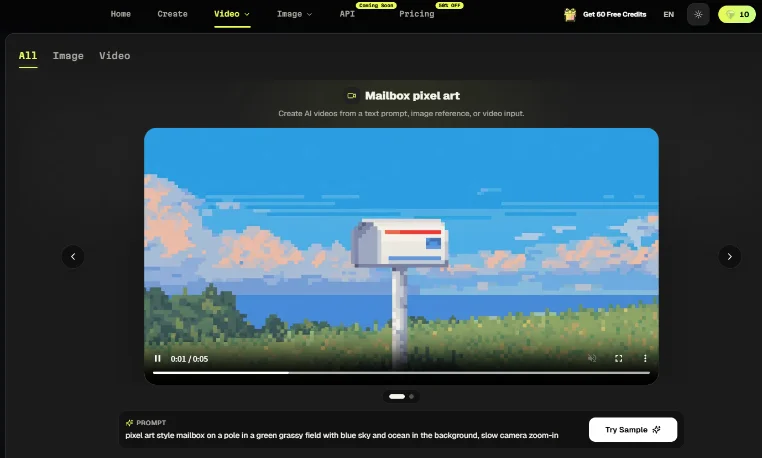
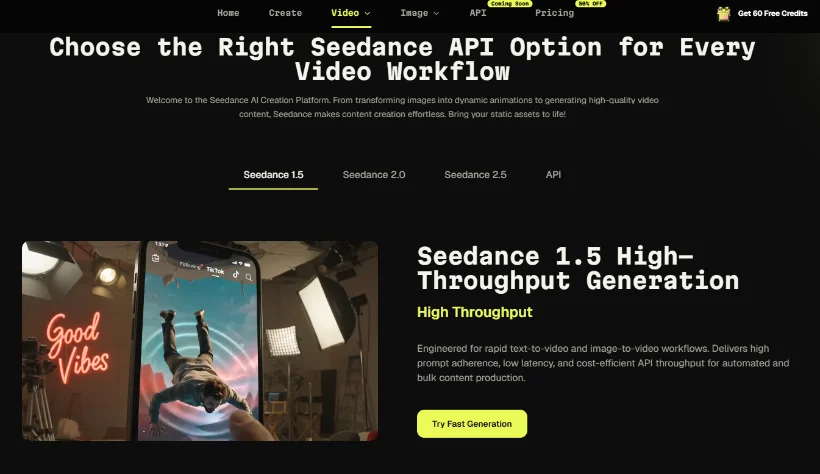
The Seedance workspace currently explains a practical flow: choose a Fast, Quality, or Lite route, write the video prompt, add an image or video reference, generate online, and compare the output. So the same page presents Seedance 2.5 as the next line. So the reliable check happens inside the account selector. A name in promotional copy does not replace a completed job.
If Seedance 2.0 generates while 2.5 appears only as a preview, report those states in plain language. The result protects two useful decisions. Teams can continue testing the model that works today, and they can keep future capabilities outside delivery promises until the newer line finishes a job in the chosen channel.
A Real Response Closes The API Check
An example payload can show the intended direction, but production readiness needs reachable documentation, a valid model ID, working authentication, an error schema, and at least one completed request in the expected environment. The public API remains marked as coming soon on the current site. Architecture plans should keep it as a pending dependency until those checks pass.
Online testing still removes expensive uncertainty. A product designer can settle prompt wording, reference ownership, crop, and rejection criteria before an engineer writes the client. The saving comes from rejecting a weak brief in the interface. It does not come from assuming the browser workflow and endpoint behave the same way.
A technical ticket should hold two proofs: the keep generated online and the log from the API request. Without the request log, the ticket remains “creative validated.” Without the keep, a green HTTP response proves transport but says nothing about subject continuity or usable motion. Keeping both proofs prevents rework late in QA.
Spend Seedance 2 Credits On Reusable Test Cases
The 1:1 return becomes valuable when present spending creates evidence for the next version. Seedance 2.0 already supports text, image, video, and audio inputs. ByteDance lists up to nine images, three video clips, and three audio clips as references, along with 15-second multi-shot audio-video output. Seedance 2.5 raises the stated single-generation length to 30 seconds and adds extensions plus production controls.
Log every eligible Seedance 2 debit with the prompt, reference set, delivery crop, and rejection reason. After the SeeAPI launch triggers the permanent 1:1 return, use the first returned credits to repeat the same cases on 2.5. Rewriting the brief and changing every source before the comparison would waste the reward as version evidence.
| Production Need | Seedance 2 Baseline | Seedance 2.5 Question |
| Short multimodal scene | Four input modes and 15 seconds | Does added duration remove manual cuts? |
| Longer narrative | Editors join several clips | Do 30 seconds and extensions hold continuity? |
| Compositing | Team repairs the output elsewhere | Do green screen controls reduce masking? |
| Software delivery | Online workspace test | Has the selected API route been verified? |
The decisive row depends on the product. A social app may care about 30 seconds, a VFX team may care about green-screen control. A SaaS product that needs thousands of clips remains blocked until its chosen API route passes authentication, error handling, and load checks. Calling every improvement an upgrade hides these separate costs.
During that review, SeeAPI can hold the accessible prompt and keep under one account. The owner records the eligible credit spend beside it. When the platform returns the same number of permanent credits, finance can reconcile the promise and the creative lead can fund a matched retest instead of another unrelated demo.
Assign one owner to each state. The creative lead approves the keep, engineering signs the endpoint test, and procurement checks the plan and returned balance. If everyone can mark the launch ready, nobody knows who should stop an incomplete release.
The test protocol should preserve the prompt, references, and delivery format across channels. A reviewer marks text unreadable when it fails in the final crop and records a result as discarded when it cannot enter the build. These observable states let another reviewer repeat the decision without relying on vague scores such as “more cinematic.”
Current Channel Limits Still Need A Manual Check
ByteDance presents Seedance 2.5 as released, while the observable SeeAPI route still describes it and the public API as upcoming. Recheck the account selector and current documentation before fixing a delivery date. The producer and access channel can update on different schedules.

Promise Only The State Your Team Reproduced
SeeAPI remains useful for testing Seedance online, comparing outputs, and preparing an acceptance gate. Its 1:1 offer gives current Seedance 2 spending a second job: it funds evidence today and can return as permanent account value for the 2.5 retest.
A credible report says “model published,” “workspace verified,” or “API verified” and attaches the matching proof. The credit ledger should be equally direct: eligible Seedance 2 spend in, the same amount returned after the platform launch. That precision prevents a cancelled demo, a rewritten client, and a marketing promise without a working route.
Ti potrebbe interessare:
Segui guruhitech su:
- Google News: bit.ly/gurugooglenews
- Telegram: t.me/guruhitech
- Facebook: facebook.com/guruhitechfb
- Instagram: instagram.com/guruhitech_official/
- X (Twitter): x.com/guruhitech1
- Bluesky: bsky.app/profile/guruhitech.bsky.social
- Rumble: rumble.com/user/guruhitech
- VKontakte: vk.com/guruhitech
- MeWe: mewe.com/i/guruhitech
- Skype: live:.cid.d4cf3836b772da8a
- WhatsApp: bit.ly/whatsappguruhitech
Esprimi il tuo parere!
Ti è stato utile questo articolo? Lascia un commento nell’apposita sezione che trovi più in basso e se ti va, iscriviti alla newsletter.
Per qualsiasi domanda, informazione o assistenza nel mondo della tecnologia, puoi inviare una email all’indirizzo [email protected].
Scopri di più da GuruHiTech
Abbonati per ricevere gli ultimi articoli inviati alla tua e-mail.