
The New Economics of Software: How AI Is Changing the Cost of Digital Decision-Making
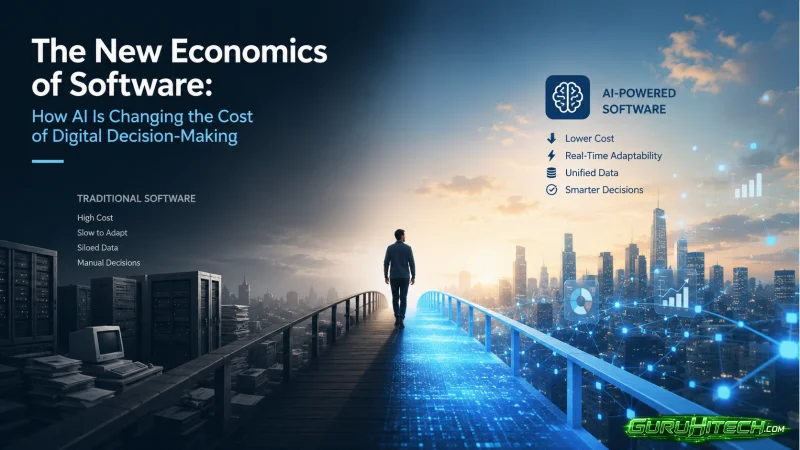
For most of its history, software has been built around rules. A user clicks a button, a database returns a result, a workflow moves to the next step, and the system behaves exactly as instructed. When the situation becomes too complex for fixed logic, the task is usually pushed to a human: a support agent, fraud analyst, dispatcher, doctor, manager, or operations specialist.
That arrangement shaped the economics of digital systems. Software could automate repetitive tasks, but many decisions remained expensive because they required human judgment. Companies could either hire more people, accept slower processes, or simplify decisions into rigid rules that often failed in edge cases.
Artificial intelligence changes this equation. Its most important impact may not be chatbots or content generation, but something quieter: AI reduces the cost of making decisions inside software. It allows applications to evaluate context, predict outcomes, prioritize actions, and adjust behavior at scale. Instead of automating only tasks, software can now automate judgment-like processes.
This shift is beginning to reshape software products, enterprise systems, digital platforms, and customer experiences. AI is becoming a decision engine embedded into the logic of modern applications.
The Hidden Cost of Decisions
Many business operations are, at their core, collections of decisions. A fraud team decides which transactions look suspicious, a support system decides which ticket should go to which agent, a retailer decides how much inventory to place in each warehouse, a logistics platform decides which delivery route is most efficient. A streaming service decides what a viewer is likely to watch next.
Before machine learning development became widely accessible, companies had two main ways to handle these decisions. They could rely on people, which offered flexibility but increased cost and slowed throughput. Or they could write deterministic rules: if a transaction is above a certain amount and comes from a new device, flag it; if a customer uses a certain keyword, route the ticket to billing.
Rules are useful, but they are blunt instruments. They struggle with ambiguity, context, and changing behavior. A fraud rule can miss subtle patterns or block legitimate customers, a support routing rule can send a complex technical issue to the wrong queue. A pricing rule can become outdated as market conditions shift.
The cost of decisions is not only labor. It is also delay, error, inconsistency, and lost opportunity. Every manual review adds friction, every poorly routed ticket damages customer experience. Every missed prediction creates operational waste. AI-powered applications are attractive because they can reduce these costs without requiring every decision to be simplified into a hard-coded rule.
AI as a Decision Infrastructure Layer
AI is increasingly functioning as an invisible infrastructure layer inside software. Users may not notice it directly, but it affects what they see, what happens next, and how systems respond.
Streaming platforms use predictive models to decide which titles appear first. E-commerce systems rank products, personalize discounts, identify likely returns, and detect suspicious purchasing behavior. Financial applications assess transaction risk in milliseconds. Enterprise platforms prioritize leads, forecast churn, recommend next actions, and identify anomalies in operational data.
These are not isolated “AI features.” They are embedded decision systems. The software product does not simply store data or execute predefined commands. It evaluates probabilities and chooses among possible actions.
This is why AI integration in software changes product economics. A platform that once required manual review for every complex case can now triage thousands of events automatically and reserve human attention for exceptions, a business that once relied on monthly planning can use predictive analytics to adjust operations continuously. A SaaS product that once treated every user the same can adapt onboarding, pricing prompts, support flows, and content recommendations in real time.
The result is a new kind of digital system: one that is not fully autonomous, but no longer purely deterministic.
Building Intelligent Decision Systems
Behind every intelligent decision system is a chain of technical components. First, the system needs data: user behavior, transactions, historical outcomes, operational events, support records, sensor streams, or business process logs. Then it needs models trained to detect patterns and produce predictions. These predictions may estimate risk, intent, demand, relevance, urgency, or probability of success.
The next layer is inference: the process of applying a trained model to live data. This is where the economics of decision-making change most visibly. A model can evaluate a transaction, rank a recommendation, classify a document, or assign a support ticket in milliseconds. It can do this repeatedly, across millions of events, at a marginal cost far lower than manual review.
Companies building these systems often rely on specialized AI software development services to connect models with real products, workflows, and business rules. The challenge is not only creating a model, but making it useful inside production software.
Feedback loops are equally important. If an AI system recommends a product, the platform must learn whether the user clicked, ignored, purchased, returned, or complained. If a fraud model flags a transaction, the system must learn whether the flag was correct. Without feedback, intelligent business systems become stale. With feedback, they become adaptive.
Why Traditional Software Architecture Is Changing
Traditional software architecture assumes that application logic can be described in advance. Developers define workflows, conditions, permissions, interfaces, and business rules. Data moves through predictable paths. Exceptions are handled separately.
AI complicates that model. Decision-making becomes probabilistic. Instead of asking whether a condition is true or false, the system may ask whether an event has a 72 percent likelihood of being risky, whether a customer is likely to churn, or whether a user needs human support.
This affects architecture across the stack. Backend systems must support real-time data processing and model inference. Data pipelines become central, because the quality of decisions depends on the quality of data. User experience design changes because adaptive software platforms may show different flows to different users based on predicted intent or need.
Application logic also becomes less static. A checkout flow, onboarding journey, search result, or dashboard may change dynamically according to model output. This does not eliminate traditional engineering. It makes engineering more complex. Developers still need deterministic guardrails, permissions, audit trails, and fallback logic. But they must now design systems where part of the behavior is shaped by machine learning infrastructure.
Engineering Platforms That Think
The phrase “platforms that think” can sound exaggerated, but it captures a real engineering shift. Modern intelligent platforms do more than display information. They interpret signals and act on them.
Building such platforms requires more than adding an API call to a model. Real-time predictions must be fast enough to support product interactions. Models must be monitored for accuracy, bias, latency, and failure. Infrastructure must scale when predictions are requested thousands of times per second. Data systems must track inputs and outcomes so teams can understand why decisions were made.
Model drift is one of the major challenges. A recommendation model trained on last year’s user behavior may become less accurate as trends change. A fraud model may weaken as attackers adapt. Also a demand forecasting model may fail when supply chains shift. Engineering teams working on AI software development services therefore need to treat models as living systems, not static software modules.
The cost of AI-driven automation is also not zero. Running inference at scale requires compute resources. Training models requires data pipelines, storage, experimentation environments, and monitoring tools. The economic question is whether the value of faster, better, more scalable decisions exceeds the cost of the infrastructure. In many high-volume digital systems, it does.
The Industries Being Reshaped First
The industries most affected are those where decision volume is high and mistakes are expensive.
In healthcare, AI decision systems can help triage patients, prioritize cases, identify risk patterns, and support clinical workflows. The goal is not to replace medical professionals, but to reduce administrative burden and surface relevant information sooner.
In fintech, intelligent decision systems are already central to fraud detection, credit scoring, transaction monitoring, customer onboarding, and risk management. The speed of financial activity makes manual review impossible at scale, while rigid rules are too easy to evade.
In logistics, predictive analytics helps companies forecast demand, optimize routes, allocate vehicles, and respond to disruptions. Each route adjustment or inventory decision may look small, but multiplied across thousands of shipments, the economic impact becomes significant.
Retail is being reshaped by AI-powered applications that personalize recommendations, forecast inventory, adjust pricing, and predict customer behavior. The most advanced systems do not simply ask what customers bought in the past. They infer what customers are likely to need next.
SaaS products are also changing. Enterprise AI solutions can prioritize sales leads, identify users at risk of churn, recommend workflow improvements, and automate routine decisions inside business platforms. This makes software feel less like a passive tool and more like an operational partner.
Conclusion
The public conversation around AI often focuses on visible outputs: generated text, images, code, or chatbot replies. But the deeper transformation may be happening inside software systems, where AI reduces the cost of digital decision-making.
When decisions become cheaper, companies can make more of them, make them faster, and personalize them to context. Processes that once required manual review can become semi-automated. Products that once behaved the same for every user can become adaptive. Enterprise systems that once recorded what happened can begin predicting what should happen next.
This does not mean software becomes magically intelligent or free from human oversight. AI systems still require careful engineering, governance, monitoring, and accountability. Poor data can produce poor decisions at scale. Badly designed automation can create new risks.
Yet the direction is clear. The future impact of AI may be less about making software talk like humans and more about making software decide more efficiently. In that sense, artificial intelligence is not just adding features to digital products. It is changing the economics of how software operates.
Scopri di più da GuruHiTech
Abbonati per ricevere gli ultimi articoli inviati alla tua e-mail.