
The Role of Data Verification in Cricket Betting
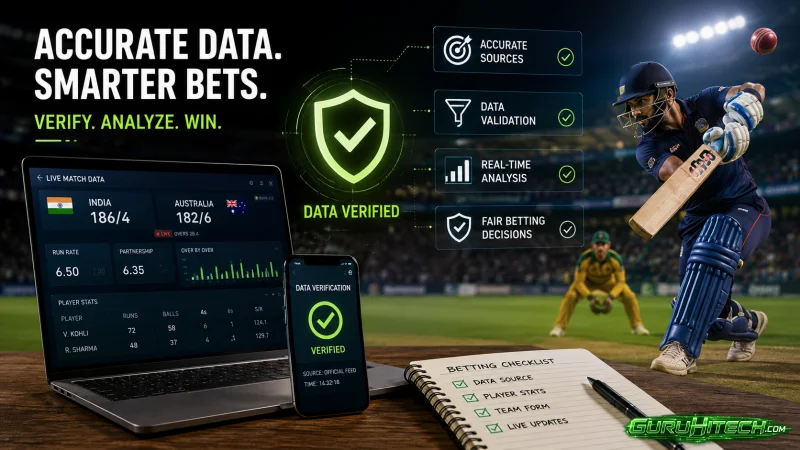
Cricket has evolved into a highly data-driven sport. Every delivery can generate information about runs, wickets, players, overs, extras, partnerships, and match conditions. Modern cricket platforms use this information to power live scoreboards, statistical tools, analytical systems, and betting markets.
But collecting data is only the first step.
Before information can be trusted, it needs to be verified.
Data verification helps determine whether a recorded event accurately represents what happened on the field. It can identify inconsistencies, prevent duplicate updates, correct errors, and help ensure that different systems are working from the same match state.
For cricket betting platforms, this process is particularly important because live markets can depend on constantly changing match information.
Important: Data verification improves the reliability of information but cannot predict sporting outcomes or eliminate betting risk. Live data can be delayed or corrected, and users should understand applicable laws, platform rules, settlement conditions, and financial risks.
What Is Data Verification in Cricket?
Data verification is the process of checking whether cricket information is accurate, consistent, complete, and supported by a reliable source.
For example, if a scoring system records a wicket, verification may involve checking:
- Which batter was dismissed
- Which bowler delivered the ball
- What the score was
- What delivery the wicket occurred on
- What type of dismissal was recorded
- Whether the player was actually involved in the match
The goal is to make sure the digital record matches the real event.
Why Data Verification Matters
A cricket match produces thousands of individual data points.
If one event is recorded incorrectly, the error can affect other calculations.
For example:
Incorrect wicket → Incorrect wicket count → Incorrect player state → Incorrect match state
The original error may be small, but its effects can spread through connected systems.
Verification provides a layer of protection against this problem.
Data Accuracy vs Data Verification
These terms are related but not identical.
Data accuracy
Accuracy describes whether the information is correct.
Data verification
Verification describes the process used to check whether the information is correct.
In simple terms:
Accuracy is the quality. Verification is the checking process.
A reliable cricket-data system needs both.
Where Cricket Data Comes From
Cricket information can originate from several sources, including:
- Official scoring systems
- Trained scorers
- Sports-data providers
- Competition organizers
- Tracking technologies
- Statistical databases
- Authorized live feeds
Different sources may serve different purposes.
The important consideration is whether the source is reliable and whether the data can be validated before being distributed.
The Cricket Data Verification Pipeline
A simplified verification process looks like this:
Match event → Data capture → Initial validation → Cross-checking → Match-state verification → Distribution → Correction monitoring
Not every platform uses exactly the same architecture, but the basic principle is similar.
Information should be checked before it becomes a trusted input for other systems.
Step 1: Recording the Match Event
The process starts when something happens on the field.
Examples include:
- Four runs
- Six runs
- Wide
- No-ball
- Wicket
- Run-out
- Catch
- Completed over
The event is entered into a scoring or data-collection system.
Step 2: Checking the Event Structure
The system can check whether the event contains all required information.
For a wicket, it may need:
- Match ID
- Innings ID
- Batter ID
- Bowler ID
- Delivery number
- Dismissal type
- Updated score
If important information is missing, the event may require additional processing before it is distributed.
Step 3: Validating the Match State
An event should make sense within the context of the match.
Suppose the current innings has:
125/3 after 15 overs
A new event reporting a fourth wicket may be valid.
But if the system suddenly reports:
125/8
without corresponding dismissal events, there is an obvious inconsistency.
Match-state validation helps identify such problems.
Step 4: Checking Player Identity
Player identification is another important part of verification.
A platform needs to know that an event is associated with the correct player.
This is why unique player IDs are often more reliable than names alone.
A player ID can connect information across:
- Matches
- Teams
- Competitions
- Career statistics
- Player markets
Why Player Verification Matters
Imagine two players have similar names.
If an event is assigned to the wrong player, their statistics can become incorrect.
The error can affect:
- Runs
- Wickets
- Balls faced
- Overs bowled
- Career records
- Individual performance data
Accurate player identification is therefore essential for player-level analysis.
Verifying Ball-by-Ball Data
Ball-by-ball information is the foundation of detailed cricket statistics.
A verification process can check:
- Over number
- Delivery number
- Batter
- Bowler
- Runs
- Extras
- Wicket
- Legal-ball status
This helps maintain a coherent sequence throughout the innings.
Why Delivery Sequencing Matters
Cricket follows a specific delivery sequence.
If the system records:
15.1 → 15.2 → 15.4
without an appropriate explanation for 15.3, there may be a missing event or classification issue.
Similarly, wides and no-balls can affect how delivery numbers are counted.
Verification helps ensure that the sequence remains logical.
Verifying Runs
Every scoring event needs to be correctly classified.
The system should distinguish between:
- Batter runs
- Extras
- Team total
For example, a wide contributes to the team score but is not normally credited as runs to the batter.
An incorrect classification can affect both team and individual statistics.
Verifying Extras
Cricket includes several types of extras:
- Wides
- No-balls
- Byes
- Leg byes
Each has different statistical implications.
A verification system should ensure that the correct category is attached to the event.
Why No-Balls Require Careful Verification
A no-ball can affect more than the score.
It can influence:
- Extra runs
- Batter scoring
- Legal-ball count
- Over progression
- Subsequent delivery conditions
Incorrectly classifying a no-ball as an ordinary legal delivery can create inconsistencies in the innings state.
Verifying Wickets
Wicket events are among the most important events to verify.
A wicket can change:
- Team wicket count
- Batter status
- Partnership
- Player statistics
- Available batting resources
- Current match state
The system needs to ensure that the wicket is associated with the correct delivery and player.
Verifying Dismissal Types
Cricket contains different dismissal methods.
Examples include:
- Bowled
- Caught
- LBW
- Run out
- Stumped
- Hit wicket
Correct classification matters because player and match records may depend on the dismissal type.
Cross-Checking Multiple Sources
One verification method is comparing information from more than one trusted source.
For example:
Source A: 154/5
Source B: 154/5
The records are consistent.
If one source reports:
154/5
while another reports:
153/5
the discrepancy requires investigation.
Cross-checking can help identify errors before they spread.
The Role of Authoritative Data
Not every data source has equal authority.
For final match results, platforms generally need to establish which source is considered authoritative under their operating and settlement rules.
This distinction is important because a temporary live update may later be corrected.
Real-Time Verification
Verification does not necessarily happen only after a match.
Modern systems can verify information while the match is still taking place.
This may involve automated checks such as:
- Score consistency
- Event sequence validation
- Player identification
- Match-status checks
- Duplicate detection
The benefit is that potential problems can be identified quickly.
Automated Verification
Software can perform many routine checks without human intervention.
For example, an automated system can ask:
Does the new score match the previous score plus the latest event?
If the answer is no, the event can be flagged.
Automation makes it possible to process large volumes of cricket data efficiently.
Human Verification
Not every situation can be resolved through simple rules.
Human operators may need to review:
- Unusual dismissals
- Player replacements
- Weather interruptions
- Data conflicts
- Scoring corrections
- Unclear match status
Human oversight can provide an additional layer when automated checks identify an anomaly.
Why Automation and Human Oversight Work Together
The most practical approach is often a combination.
Automation
Handles routine, high-volume validation.
Human review
Handles unusual or ambiguous situations.
This creates a layered verification process rather than relying entirely on one method.
Detecting Duplicate Events
A live data system may occasionally receive the same event more than once.
If the platform processes both messages independently, the score could be inflated.
For example:
Original event: +4
Duplicate event: +4
The system might incorrectly show an additional four runs.
Unique event IDs and sequence numbers can help prevent this.
Detecting Missing Events
Verification can also identify missing information.
Suppose the event sequence jumps unexpectedly.
The system may determine that:
- An event is missing
- A message was delayed
- A connection failed
- A correction is required
The platform can then attempt to reconcile the match state.
What Is Data Reconciliation?
Data reconciliation means comparing records to identify and resolve differences.
A platform may compare:
Current match state
with
Underlying event history
If the two do not agree, the system can investigate.
Reconciliation is particularly useful in distributed systems where information passes through multiple services.
Why Data Verification Matters for Live Markets
Live cricket markets depend on information that changes throughout the match. A wicket, boundary, injury, or innings change can alter the underlying match situation. The general process may be:
Live event → Verified data → Match-state update → Statistical processing → Market update
In this environment, a Radhe Exchange ID Provider can be referenced as an example of an online betting service where dependable match information is relevant to how cricket markets are presented and updated.
Verification helps ensure that market-supporting systems receive information that accurately represents the match.
A Wicket Example
Consider a hypothetical chase.
The team is:
140/3
The next delivery results in a wicket.
The data system receives:
Wicket: batter dismissed
Verification checks:
- Was the batter active?
- Was the delivery valid?
- Was the wicket recorded correctly?
- Does the wicket count increase from three to four?
- Does the partnership end?
- Is the incoming batter correctly identified?
Once verified, the updated state becomes:
140/4
Other systems can then use the new state.
A Boundary Example
Suppose the score is:
160/4
The batter hits a six.
The verified update should reflect:
166/4
The batter’s score also increases by six, subject to the specific scoring event.
The bowler’s figures and other calculations are updated accordingly.
Verification helps ensure that all of these connected changes remain synchronized.
Why Data Verification Matters for Player Markets
Individual player markets depend heavily on player-level data.
A platform may need to track:
- Runs
- Balls faced
- Wickets
- Overs
- Boundaries
- Dismissal status
If an event is attributed to the wrong player, the resulting data can become unreliable.
This makes player identity verification especially important.
Playing XI Verification
Before a match starts, platforms need accurate information about who is actually playing.
A confirmed playing XI can differ from an earlier expected lineup.
Verification can help ensure that:
- The correct players are active
- Replacements are recorded
- Player IDs are correct
- Team composition is updated
This provides a more reliable foundation for pre-match and live systems.
Replacement Player Verification
A replacement player can change the structure of a team.
The platform needs to confirm:
- Who has left
- Who has entered
- Whether the replacement is officially recognized
- What role the player occupies
Accurate replacement information is especially important when individual performance data is being tracked.
Verifying Bowling Data
Bowling information includes:
- Bowler identity
- Overs
- Runs conceded
- Wickets
- Maidens
- Economy rate
Verification helps ensure that each delivery is attributed to the correct bowler.
An incorrect bowler assignment can distort both current and historical statistics.
Verifying Match Status
A cricket match can move through several states:
- Scheduled
- Toss completed
- Innings underway
- Innings break
- Delayed
- Suspended
- Resumed
- Completed
- Abandoned
Incorrect match status can cause confusion across digital platforms.
Verification helps ensure that the current status reflects the actual state of the match.
Rain and Weather Verification
Weather interruptions create additional complexity.
A rain delay may lead to:
- Fewer overs
- Revised target
- Changed match duration
- Different innings conditions
The system should use authoritative information when updating these fields.
Why Revised Targets Need Verification
A revised target can change the entire structure of a chase.
The platform needs to know:
- New target
- Overs available
- Runs required
- Current innings state
Incorrect information can cause other calculations to become inconsistent.
Data Latency and Verification
Verification can introduce a small amount of processing time.
However, the goal is not to delay every event unnecessarily.
Instead, systems need to balance:
Speed + Accuracy + Validation
A slightly delayed verified update can be more reliable than an immediate but incorrect update.
Why Fast Does Not Always Mean Better
Imagine two systems.
System A
Updates instantly but occasionally displays incorrect events.
System B
Processes information slightly more slowly but maintains strong validation.
For applications where accuracy matters, System B may provide a more dependable experience.
The ideal infrastructure aims to combine low latency with strong verification.
Data Corrections
Even strong systems can encounter errors.
A scoring decision may be changed after review, a player identity may be corrected, a match status may be updated, a reliable data pipeline needs to support corrections without corrupting the rest of the match history.
How Corrections Propagate
Suppose a delivery was initially recorded as a dot ball but later corrected to a four.
The system may need to update:
- Team score
- Batter score
- Bowler figures
- Run rate
- Required runs
- Match state
This is why corrections should be treated as structured events rather than simple edits to a visible scoreboard.
Event Sourcing and Cricket Data
Some modern architectures maintain a chronological record of events.
Instead of storing only the latest score, the system stores the sequence of match events.
For example:
Ball 1 → Ball 2 → Ball 3 → Wicket → Ball 5
The current match state can then be reconstructed from that history.
This approach can help with auditing and reconciliation.
Why Audit Trails Matter
An audit trail records how a piece of data changed.
For example:
Initial event → Correction → Final event
This can help technical teams understand:
- What changed
- When it changed
- Why it changed
- Which systems received the correction
Auditability is valuable in complex live-data environments.
APIs and Verification
APIs provide the communication layer between systems, but verification needs to happen around the API as well.
A platform can verify:
- Message structure
- Authentication
- Event sequence
- Match ID
- Player ID
- Data consistency
This helps ensure that incoming information belongs to the correct match and is processed correctly.
The Importance of Data Freshness
Verification should also consider how current the information is.
A perfectly accurate score from several minutes ago is not an accurate representation of the current match state.
Therefore, high-quality live data needs both:
Correctness + Freshness
Data Verification and Historical Records
Verification does not stop when the match ends.
Historical records are used for:
- Player statistics
- Team records
- Performance analysis
- Statistical models
- Match archives
If incorrect information enters the historical database, it can continue affecting future analysis.
Why Historical Corrections Matter
A match record may initially contain an error that is discovered later.
A robust database should be able to update the historical record while preserving a reliable audit trail.
This prevents inaccurate information from becoming part of long-term cricket statistics.
Data Verification and Statistical Models
Statistical models depend on historical and live information. If the input data is incorrect, model outputs can also become unreliable. For bettors researching cricket markets and using a digital cricket id for betting, reliable match information is particularly relevant because market analysis can depend on accurate scores, player statistics, and current match conditions.
For example, a model using player averages may produce different results if several historical scores are incorrectly attributed. This is why data quality is important before information reaches analytical systems.
Data Verification Does Not Guarantee Predictions
This distinction is crucial.
A verified data feed tells you what has happened.
It does not tell you what will happen next.
For example:
Verified fact: A team is 120/4 after 15 overs.
Prediction: The team will finish above a particular total.
The first can be verified against match records.
The second remains an estimate.
Common Data Verification Challenges
1. Human Input Errors
Scorers can make mistakes.
2. Network Delays
Information can arrive late.
3. Duplicate Messages
The same event can be transmitted more than once.
4. Missing Events
A delivery can fail to reach a system.
5. Player Identification Errors
Similar names can cause confusion.
6. Match Interruptions
Rain can change the match structure.
7. Corrections
Official decisions may change previously recorded information.
8. Conflicting Sources
Different feeds may temporarily report different states.
A good verification architecture needs to account for these possibilities.
How Cricket Platforms Can Improve Data Verification
Use Trusted Sources
Choose reliable and appropriately authorized data providers.
Validate Every Event
Check new information against the current match state.
Use Unique Identifiers
Prevent confusion between players, matches, and events.
Maintain Event Sequences
Keep a record of the order in which events occurred.
Reconcile Data
Compare current states against authoritative information.
Support Corrections
Allow errors to be amended systematically.
Monitor Data Freshness
Detect delayed or stale information.
Maintain Audit Trails
Record important changes to match data.
A Practical Verification Workflow
A robust cricket-data system can follow this sequence:
1. Event occurs
A delivery or other match event happens.
2. Event is captured
The scorer or data system records it.
3. Event is structured
The information is converted into standardized fields.
4. Event is validated
Basic consistency checks are performed.
5. Match state is checked
The event is compared against the existing state.
6. Event is distributed
Verified information is sent to connected systems.
7. Downstream systems update
Statistics and other applications process the information.
8. Corrections are monitored
Later changes are propagated when necessary.
This layered process helps reduce the risk of incorrect information spreading through the wider system.
Frequently Asked Questions
What does data verification mean in cricket betting?
It means checking cricket information to ensure that live events, scores, player data, match status, and other records accurately represent the official match situation.
Why is verification important for live cricket data?
Live cricket changes rapidly, and one incorrect event can affect several connected statistics and systems. Verification helps identify and reduce these errors.
How are cricket events verified?
Verification can involve automated consistency checks, player and match identification, event sequencing, cross-source comparison, reconciliation, and human review.
Can cricket data be corrected after an event?
Yes. A previously recorded event may be corrected if the official scoring information changes. Reliable systems need mechanisms to propagate those corrections.
Why are player IDs important?
Unique player identifiers help ensure that events and statistics are assigned to the correct individual, especially when players have similar names.
Does verified data guarantee accurate betting predictions?
No. Verification establishes the quality of the underlying information. Predictions still depend on models, assumptions, and uncertain future events.
What is the difference between data verification and data latency?
Verification concerns whether information is correct. Latency concerns how long it takes for information to reach a system. Reliable live data requires attention to both.
Responsible Use of Cricket Data
Verified cricket information can improve the reliability of digital platforms, but no verification system can remove uncertainty from sporting events.
Live data can be delayed, amended, or temporarily unavailable. Market prices and statistical models can also change rapidly.
Users should understand the laws and regulations applicable to them, along with platform terms, settlement rules, and the financial risks associated with betting.
Conclusion
Data verification is a critical layer in modern cricket betting infrastructure because it helps ensure that live information accurately represents what is happening on the field.
The process goes beyond checking the final score. It can involve verifying:
- Ball-by-ball events
- Runs and extras
- Wickets
- Player identities
- Playing XI information
- Bowling data
- Match status
- Innings transitions
- Weather-related changes
- Historical records
A simplified system looks like:
Match event → Data capture → Validation → Verification → Distribution → Match-state processing → Downstream systems
The value of verification becomes clear because cricket data is interconnected. A single incorrect wicket, extra, player ID, or delivery classification can affect several statistics and systems.
Ultimately, reliable cricket-data infrastructure needs more than speed. It requires accuracy, consistency, completeness, freshness, reconciliation, correction processes, and appropriate authoritative sources.
As live cricket technology continues to develop, data verification will remain one of the key safeguards connecting events on the field with the digital information platforms rely on.
Ti potrebbe interessare:
Segui guruhitech su:
- Google News: bit.ly/gurugooglenews
- Telegram: t.me/guruhitech
- Facebook: facebook.com/guruhitechfb
- Instagram: instagram.com/guruhitech_official/
- X (Twitter): x.com/guruhitech1
- Bluesky: bsky.app/profile/guruhitech.bsky.social
- Rumble: rumble.com/user/guruhitech
- VKontakte: vk.com/guruhitech
- MeWe: mewe.com/i/guruhitech
- Skype: live:.cid.d4cf3836b772da8a
- WhatsApp: bit.ly/whatsappguruhitech
Esprimi il tuo parere!
Ti è stato utile questo articolo? Lascia un commento nell’apposita sezione che trovi più in basso e se ti va, iscriviti alla newsletter.
Per qualsiasi domanda, informazione o assistenza nel mondo della tecnologia, puoi inviare una email all’indirizzo [email protected].
Scopri di più da GuruHiTech
Abbonati per ricevere gli ultimi articoli inviati alla tua e-mail.