
Why Is Cable Management Important for Modern Industrial Automation?
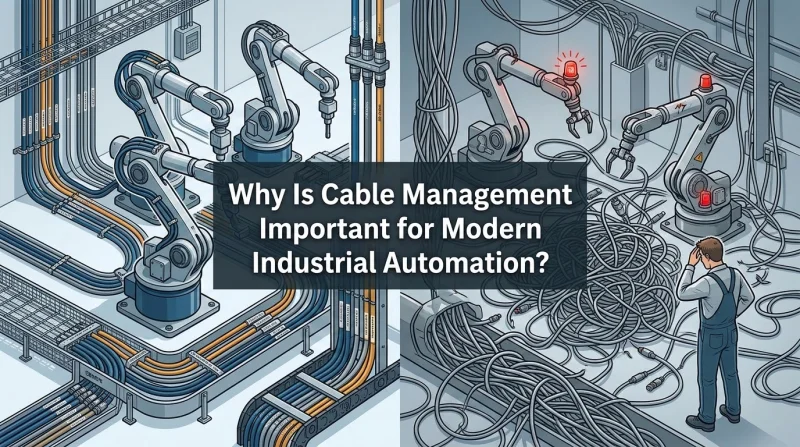
Walk onto any automated production floor and you will usually spot the problem areas just by looking at the ceiling trays or the floor trenches. Everyone focuses on the heavy lifters like multi-axis arms, programmable logic controllers, and high resolution vision systems. The actual physical wiring that connects all these expensive components often gets treated like a complete afterthought.
That is a massive operational mistake. When a high speed assembly line stops dead, it is rarely because a central processor spontaneously fails. It is usually because a fifty dollar sensor cable got pinched, pulled, or chafed until the copper inside finally snapped. Cable management is not just about making a machine look neat. It is a structural requirement for keeping a facility running without constant interruptions.
The Mechanics of Continuous Motion
Automation inherently involves fast and repetitive movement. Cables routed to these moving parts are subjected to millions of bending and twisting cycles over their operational lifespan. If you just zip tie standard commercial wiring to a moving joint, you are setting a very short timer for unexpected downtime.
You have to account for bend radius, torsion, and continuous flexing. A properly specified robotic cable assembly is designed exactly for this environment. The outer jackets are formulated to resist harsh abrasion, and the inner conductors are stranded in a way that allows them to move without work hardening and breaking. But even the best cables will fail if they are routed incorrectly.
You have to use continuous flex conduits, strain reliefs, and energy chains to control the path of the wire. Leaving slack where it is not needed creates loose loops that can catch on tooling or the product itself. Conversely, pulling cables too tight puts severe stress on the connectors. That tension eventually backs out pins and causes intermittent faults that are incredibly hard to trace. You want the wiring to move in harmony with the machine geometry.
Signal Integrity on the Factory Floor
A modern factory is an electrically noisy environment. You have large AC motors starting and stopping, variable frequency drives dumping harmonic noise back into the grid, and automated welding equipment generating massive magnetic fields. If you run your low voltage sensor wires and Ethernet cables right alongside your high voltage power lines, you will absolutely run into phantom issues.
Motor drives will fail for no apparent reason. Position encoders will drop counts and ruin parts. Getting to the root of these electrical noise problems takes days of frustrating troubleshooting. Good cable management separates power from data at the design phase. Physical distance is your best and cheapest defense against electromagnetic interference.
When you run cables through shared trays, you need physical metal dividers. You also need to pay close attention to shielding. Grounding a shielded cable at both ends can sometimes create a ground loop that pulls noise directly into your signal line instead of keeping it out. Managing how and where cables are routed and terminated directly impacts the reliability of your entire control architecture.
Maintenance Speed and Predictability
Things break on the floor. Sensors get smashed by careless forklift drivers. Actuators eventually burn out. When a maintenance technician has to replace a part at two in the morning, the way the machine is wired dictates how long the production line stays down.
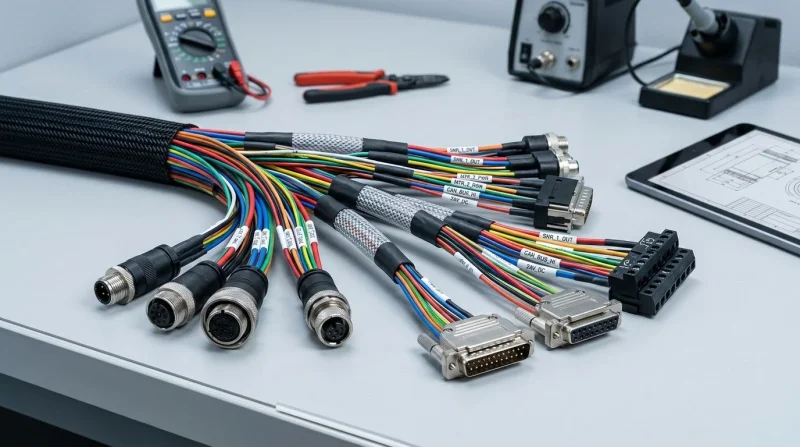
If they open a main control panel and find a massive tangled web of identical grey wire, a ten minute swap turns into a two hour tracing job. Every wire needs a clear label at both ends. Wireways need enough extra physical space so that a technician can actually pull a new replacement wire without having to rip out twenty others.
Partnering with a reliable cable harness supplier can solve a lot of these panel building and field wiring headaches. Getting pre-built, tested, and labeled harnesses means your technicians are just plugging in standardized components rather than crimping hundreds of individual tiny pins manually on the shop floor. Standardization makes repairs predictable. If every machine uses the exact same routing standards and naming conventions, your team doesn’t have to relearn the system every time a different asset breaks down.
Thermal Management and Equipment Safety
Cables naturally generate heat when current flows through them. If you stuff too many power cables into a single enclosed conduit or pack a cable tray until it is overflowing, that heat has nowhere to go. Insulation degrades significantly faster at high temperatures. Eventually it breaks down completely, exposing bare copper and causing a direct short circuit.
That is a serious fire hazard. There are strict industrial electrical codes dictating exactly how much space you must leave empty in a conduit or tray for this exact reason. Beyond the fire risk, sloppy cabling is a physical safety hazard for machine operators. Tripping hazards on the plant floor are obvious. You also have to watch out for loose cables near rotating equipment. A wire that sags into a moving conveyor belt or a lathe spindle can cause catastrophic damage to the machine and severe injury to anyone standing nearby. Proper routing keeps everything secured and out of harm’s way.
Designing for Future Scalability
An automated cell is rarely completely finished on day one. A few months after commissioning, operations will usually want to add a new inspection camera or another proximity switch to catch a new defect. If your wireways and conduits are already packed tight, adding that one single new sensor becomes a major mechanical project.
Good design leaves twenty to thirty percent of the tray capacity entirely empty. It includes running spare wires to terminal blocks just in case they are needed later. You need to plan for the physical reality of upgrading the system over time.
When you look at an automated line, the cable management tells you exactly how much thought went into the long term operation of the equipment. Neatly routed, labeled, and properly supported wiring shows that the builders understood what it takes to keep a plant running for a decade. A messy installation just proves they were in a rush to get the equipment out the door. It pays to get the physical infrastructure right before you start worrying about software updates.
Scopri di più da GuruHiTech
Abbonati per ricevere gli ultimi articoli inviati alla tua e-mail.