
How Can Manufacturers Reduce Wiring Errors in Complex Electronic Systems?

The Reality of Modern Connectivity
A single pinned wire in the wrong connector cavity can bring a complex piece of equipment to a dead stop. In medical diagnostics, industrial automation, or aerospace control systems, the stakes are exceptionally high. We spend a massive amount of time talking about software bugs and code updates. Yet the physical hardware still relies on thousands of manual connections to function.
When you have a chassis packed with miles of wire, the probability of human error goes up exponentially. These errors usually happen at the operator level. A technician grabs the red wire with the white stripe instead of the white wire with the red stripe, a crimp is not seated all the way into the housing. A schematic has not been updated to the latest engineering revision. Fixing these issues requires looking at the actual floor processes and making it physically harder for technicians to make mistakes in the first place.
Mistakes caught on the assembly line are frustrating. Mistakes caught in the field destroy profit margins. Sending a field service technician on a flight to diagnose a machine, only to find a single backed out pin, is a total waste of resources.
Stop Relying on Static Paper Drawings
For decades, shop floors relied on massive flat boards with nails and printed out two dimensional schematics. That method does not work well for modern enclosures. A technician trying to translate a flat drawing into a tightly packed three dimensional space is going to guess occasionally. Guessing always leads to rework.
Transitioning to digital work instructions is a basic operational requirement now. Giving technicians a monitor where they can rotate a 3D CAD model of the enclosure removes the ambiguity. They can zoom in on a specific connector and see exactly which pin goes into which slot.
If an engineering change order happens, the digital model updates immediately across the floor. You eliminate the risk of someone building a revision from three months ago just because they found an old print tucked under their workbench. Visual aids like color coded routing paths on a screen are far more effective than asking a technician to trace a thin black line across a massive piece of paper.
Shift the Complexity Off the Assembly Line
One of the fastest ways to reduce wiring errors on your final assembly floor is to stop building every single cable internally. If your core business is building medical imaging machines or radar systems, your floor space and labor are better spent on final system integration.
Building complex bundles from scratch on the main line invites mistakes. Instead, you can hand that specific sub assembly over to a specialized wire harness manufacturer. These external shops are set up exclusively for cutting, stripping, terminating, and bundling wires at volume. They have dedicated automated tooling and quality checks just for that process.
When you bring in a completed and pre tested sub assembly, your technicians just have to plug in a few main connectors rather than routing fifty individual wires. It shrinks the margin for error on your floor and speeds up your total cycle time. You trade dozens of potential failure points for a handful of simple plug and play connections.
Upgrade the Workstation Environment
Wiring is tedious and physically demanding work. It requires fine motor skills and intense, sustained focus. If you want to know why miswiring happens late in the afternoon on a long shift, look at the physical environment and the tools provided to the operators.
Dim lighting makes color coding blend together. Trying to differentiate between a dark blue and a black wire in shadows is a common source of crossed signals. Hand crimping hundreds of pins a day causes intense hand fatigue. When hands get tired, crimps get sloppy. Wires pull out of their housings during vibration testing later on.
Upgrading to pneumatic or electric crimpers takes the physical strain off the operator. Investing in high lumen, shadowless overhead lighting ensures color bands are actually visible. Some advanced facilities even use augmented projection systems that shine a light directly onto the correct connector cavity on the physical board. The goal is to make the environment actively support the work rather than fighting against the operator.
Implement Automated Testing at the Source
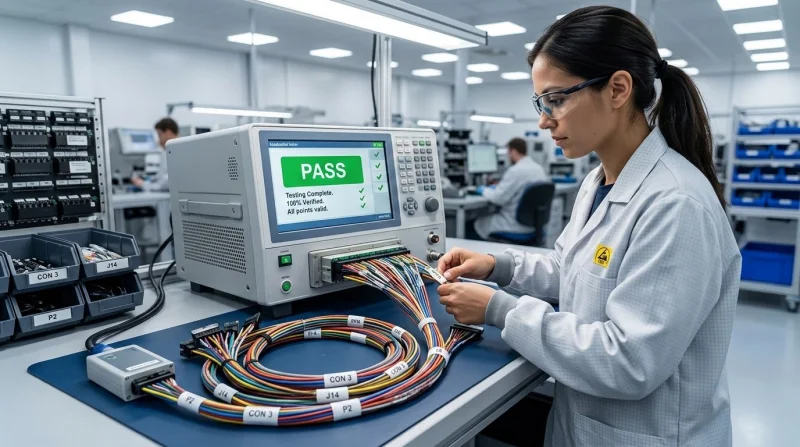
You cannot wait until the final power on test to find out if something is wired incorrectly. If a system is fully buttoned up and fails a functional test, tearing it back down to find one swapped pin costs hours of labor.
Testing needs to happen early and often at the sub-assembly level. This is especially critical when dealing with a high accuracy cable assembly that routes sensitive data signals or heavy power loads. If that specific bundle is tested for continuity and voltage resistance before it ever goes into the main chassis, you know your foundation is solid.
Automated cable testers can check thousands of points in a matter of seconds. The operator plugs both ends of the bundle into the machine, and the system instantly flags open circuits, shorts, or miswires. It is a completely binary process. The screen shows green or it shows red. This removes the subjectivity of a technician trying to manually probe tiny pins with a multimeter while looking back and forth at a schematic. Catching a short here costs pennies compared to catching it during final validation.
Standardize Your Components
Look closely at your bill of materials. If an engineer specified five different types of connectors from three different vendors for a single control box, they are setting the manufacturing floor up for failure.
Different connectors require different pins, different crimp tools, and different insertion techniques. Every time an operator has to switch tools or recall a different assembly method, there is a chance they grab the wrong tool or apply the wrong torque.
Work with your engineering team to consolidate the component list. Using a single connector family across a product line means operators build strong muscle memory. They use the same extraction tool and the same seating process every time. Consistency reduces variables on the floor. Fewer variables always mean fewer mistakes.
Engineer Mistakes Out of the Process
Mistakes on the floor are rarely just careless workers. They are a symptom of a process that leaves room for errors to occur.
One of the most effective strategies is physical mistake proofing through part selection. Use keyed connectors that physically cannot be plugged in backward. Use different connector sizes for power and data so a technician cannot accidentally plug a high-voltage line into a sensitive sensor board. If it only fits one way, you do not have to rely on an operator reading a label correctly.
Reducing wiring faults takes a systematic approach. It requires clear digital instructions, standardized parts, proper lighting, and automated validation. When you remove the friction and ambiguity from the physical build process, you do not just get a faster assembly time. You get a product that works exactly as intended the first time you flip the switch.
Scopri di più da GuruHiTech
Abbonati per ricevere gli ultimi articoli inviati alla tua e-mail.