
Beyond Data Labeling: Why “AI Asset Management” Is the Next Big Discipline for ML Teams
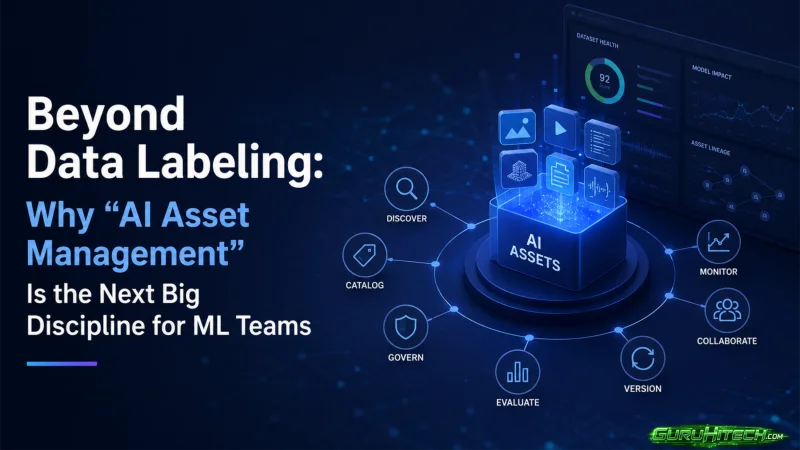
ML teams everywhere are running into the same wall. Models get bigger, datasets grow heavier, and fine-tuning cycles speed up — but the way teams organize and govern the assets that power those models has barely changed. We are still treating labeled datasets like throwaway files in a cloud bucket, versioning models in spreadsheets, and rediscovering the same data preparation work every quarter.
This is where a new discipline is starting to emerge: AI Asset Management. If 2020–2024 was the era of “ship the model fast,” 2026 is the era of “treat every artifact in the ML pipeline as a managed, governed asset.”
This shift matters because the bottleneck has moved. Until recently, the limiting factor in AI was model architecture. Today, it is the operational mess around models — fragmented datasets, untracked label schemas, undocumented training runs, and shadow copies of fine-tuned weights nobody can find when audit time arrives.
What Exactly Is an “AI Asset”?
The simplest definition: an AI asset is anything inside your ML pipeline that has value, can be reused, and could break a model if it changes silently. That covers more than people expect.
It includes:
- Training datasets — raw, processed, and augmented versions
- Labels and annotations — the structured tags that teach the model what is in the data
- Label schemas and taxonomies — the rules that define how labels are applied
- Model weights and checkpoints — every fine-tuned variant, not just the latest one
- Prompts and prompt templates — increasingly critical for LLM-powered applications
- Evaluation sets and benchmarks — the ground truth used to validate performance
- Pipelines and feature configurations — the glue holding it all together
Without a system to manage these assets, ML teams waste an astonishing amount of time. Industry research consistently shows that 60–80% of ML project time is consumed by data preparation alone. AI Asset Management is the discipline that aims to recover that time.
Why Data Labeling Was Just the Beginning
For years, Data Labeling was treated as a one-off project — hire annotators, label a dataset, train a model, move on. That worked when models were trained once and deployed for years. It does not work anymore.
Modern ML teams retrain constantly. Foundation models are fine-tuned on bespoke datasets weekly. Computer vision models drift as new edge cases emerge. LLM applications need fresh evaluation data every release. The labeled dataset is no longer a destination — it is a living asset that needs versioning, lineage, quality scoring, and governance throughout its life.
You can see this clearly in modern auto-labeling platforms that transform PDFs into structured training data with around 90% out-of-the-box accuracy, exporting straight to PyTorch, TensorFlow, or HuggingFace formats in JSON or Markdown. The technical work of labeling has become fast. The harder problem is what happens after the labels exist — how they are stored, reused, audited, and connected to the models they train.
GuruHiTech previously explored how artificial intelligence data labeling is transforming AI models. AI Asset Management is the natural next chapter in that story.
The Five Pillars of AI Asset Management
If you are building this discipline inside your team, here are the five areas you cannot skip.
- Asset Inventory — A single source of truth for every dataset, label schema, model checkpoint, and prompt template in production or staging. If your team cannot list every fine-tuned model deployed today in under five minutes, you do not have one.
- Versioning and Lineage — Every artifact must have a version, and every model must trace back to the exact data, labels, and code that produced it. Without lineage, debugging in production becomes guesswork.
- Quality Scoring — Not all labels are equal. Modern AI asset platforms attach confidence scores to every annotation, flagging low-confidence regions for review and feeding them back into retraining loops. This is the foundation of data-centric AI.
- Access and Governance — Who can read which dataset? Who approved this label schema change? Which model is allowed to use which training data under your contracts and compliance constraints? These questions need automated answers, not Slack threads.
- Reusability — Labeled data should travel across projects. A medical imaging team that labels 50,000 X-rays for one model should not start from zero on the next. Reusability turns one-off cost into long-term capital.
Where the Discipline Is Showing Up First
A few industries are already feeling the pressure to adopt AI Asset Management seriously.
1. Healthcare and Life Sciences
Medical AI models are governed by HIPAA, the EU AI Act, and FDA approval pathways. Regulators are starting to demand full lineage from a clinical decision back to the labeled dataset that trained the model. No asset management, no approval.
2. Financial Services
Banks and insurers training models on contracts, invoices, and loan documents have to prove provenance for every label. Domain-specialized auto-labelers — for legal, financial, invoice, expense, and loan documents — only deliver lasting value when the resulting datasets are versioned and auditable.
3. Automotive and Robotics
Autonomous driving teams generate petabytes of labeled LiDAR, image, and sensor data. Without an asset layer, those labels get duplicated, lost, or relabeled by different vendors using conflicting schemas. The cost is measured in millions.
4. Enterprise LLM Deployments
Companies fine-tuning open-source models on proprietary data now treat prompts, evaluation sets, and reinforcement learning feedback as critical assets. As GuruHiTech recently covered, Google AI Mode is changing how people search online — and behind every shift like this sits a managed pile of training data, prompts, and evaluation sets.
5. Content Operations
Even teams using AI to assist with content — like the workflows behind AI-powered writing and review tools — need to manage prompts, examples, and fine-tuning data as reusable assets rather than copy-pasted snippets in shared documents.
Suggested mid-article image: A side-by-side comparison graphic — “Old ML workflow” (linear, one-shot labeling) vs. “Asset-managed ML workflow” (datasets, labels, models, and prompts versioned and linked). 800 x 450 px, .webp format.
Common Failures Without Asset Management
Teams that ignore this discipline run into a predictable set of problems:
- Silent data drift — a labeling team updates the schema mid-project, but nobody notifies the model owners, so production accuracy quietly degrades.
- Untraceable models — a fine-tuned model ships to production, then six months later nobody can identify what data trained it.
- Wasted labeling spend — the same dataset gets labeled twice because two teams could not find each other’s work.
- Audit failures — regulators request lineage from a model’s prediction back to its source data, and the team cannot produce it.
- Vendor lock-in — labels created in one vendor’s tool cannot be exported, versioned, or governed independently of that vendor.
Each of these is invisible until it is not — and then it costs months of recovery work.
The Toolchain Forming Around This Discipline
Auto-labeling tools that combine foundation models with human-in-the-loop review can reduce manual annotation effort by up to 80%. Weak supervision techniques such as programmatic labeling can be 10–100x faster than fully manual approaches while maintaining quality through statistical denoising. Multi-modal fusion methods — combining foundation model embeddings with domain-specific labeling rules — produce labels that outperform either approach used alone.
But none of these techniques deliver durable value unless the outputs are managed as assets. The platforms winning in this space pair fast labeling with structured exports (JSON or Markdown, with bounding boxes and confidence scores), schema versioning, taxonomies aligned with public standards like PubLayNet and DocBank, and clean integration with the broader MLOps stack.
Future Trends in AI Asset Management
A few trends are worth watching closely over the next 12 to 18 months:
- Asset-aware MLOps platforms — the next generation of MLOps tools will treat datasets and labels with the same rigor as model weights and code.
- Automated lineage capture — pipelines will record asset relationships automatically, removing the documentation burden from engineers.
- AI-generated quality scores — models will evaluate the quality of other models’ training labels, creating self-improving annotation systems.
- Cross-organization asset standards — expect industry consortia to publish shared schemas for medical, legal, and financial document labels, mirroring what PubLayNet and DocBank already did for layout analysis.
- Compliance-by-design — EU AI Act requirements will push asset management from optional to mandatory for high-risk AI systems.
Building Smarter AI Starts with Managed Assets
The teams that will win the next phase of AI are not the ones with the biggest models. They are the ones with the cleanest, best-organized, most-reusable assets feeding those models. Labels, datasets, prompts, schemas, evaluations — these are the new operational capital of an ML organization.
If you are starting from scratch, the entry point is almost always the same: get your labeling pipeline under control first. Modern auto-labeling tools that segment PDFs in 15–30 seconds, apply PubLayNet-based taxonomies with around 94% accuracy, and export ML-ready JSON give smaller teams a way to skip the months of infrastructure work that used to be the price of admission. From there, the rest of the discipline becomes far easier to build.
Data labeling started this conversation. AI Asset Management is where it goes next.
Ti potrebbe interessare:
Segui guruhitech su:
- Google News: bit.ly/gurugooglenews
- Telegram: t.me/guruhitech
- Facebook: facebook.com/guruhitechfb
- Instagram: instagram.com/guruhitech_official/
- X (Twitter): x.com/guruhitech1
- Bluesky: bsky.app/profile/guruhitech.bsky.social
- Rumble: rumble.com/user/guruhitech
- VKontakte: vk.com/guruhitech
- MeWe: mewe.com/i/guruhitech
- Skype: live:.cid.d4cf3836b772da8a
- WhatsApp: bit.ly/whatsappguruhitech
Esprimi il tuo parere!
Che ne pensi di questa notizia? Lascia un commento nell’apposita sezione che trovi più in basso e se ti va, iscriviti alla newsletter.
Per qualsiasi domanda, informazione o assistenza nel mondo della tecnologia, puoi inviare una email all’indirizzo [email protected].
Scopri di più da GuruHiTech
Abbonati per ricevere gli ultimi articoli inviati alla tua e-mail.