
Can Solar Power Keep Your Satellite Internet Running Off-Grid?
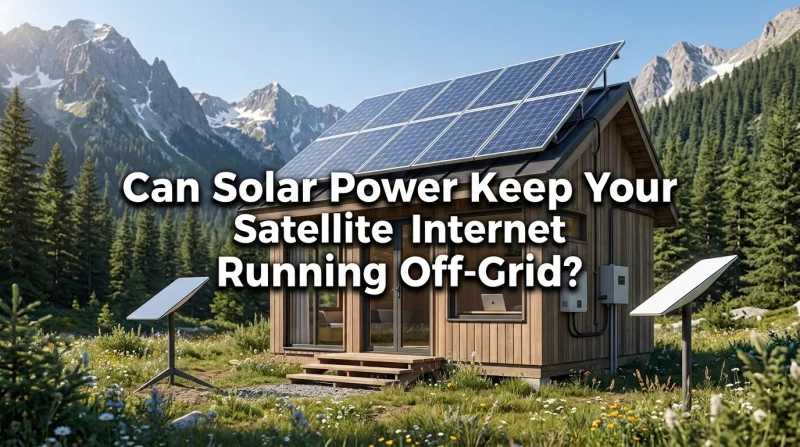
Getting high speed internet in the middle of nowhere used to be an expensive fantasy. Now you just order a box, point a flat dish at the sky, and you’re online. Remote workers are setting up offices in national forests and mountain cabins across the country. But anyone who has actually managed a remote site knows the satellite signal is rarely the main bottleneck. The real challenge is the power supply.
When you are completely disconnected from the grid, every single watt matters. You can’t just plug a router into the wall and forget about it. Modern satellite internet systems are power hungry pieces of hardware. If you want to keep your connection stable through a three day storm, you need a solar setup designed specifically for continuous heavy draw.
The True Power Requirements of Modern Satellite Systems
People usually underestimate how much juice these dishes need to operate. A standard modern satellite internet setup pulls somewhere between 50 and 75 watts continuously. That might not sound like a massive number until you multiply it by 24 hours. You’re looking at 1.2 to 1.8 kilowatt-hours every single day just to keep the network hardware turned on.
That is only the baseline power consumption. When the temperature drops and the dish turns on its automated snow melt feature, that power draw can easily double. It can spike to 150 watts or more. If your power system isn’t built to handle that extended surge, your inverter will trip right when you need weather updates the most.
You also have to account for the router, any network switches you are running, and the devices you plan to actually connect. A laptop and a phone charger add up quickly over a workday. Running everything through an AC inverter also introduces efficiency losses. A cheap inverter might waste 15 percent of your battery power just converting DC to AC. Many off-grid operators modify their satellite setups to run directly on DC power to eliminate this waste, though this requires cutting cables and voids the warranty.
Sizing Your Solar Panels and Battery Bank
Throwing a couple of cheap solar panels on a roof and hooking them up to a marine battery won’t cut it for reliable internet access. You need a properly sized and balanced system.
The panels are only there to charge the batteries. The batteries are what actually run your equipment overnight and during bad weather. For a continuous 75-watt draw, I usually recommend a minimum of 400 watts of solar panels and at least 200 amp-hours of usable battery capacity at 12 volts. That gives you a modest buffer for cloudy days.
Before you buy any hardware, you need to map out your exact energy needs. Use an Electrical Power Calculator to get the math right for your specific location. Plug in the exact wattage of your dish, router, and computers. Multiply that by your daily usage hours. Then factor in your local winter sun hours, which will be vastly different in the Pacific Northwest compared to the Southwest. Guessing usually ends up costing you a lot more money when you are forced to rebuild the system six months later.
Lithium iron phosphate batteries are the standard now for remote installations. They cost more upfront than traditional lead acid batteries, but you can actually use their full capacity without destroying them. They also handle the constant charge and discharge cycle of an off grid internet setup much better over a five year lifespan.
Managing the Impact of Weather and Temperature
Solar power works flawlessly when the sun is out. The real test of an off-grid system is a week of heavy clouds in late November.
If your panels are covered in snow, you are generating zero power. If your dish is covered in snow, it draws double the power to clear itself. This combination is what usually knocks remote work sites offline. You need a distinct strategy for winter weather.
This might mean adjusting the physical angle of your solar panels for the winter months so snow slides off easier and they catch the lower sun angle. It might mean keeping a small backup gas generator on site to top off the batteries during a long storm.
Temperature also affects the batteries directly. Lithium batteries cannot be charged when their internal temperature drops below freezing. If your battery bank is sitting in an unheated shed, your solar panels could be producing maximum power, but the charge controller will refuse to send it to the batteries. You have to keep the batteries in a conditioned space or buy self heating models.
Some users put their satellite dish on a timer or manually unplug it at night to save power. If you only need to sync emails a few times a day, this is a perfectly valid strategy. If you run remote monitoring equipment or need a constant connection for communication, you just have to spend the money and build a larger battery bank.
Troubleshooting Connection and Power Issues
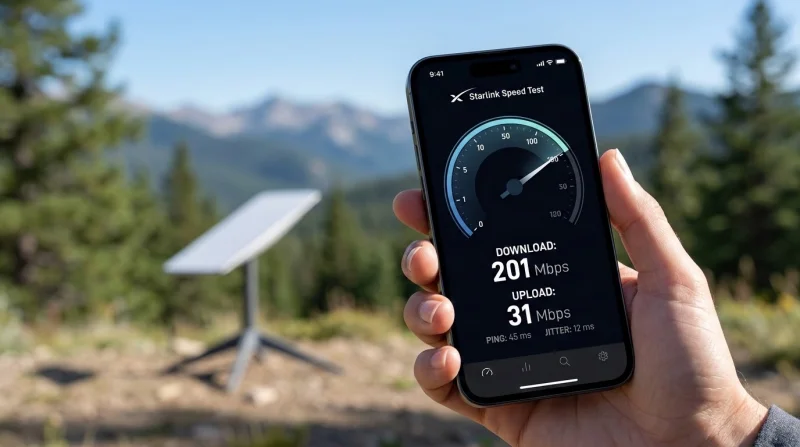
When your internet drops at an off-grid location, you might assume the satellite lost its signal. A lot of the time it is actually a power issue masquerading as a network problem.
If your battery voltage drops too low, your inverter might not shut off completely right away. Instead, it might output dirty or fluctuating power. Sensitive network electronics absolutely hate voltage fluctuations. You might see the dish rebooting constantly or dropping the connection every few minutes.
To rule out power issues, check your charge controller logs first. If the battery dropped below its safe threshold right when your internet cut out, you found the culprit. Wire gauge is another common failure point. If you use wires that are too thin for the distance between your batteries and your inverter, the voltage will drop before it even reaches the equipment.
If the power is completely stable but things feel sluggish, you can run a Starlink speed test or a standard network diagnostic to see if the dish is communicating properly with the satellites. Sometimes a physical obstruction blocks the signal just enough to cause severe packet loss. It is incredibly common for people to blame their solar setup when the real issue is a pine tree that grew two feet since the dish was originally installed.
The Practical Reality of Remote Connectivity
Running high-speed internet entirely on solar power is a proven concept. Plenty of remote workers and off-grid sites operate this way year round. You just have to treat the satellite equipment like a major household appliance rather than a basic phone charger.
Build the power system significantly larger than your initial calculations suggest. Winter weather always demands more energy and provides less sun than you want. Invest in quality batteries, use the correct wire sizes, and plan for the physical realities of your specific location.
If you respect the math and prepare for the worst local conditions, your connection will stay online long after the paved roads end.
Scopri di più da GuruHiTech
Abbonati per ricevere gli ultimi articoli inviati alla tua e-mail.