
How Do You Design a Reliable Industrial Electrical System From Panel to Production Floor?
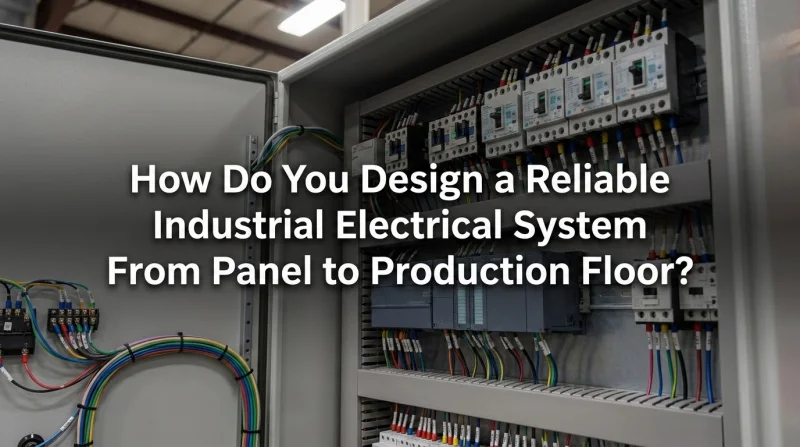
Walk onto any manufacturing floor where a line has suddenly stopped. You will usually find someone staring at a tripped breaker, an overheated drive, or a loose terminal. Building an electrical system for an industrial environment takes more than just meeting code. The National Electrical Code sets the baseline to keep the building from catching fire. Your job is to keep the production line running three shifts a day for the next fifteen years without nuisance faults.
Map Out the True Load First
Before anyone picks up a wire stripper, you have to know exactly what this system will power. It’s easy to calculate the steady running load. The problems start when you ignore peak demands. A dozen heavy induction motors starting up simultaneously will pull a massive inrush current. If the system is sized only for the steady state, you are going to experience voltage sags and tripped breakers immediately.
List out every motor, heater, variable frequency drive, and programmable logic controller. Check their nameplates and installation manuals. You also need to look at the Short Circuit Current Rating for the equipment. If the utility transformer outside can deliver fifty thousand amps of fault current, your main disconnect and distribution blocks must be rated to handle that safely. Always factor in a 20 percent buffer for future expansion. Facility managers will inevitably want to add another conveyor or packing machine later. You need a complete picture of the ampacity requirements to size your main feed and transformers correctly.
Coordinating Overcurrent Protection
Knowing the load is just the first step. You also have to protect the wires and the equipment from short circuits and overloads. This is where breaker and fuse coordination comes into play. If a single motor faults out on a packing line, you only want the breaker for that specific motor to trip. You don’t want the main feeder breaker to trip and shut down the entire facility.
Achieving this requires looking at the trip curves of your circuit breakers and fuses. You have to ensure the downstream device clears the fault before the upstream device even starts to react. It takes time to match these components correctly. Many people skip this step and just buy whatever breakers are in stock at the local supply house. That is a mistake that causes massive downtime later on.
When choosing between fuses and circuit breakers, think about the application. Breakers are convenient because you can simply reset them. Fuses often provide better current limitations for sensitive electronics. For high fault current areas, Class J fuses are a standard choice in American facilities because they act incredibly fast to limit the energy released during a short circuit.
Getting the Enclosure Right
The heart of the system is the main enclosure. If things are cramped in here, maintenance will be a nightmare and components will overheat. Heat is the absolute enemy of industrial electronics. You need to calculate the heat load of all the components inside and size your cooling fans or air conditioners accordingly.
A good panel layout separates high voltage power from low voltage control signals to prevent electromagnetic interference. Put your drives and heavy contactors at the top or wherever the airflow can pull heat away from them efficiently. Make sure you specify the right NEMA rating for the environment. A NEMA 12 enclosure works well for general indoor dust and oil drips. If the area gets sprayed down with water, you need NEMA 4 or 4X.
When it comes to assembly, discipline matters. Sloppy control panel wiring leads to loose connections and phantom faults that take days to track down. Every wire should be labeled at both ends. Use ferrules on stranded wire before landing them in terminal blocks. Run wires through properly sized slotted wire ducts and leave some slack. If a technician has to replace a relay three years from now, they shouldn’t have to pull the wire tight like a guitar string to make it fit.
Moving Power Across the Floor
Once you leave the safety of the main enclosure, the environment gets rough. Cables have to survive forklift traffic, oil spills, and constant machine vibration. You generally distribute power using rigid conduit or overhead cable trays. Trays are easier for future modifications and visual inspections. Conduit offers much better physical protection against impacts.
Voltage drop is a major factor on large production floors. If a machine is located three hundred feet away from the main panel, you might need to upsize the conductors just to ensure the motors receive the proper voltage. Running a motor on low voltage causes it to draw more current and burn out its windings prematurely.
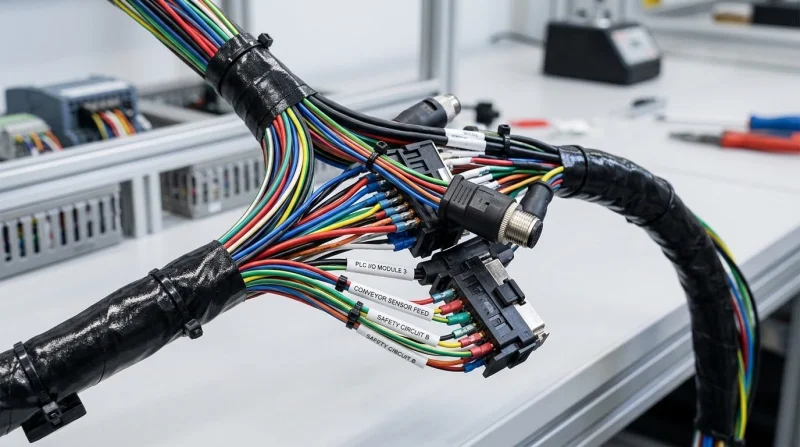
For complex automated cells or robotic stations, you might decide to use a pre-assembled factory wiring harness to connect the distribution point to specific machine components. This approach speeds up the installation process and reduces the chance of landing a wire on the wrong terminal during field assembly. Just make sure the jacket material is rated for the chemicals present in your specific facility. Polyurethane jackets hold up well against cutting fluids. Standard PVC might harden and crack over time.
Grounding Is Not Optional
Grounding is where a lot of otherwise decent installations completely fail. A poor ground will cause drives to throw weird error codes. Sensor readings will fluctuate randomly. You cannot just bond everything to the nearest piece of building steel and call it a day.
Create a star grounding network where all ground connections tie back to a single central point. This prevents ground loops. Ground loops happen when different ground points sit at slightly different potentials and current starts flowing through the communication shielding.
Scrape the paint off your back panels before bolting ground lugs down. A painted surface is an insulator. Relying on the threads of a mounting bolt for your ground path is asking for trouble. Ensure that the grounding conductors are sized appropriately for the largest possible fault current.
Built for the Maintenance Team
The true test of an industrial electrical system happens at two in the morning when something stops working. The person troubleshooting the issue did not design the system. They rely entirely on how well you laid things out and how accurately you documented it.
Design your system with safety and troubleshooting in mind. Make sure disconnects are easily accessible for lockout and tagout procedures. Include a 120-volt convenience receptacle inside the panel for programmers to plug in their laptops.
Leave an updated set of schematics in a pocket inside the panel door. If you make a field change during commissioning, take a pen and mark it on that drawing immediately. Print durable labels for every breaker, push button, and indicator light. If a fault occurs, the operator should be able to look at the panel and know immediately which circuit has a problem. Reliability comes from specifying the right components, respecting physical limits, and assembling it all with the understanding that someone will eventually have to fix it.
Scopri di più da GuruHiTech
Abbonati per ricevere gli ultimi articoli inviati alla tua e-mail.