
Classic Solitaire vs FreeCell: Key Differences in Rules, Strategy & Win Rates
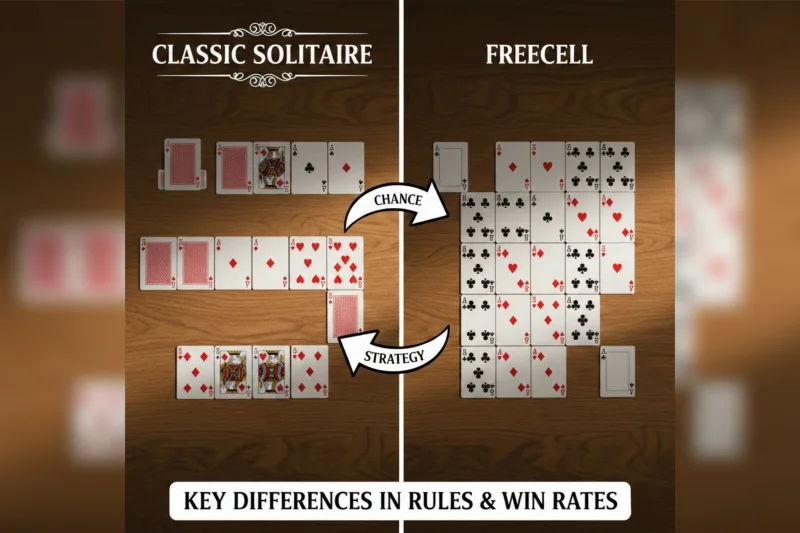
Classic Solitaire vs FreeCell are two examples of the two pillars of solitaire gaming that share a single deck of 52 cards, and use them to create suit-based foundations ranging between the Ace and the King.
To understand it more deeply, you can play FreeCell or Solitaire online, and there is solitaire on many online platforms for free that helps you know all the rules and differences between FreeCell and Classic Solitaire.
Classic Solitaire vs FreeCell: Layout and History
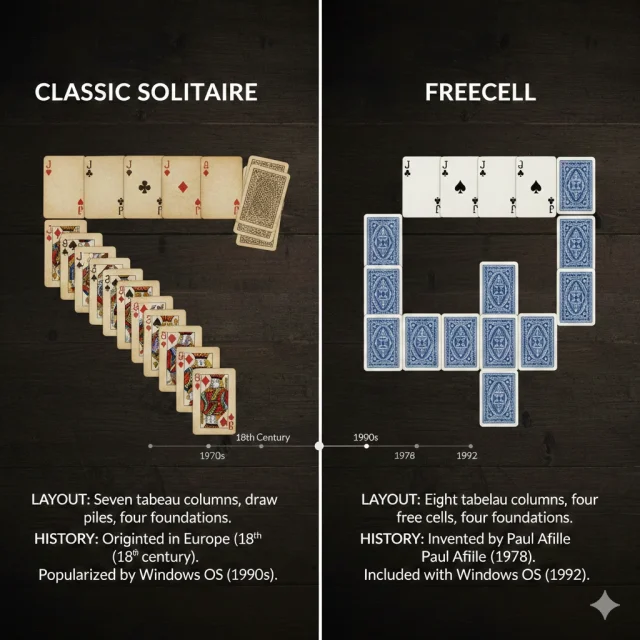
FreeCell vs Classic Solitaire diverges immediately in tableau configuration, shaping strategic depth from the outset.
Classic Solitaire uses seven cascades: one exposed card and increasing to seven, one of which is always face-up. A 24-card stock offers draws, generally three cards which are passed in a complete circle to waste during the standard Turn 3 variant, and four foundation piles that await ascent in suit.
Building Tableau requires alternating descending sets of colors, with spaces that contain only a King, to ensure a natural progression.
FreeCell, by contrast, deploys all cards face-up across eight compact columns, eliminating draws entirely. Four free cells offer single-card storage, enabling compound moves: available spaces dictate sequence length, such as four cards with maximal frees and an empty column. This transparency transforms gameplay into systematic navigation.
Classic Solitaire vs FreeCell Rules Comparison
| Feature | FreeCell Solitaire | Classic Solitaire (Klondike) |
| Visibility | Complete from the initial deal | Partial, progressive reveals |
| Auxiliary Areas | Free cells and dynamic columns | Stock and waste piles |
| Sequence Mobility | Scalable by open spaces | Limited to single or short runs |
| Column Reuse | Universal access | King-restricted |
| Decision Tempo | Board-wide foresight | Draw-dependent |
Strategic Emphasis: Chance Versus Calculation
Classic Solitaire incorporates substantial randomness, with 60-80% of outcomes linked to the deal and draw sequence. Human win rates average 10-30%, even with optimal execution, constrained by occluded cards. Theoretical solvability peaks at approximately 43% under perfect conditions, underscoring its probabilistic nature.
FreeCell prioritizes proficiency, boasting near-total resolvability; over 99% of configurations yield to precise sequencing, with rare exceptions like deal #11982. Experienced players achieve 40-42% success across extensive datasets, a figure that rises with mastery of spatial constraints.
Classic Solitaire vs FreeCell Solitaire Win Rates
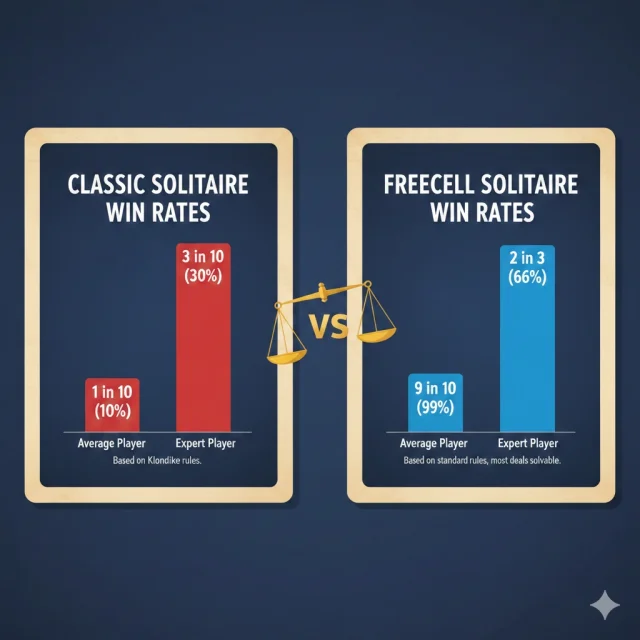
The FreeCell games can almost always be won, and the computer can solve more than 99 percent of deals. Good players win approximately 40-42 percent of the time with smart play planning. So if you’re asking if every Game of FreeCell is winnable, the answer is nope its not.
Classical Solitaire is far more difficult: the majority of players only win 11-20 per cent on Turn 3 due to the hidden cards and misfortune usually affecting you, even when playing well. So if you are all solitaire games winnable, the clear answer is no.
The big difference? FreeCell gets easier as you learn to think ahead, while Classic Solitaire stays unpredictable no matter how good you get.
Winning Tips for Solitaire and FreeCell
To play FreeCell well, manage your space carefully. Keep free cells empty for important moves instead of filling them early. Try to move low cards to the foundation as soon as possible and clear columns when you can. Empty columns give you more freedom to move cards. Always think a few moves ahead, usually three to five steps, so you do not trap yourself later.
In Classic Solitaire, focus first on turning face-down cards face up. The more cards you reveal, the more options you get. Move cards to the foundation only when it does not block future moves. In Turn 3 mode, place useful cards in the waste pile wisely so they are easy to access in the next cycle.
Games and results tracked: Online sites help gamers follow their games and outcomes. This is because it becomes easier to observe improvement, learn, and get better over time.
How Solitaire and FreeCell Improve Your Brain
- The two games enhance concentration, rationality, and tolerance. They exercise their brains by thinking through steps to make the right moves and by remaining relaxed with a limited number of options.
- FreeCell is likened to a puzzle that develops planning and problem-solving abilities. Classic Solitaire teaches its players to deal with uncertainty and to make the most out of a minimal amount of information.
- Since each game is short, they are perfect for quick breaks. Digital versions make them easy to play anytime, without needing real cards.
Which Solitaire Version Is Best to Play
Choose Classic Solitaire if you want an easy game to start and enjoy quick wins that also depend on luck. It is simple, relaxing, and good for casual play, especially if you prefer a traditional card experience with gradual reveals.
Pick FreeCell if you enjoy thinking ahead and solving the game step by step. If you like strategy-based challenges, you can play freecell online to test your planning skills in a fully visible layout where every move matters. Here, skill matters more than luck, and careful decisions lead to consistent success.
Many experienced players switch between the two games. Each one offers a different kind of fun and helps improve different skills, whether you prefer the unpredictability of Classic Solitaire or the logical precision of FreeCell.
Ti potrebbe interessare:
Segui guruhitech su:
- Google News: bit.ly/gurugooglenews
- Telegram: t.me/guruhitech
- Facebook: facebook.com/guruhitechfb
- Instagram: instagram.com/guruhitech_official/
- X (Twitter): x.com/guruhitech1
- Bluesky: bsky.app/profile/guruhitech.bsky.social
- Rumble: rumble.com/user/guruhitech
- VKontakte: vk.com/guruhitech
- MeWe: mewe.com/i/guruhitech
- Skype: live:.cid.d4cf3836b772da8a
- WhatsApp: bit.ly/whatsappguruhitech
Esprimi il tuo parere!
Ti è stato utile questo articolo? Lascia un commento nell’apposita sezione che trovi più in basso e se ti va, iscriviti alla newsletter.
Per qualsiasi domanda, informazione o assistenza nel mondo della tecnologia, puoi inviare una email all’indirizzo [email protected].
Scopri di più da GuruHiTech
Abbonati per ricevere gli ultimi articoli inviati alla tua e-mail.